

6 Things I Wish Every Patient Knew About Hair Loss After 45
A patient flew 5,000 miles to ask what I did for my mother’s hair. I told her six things — every one the opposite of what she’d been doing. It shouldn’t take a flight across the world to hear them.
In Stock · Free Shipping · 90-Day Money-Back Guarantee
A few months ago, a woman flew from England to my clinic in California — because of my mother.
She knew my mom, Gaynor. She’d watched Gaynor’s hair come back over the better part of a year, in person, while her own was thinning. So she didn’t email. She got on a plane, flew 5,000 miles, and asked me one question: “What did you do for her?”
I told her. Six things — every one the opposite of what she’d been doing. It shouldn’t take a flight across the world to hear them. So here they are.
Your hair isn’t the problem — your scalp is.
Pull a strand from your brush. Full, pigmented, intact — that’s not a dying hair. Something pushed it out, and that something is the scalp underneath.
Harvard proved it in 2020: a dying follicle moved into young scalp grew back; a healthy one moved into aged scalp died. The follicle never decided. The scalp did.
Biotin and collagen were never going to fix this.
They feed the hair. Your hair was never starving — your scalp was aging. It’s more building material poured into a factory that’s already shutting down.
Minoxidil isn’t wrong — it’s incomplete.
It forces blood to the surface, and if it’s helped you at all, you’re not imagining it. But the real problem — the aging scalp underneath — is one floor down, and minoxidil never goes there. It props up the top floor while the foundation keeps sinking.
Washing less doesn’t save your hair — it hides the shedding.
Stretching your wash days doesn’t mean less loss. It means the same loss, saved up into one bigger clump. What’s happening between washes is the problem — not the washing.
Thinning after 45 usually isn’t permanent.
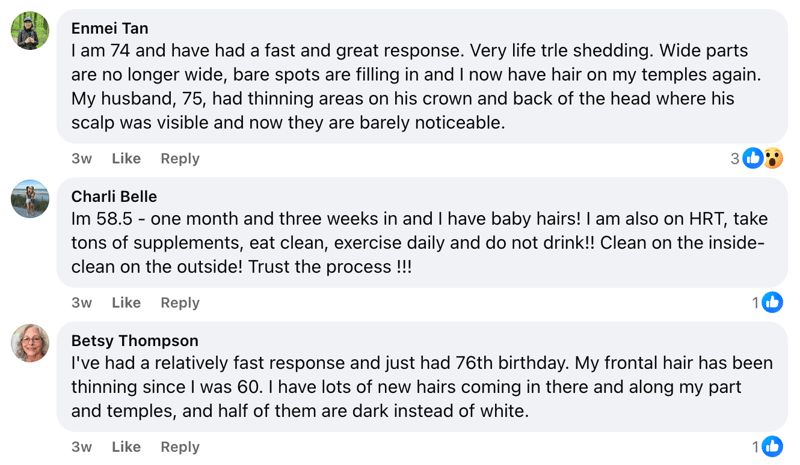
Read this one slowly. The hair you’ve lost isn’t gone — the follicles aren’t dead. They’ve gone quiet, waiting on a scalp that stopped feeding them.
Here’s how you tell: if the strands in your brush still have their structure, the follicle that made them is alive. It didn’t die. It’s starving. Feed the scalp, and it wakes back up — the shedding stops, then the part fills in.
Your doctor couldn’t have told you — until this June.
Normal bloodwork, “it’s just age” — both true, neither explained your hair, because the answer sits in a layer of skin no blood test checks and most dermatology training (built on studies of men) skips.
That changed this June, when the first women-only trial published in the Journal of Drugs in Dermatology. An independent lab counted every strand shed, by hand, before and after:
Minoxidil’s response rate in women is about 30%. A 98% response is a number you almost never see in dermatology. That’s why you’re only hearing this now.
Everything Above Was Pointing At One Thing
Every point above lands in one place: the scalp. So that’s what I spent years building for — the first serum designed to reverse the aging underneath your hair, not chase the strand like everything else. It’s the exact serum every woman in the trial used.
The KilgourMD Prevention Serum. Thirty seconds a night.
How it works
No hormones. No prescription. Nothing in your bloodstream — because the problem was never there. Zero side effects across the entire trial. 150,000 women on it. 1,000+ clinicians recommend it through FrontRowMD.
My 90-Day Guarantee

Use it every night for 90 days. If your hair isn’t visibly better, email me “it didn’t work.” Every penny back, keep the bottle. No forms, no return, no retention call.
My mother’s 68 now — two years on it, more density than she had at 55. This is the answer I couldn’t give her when she started losing it.
When 95 of 100 women stop shedding, the guarantee isn’t generous. It’s just honest.

Picture the version most women never get to: the part closed back in, the ponytail that holds weight again, the morning you realize you haven't thought about your hair in a week.
That's not a promise — it's what 98 of 100 women in the trial walked toward, thirty seconds a night.
Here's the part nobody says out loud: the scalp doesn't pause while you decide. Every month you wait, the collagen thins a little more and a few more follicles go quiet. Doing nothing isn't holding steady — it's losing ground you'll have to win back later.
For most women over 45, the hair isn't gone. It's waiting on a scalp nobody ever treated. Thirty seconds a night, for 90 days, covered either way — that's how you find out which side of the line you're on.

— Dr. James Kilgour, MD · Board-Certified Dermatologist · Stanford-Trained
In Stock · Free Shipping · 90-Day Money-Back Guarantee