
PCOS and Hair Loss: Understanding the Hormonal Triggers
April 11th, 2026
Dr James Kilgour, MD
This article is for you if...
PCOS and Hair Loss: Understanding the Hormonal Triggers
If you have ever stood over a bathroom sink, staring at a cluster of fallen strands and wondering why your ponytail feels half as thick as it did last year, you know the quiet panic that comes with Polycystic Ovary Syndrome (PCOS). Hair loss is more than a cosmetic annoyance; it is a visible signal from your endocrine system that something deep within your hormonal chemistry is out of sync.
The journey to reclaiming your hair starts with moving past the surface-level frustration. To fix the "follicle," we have to understand the "factory." In this guide, we will strip away the clinical jargon and look at exactly why PCOS triggers hair thinning, how these hormonal imbalances occur, how your metabolism plays a hidden role, and what you can actually do to stabilize the situation.
The Connection Between Your Hormones and Your Hair
Your hair follicles are remarkably sensitive biological sensors. They are among the fastest-growing cells in the human body, which makes them incredibly responsive—and vulnerable—to the chemical environment of your blood. In a state of hormonal balance, hormones like estrogen and progesterone act as protectors of the hair, keeping it in the "growth phase" for as long as possible.
In the context of PCOS, this protective environment shifts. PCOS is not just a "reproductive" issue; it is a complex endocrine disorder. When your ovaries or adrenal glands produce an excess of specific hormones, the delicate conversation between your scalp and your bloodstream changes. Think of your hormones as a thermostat. When the "androgen" setting is turned up too high, the climate of your scalp becomes hostile to long-term growth. Understanding this connection is the first step toward realizing that your hair loss isn't a failure of hygiene or "bad genes"—it is a metabolic symptom that requires a systemic solution.
Why PCOS Causes Hair Thinning: The Science of Androgens
The hallmark of PCOS-related hair loss is "hyperandrogenism," which is a fancy way of saying your body has a surplus of male-pattern hormones. While every woman needs a baseline level of androgens for bone health and libido, the excess seen in PCOS creates a specific type of havoc on the scalp known as androgenic alopecia.
The Role of Testosterone and DHT
When we talk about androgens, testosterone usually gets all the attention. However, the real villain in the story of hair thinning is often a byproduct called Dihydrotestosterone (DHT).
Inside your hair follicles is an enzyme called 5-alpha reductase. Its job is to convert circulating testosterone into DHT. If testosterone is a gentle breeze, DHT is a hurricane. It is significantly more potent and has a high "affinity" for the receptors in your scalp follicles. In women with PCOS, either the body produces too much testosterone to begin with, or the follicles become hypersensitive to the DHT being created. Once DHT binds to those receptors, it begins to signal the follicle to shut down.
How Hair Follicles React to Hormonal Shifts
The life of a hair strand occurs in three phases: growth (anagen), transition (catagen), and rest (telogen). Under the influence of high androgens, the growth phase is prematurely cut short.
Imagine a marathon runner who is told they have to stop at mile ten instead of mile twenty-six. Because the growth phase is shorter, the hair never reaches its full length or thickness. Over time, the follicle itself begins to change. The environment created by excess DHT causes the follicle to enter a state of "distress," where it spends more time resting and less time producing. This shift is the engine behind the visible thinning most women notice long before they see actual bald spots.
Recognizing Female Pattern Hair Loss (FPHL)
Unlike men, who typically see a receding hairline or a bald spot on the crown, women with PCOS experience a more diffused thinning. This is medically referred to as Female Pattern Hair Loss (FPHL). Understanding the specific geography of this loss can help you distinguish PCOS symptoms from other issues like thyroid dysfunction or simple shedding.
The "Christmas Tree" Pattern vs. Patchy Loss
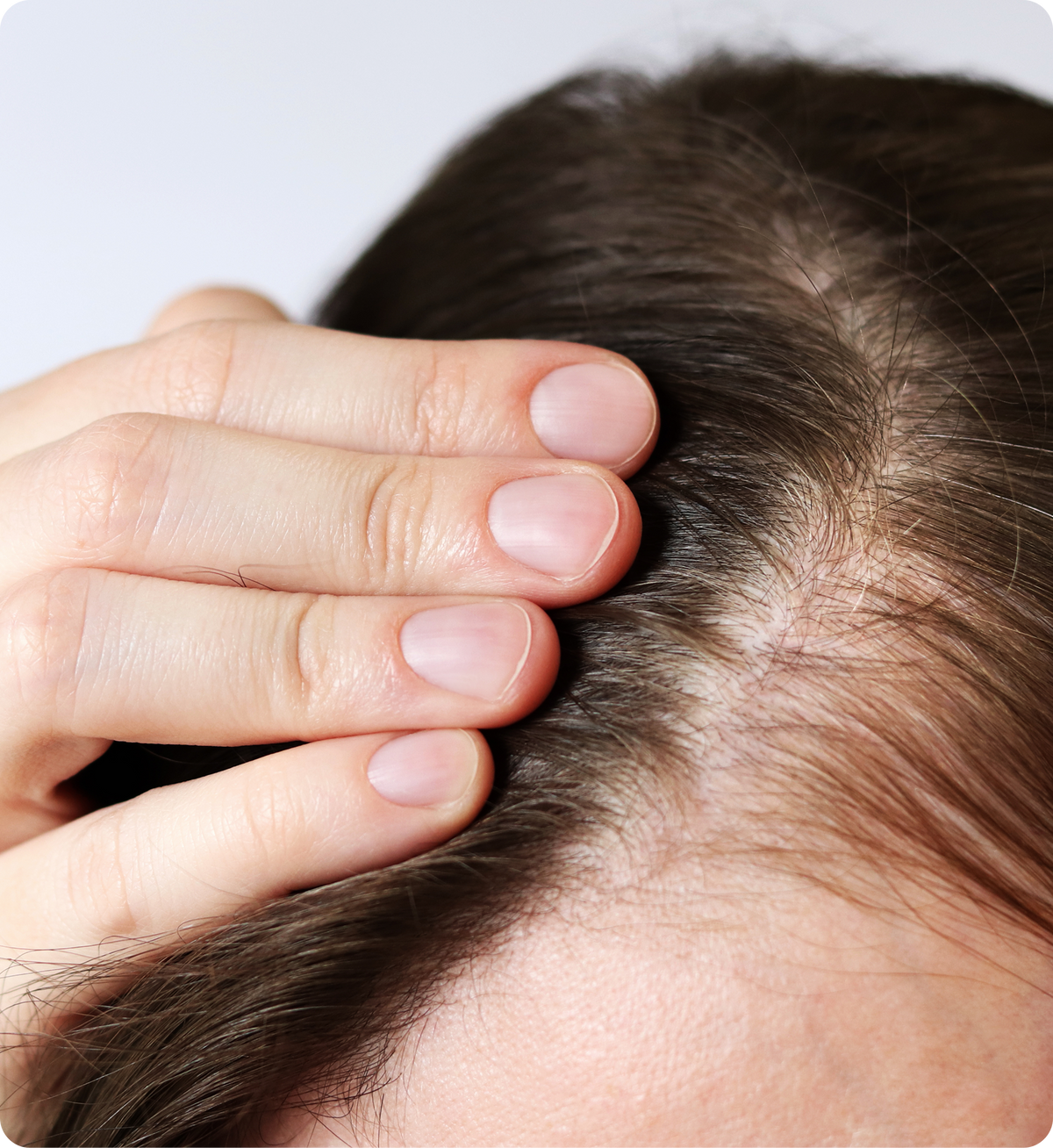
If you look in the mirror and notice that your part line seems wider than it used to be, you are seeing the classic PCOS pattern. Doctors often refer to this as the "Christmas Tree" pattern. The thinning is most prominent at the very front of the hairline and widens as it moves back toward the crown of the head, resembling the silhouette of a pine tree.
Crucially, PCOS hair loss is rarely "patchy." If you are seeing circular, smooth bald spots, that is more likely Alopecia Areata, an autoimmune condition. In PCOS, the hairline usually stays intact (you don't "go bald" in the front like a man), but the density behind that hairline gradually fades away until the scalp becomes visible under bright lights.
Miniaturization: Why Your Hair Feels Thinner Before It Falls Out
The most frustrating part of FPHL is a process called miniaturization. This is the "shrinking" of the hair follicle. With each successive growth cycle, the follicle produces a hair that is slightly thinner, shorter, and more fragile than the one before.
Eventually, a terminal hair (thick and pigmented) is replaced by a vellus hair (wispy, peach-fuzz-like hair). This is why you might feel like your hair has "lost its body" or "won't hold a curl" long before you notice clumps in the drain. The hair is still there, but it has become so microscopic that it no longer contributes to the overall volume of your style.
The Insulin Resistance Factor
If androgens are the fire, insulin is the gasoline. Roughly 70% to 80% of women with PCOS struggle with insulin resistance, regardless of their body weight. This metabolic quirk is perhaps the most significant "hidden" driver of hair loss.
The Metabolic Loop: Weight, Insulin, and Scalp Health
This creates a vicious cycle. Insulin resistance often leads to weight gain around the midsection; fat tissue itself can then convert other hormones into androgens through a process called aromatization (though in PCOS, the androgenic effect usually dominates). Furthermore, high insulin levels promote systemic inflammation. This inflammation can affect the micro-environment of the scalp, making it harder for follicles to receive the nutrients and blood flow they need to thrive. Addressing hair loss without addressing insulin is like trying to put out a fire while someone else is pouring fuel on the back of the house.
Common Triggers That Worsen PCOS Hair Loss
While hormones and insulin are the primary drivers, they don't act in a vacuum. Several "accelerants" can take a manageable thinning situation and turn it into a crisis.
Chronic Inflammation and Oxidative Stress
PCOS is fundamentally an inflammatory condition. When your body is in a state of chronic low-grade inflammation, it produces "free radicals" that damage cellular structures, including those in the hair follicle. Oxidative stress can actually trigger the follicle to enter the shedding phase prematurely. Diet, lack of sleep, and environmental toxins all contribute to this inflammatory load.
Nutritional Deficiencies (Iron, Zinc, and Vitamin D)
Your hair is a non-essential tissue. When your body is low on resources, it diverts nutrients away from your hair and toward your vital organs. Many women with PCOS are chronically low in Ferritin (stored iron), Zinc, and Vitamin D.
-
Iron is required for the enzyme that helps hair cells grow.
-
Zinc is a natural 5-alpha reductase inhibitor (it helps block DHT).
-
Vitamin D is essential for "waking up" dormant follicles. If your "fuel tank" is empty, no amount of hormonal balancing will bring your hair back.
The Impact of High-Androgen Birth Control Pills
Ironically, the very medication often prescribed for PCOS can sometimes make hair loss worse. Not all birth control pills are created equal. Some older progestins used in pills (like levonorgestrel) are "androgenic," meaning they mimic testosterone. If you are already struggling with high androgens, these pills can act like "chemical DHT," accelerating the thinning process. It is vital to use "low-androgen" or "anti-androgen" pills if hair preservation is the goal.
Stress and the Adrenal Connection
Your ovaries aren't the only source of androgens; your adrenal glands produce them too. When you are under chronic stress, your body produces cortisol. High cortisol often goes hand-in-hand with high DHEA-S, an adrenal androgen. This "stress-induced" androgen surge can trigger a sudden flare-up of hair thinning, even if your insulin and ovarian hormones are relatively stable.
The Difference Between PCOS Shedding and Telogen Effluvium
It is important to distinguish between the slow, progressive thinning of PCOS (Androgenetic Alopecia) and a sudden "shedding" event called Telogen Effluvium (TE).
TE is a temporary condition usually triggered by a shock to the system—a high fever, a crash diet, a major surgery, or extreme psychological stress. In TE, you will see a massive amount of hair falling out all at once, often three months after the triggering event.
In PCOS, you may experience both. You might have the slow thinning caused by DHT, punctuated by periods of heavy shedding caused by hormonal fluctuations or nutritional gaps. Understanding which one is happening helps you manage your expectations: TE usually grows back once the trigger is removed; PCOS thinning requires ongoing management of the underlying hormonal "climate."
Diagnostic Steps: What Your Doctor Should Be Checking
If you suspect your hair loss is PCOS-related, a "wait and see" approach is rarely effective. You need data.
Key Blood Tests for Hormonal Hair Loss
A standard "wellness panel" isn't enough. You should ask for a comprehensive "Hair Loss Panel" that includes:
-
Total and Free Testosterone: To see how much "active" hormone is circulating.
-
DHEA-S: To check for adrenal androgen contributions.
-
Androstenedione: Another precursor to DHT.
-
Fasting Insulin and Hemoglobin A1c: To assess insulin resistance.
-
Ferritin: Your iron stores (aim for a level of at least 70 ng/mL for hair growth).
-
Vitamin D3 and B12: Crucial for follicular health.
-
TSH, Free T3, and Free T4: To rule out thyroid issues, which often mimic PCOS hair loss.
Scalp Examination
Sometimes, the answer isn't in the blood, but on the skin. A dermatologist or other healthcare professional can perform a "pull test" or use a trichoscope (a specialized magnifying tool) to look for signs of miniaturization or scalp inflammation. This helps confirm whether the follicles are truly shrinking or if you are simply experiencing a temporary shed.
Natural Approaches to Managing PCOS Hair Loss
Managing PCOS hair loss is a marathon, not a sprint, necessitating sustainable lifestyle changes through a "top-down" (hormonal) and "bottom-up" (nutritional) approach.
Regulating Insulin Through Dietary Changes
Since insulin drives androgen production, your fork is one of your most powerful tools. Focus on a "Low Glycemic" or "Anti-Inflammatory" way of eating. This doesn't mean you have to go zero-carb, but it does mean choosing complex, fiber-rich carbohydrates over refined sugars.
Pairing carbohydrates with protein and healthy fats prevents the "insulin spikes" that tell your ovaries to make more testosterone. Think of every meal as a chance to tell your ovaries to "calm down."
Natural Treatments with Research-Backed Potential
-
Scalp serums: Target scalp health to optimize follicle repair and hair growth.
-
Inositol (Myo and D-Chiro): Specifically in a 40:1 ratio, it helps improve insulin sensitivity and has been shown to lower testosterone levels.
-
Spearmint Tea: Drinking two cups a day has been shown in studies to have a significant anti-androgen effect.
-
Saw Palmetto: A natural herb that may help inhibit the 5-alpha reductase enzyme (blocking DHT).
-
Omega-3 Fatty Acids: To reduce the systemic inflammation that stresses the follicles.
Coping with the Emotional Impact of Hair Thinning
We cannot discuss hair loss without acknowledging the psychological toll. Hair is often tied to our sense of femininity, health, and identity. Watching it thin can feel like losing a part of yourself.
It is okay to grieve. It is okay to feel frustrated. However, try not to let the stress of the loss feed the cycle. High stress increases cortisol, which increases androgens. Finding a community of other women with PCOS, working with a therapist, or even exploring "hair helper" options like high-quality toppers or extensions can take the "emergency" feel out of the situation. When you feel more in control of your appearance, your stress levels drop, which creates a better internal environment for your treatments to work.
Summary of Key Takeaways
PCOS hair loss is a complex puzzle, but it is one that can be decoded. The main takeaway is that your hair is reacting to an internal chemical shift—primarily driven by high androgens and fueled by insulin resistance.
-
DHT is the primary culprit that shrinks hair follicles.
-
Insulin resistance acts as a catalyst, pumping up androgen levels and lowering protective proteins.
-
Patterns matter: PCOS thinning usually presents as a widening part rather than patches.
-
Testing is non-negotiable: You need to know your testosterone, insulin, and ferritin levels to create a targeted plan.
-
Management is multi-faceted: It requires balancing blood sugar, blocking androgens, and ensuring your body has the raw materials (iron, zinc, vitamins) to grow hair.
Healing takes time. Because the hair growth cycle is months long, any changes you make today won't be visible for three to six months. Be patient with your body. You aren't just trying to "grow hair"; you are trying to cultivate a healthier, more balanced version of yourself from the inside out. When the internal environment is right, your hair will follow.