
The Truth About Hard Water: Will a New Shower Head Save Your Hair?
June 23 2026
Dr James Kilgour MD
This article is for you if...
You’ve likely felt it before—that frustrating sensation of stepping out of the shower only to find your hair feeling like straw, despite using a salon-grade conditioner. Or perhaps you’ve noticed more strands than usual swirling around the drain. You switch shampoos, try a deep-conditioning mask, and avoid heat styling, yet the dullness and thinning persist. It feels like you’re fighting a losing battle against your own reflection.
The culprit might not be your DNA, your diet, or your stress levels. It might be the very water you use to get clean. We often think of water as the ultimate hydrator, but for many of us, the liquid coming out of our taps is laden with a cocktail of minerals that act more like sandpaper than silk. If you’ve been hovering your mouse over a "Buy Now" button for a handheld filtered shower head, wondering if it’s a miracle cure for hair loss or just another piece of plastic marketing, you’re in the right place. Let’s peel back the curtain on what hard water is actually doing to your scalp and whether a simple hardware change can truly save your hair.
Why Your Hair Hasn't Felt Like "You" Lately
There is a specific kind of "hair fatigue" that comes from living in an area with hard water. It starts subtly: your favorite shampoo stops lathering the way it used to. Then, your hair loses its "swing"—that natural, light movement—and becomes stiff and unmanageable. Eventually, you might notice your color fading faster or your scalp feeling perpetually itchy and dry.
The hidden link between your plumbing and your hair health
Most of us treat our hair topically. we apply oils, serums, and creams to the surface, hoping to fix the problem. But the real issue is often foundational. Imagine trying to wash a delicate silk blouse with water full of fine sand. No matter how much luxury detergent you use, the sand will eventually wear down the fibers.
Your plumbing is essentially a delivery system for geographical minerals. Depending on where you live, your water travels through ancient limestone deposits or chalky aquifers before reaching your shower. By the time it hits your head, it’s no longer just H20. It’s a mineral-heavy solution that interacts chemically with your hair’s natural proteins. This hidden link between the geology of your city and the health of your hair is the missing piece of the puzzle for many people struggling with inexplicable thinning and dryness.
The Science of Hard Water: What’s Actually Coming Out of Your Tap?
To understand why your hair is struggling, we have to look at the chemistry of your shower. "Hard water" isn't just a buzzword; it’s a specific classification for water that contains high concentrations of dissolved minerals, primarily calcium and magnesium.
Calcium, magnesium, and the "invisible" mineral buildup
When rainwater falls, it is naturally soft. However, as it trickles through the ground and into our reservoirs, it picks up minerals from rocks like limestone and gypsum. Calcium and magnesium are the primary offenders. While these minerals are essential for your diet, they are aggressive when applied to your hair.
Think of these minerals as tiny, microscopic barnacles. When the water evaporates from your hair after a shower, the minerals stay behind. They don't just sit on the surface; they bond to the hair shaft. Over weeks and months, these layers of calcium and magnesium build up, creating an invisible "film" that prevents moisture from entering the hair and prevents natural oils from lubricating the strands.
How hard water behaves differently than soft water on a molecular level
Soft water is "hungry" water. Because it lacks a high mineral content, it is highly effective at dissolving soap and rinsing it away completely. Hard water, conversely, is already "full." Because it is saturated with calcium and magnesium ions, it has a harder time dissolving other substances—like your shampoo.
On a molecular level, the minerals in hard water have a positive charge. Your hair, especially if it is damaged or porous, has a slightly negative charge. In the world of physics, opposites attract. This creates a magnetic-like bond between the minerals and your hair, making it incredibly difficult to wash the "hardness" away with regular soap. This is why hair washed in hard water often feels "filmy" or "tacky" even when it’s technically clean.
How Hard Water Impacts Your Hair and Scalp
The damage caused by hard water isn't just a surface-level annoyance; it’s a multi-pronged attack on the structural integrity of your hair and the health of your scalp.
The "Scum" Effect: Why your shampoo isn't lathering
If you’ve ever noticed a white, chalky residue on your shower tiles or a ring around your bathtub, you’ve seen "soap scum." This same chemical reaction is happening on your head. When the fatty acids in your shampoo meet the calcium and magnesium in hard water, they undergo a process called saponification, forming an insoluble curd.
Instead of a rich, cleansing lather that lifts away dirt and oil, you get a sticky paste that clings to your scalp and hair. This "scum" blocks the hair follicles and weighs down the roots, making your hair look flat and greasy even hours after washing.
Altering the pH: Breaking the hair's natural defensive barrier
Healthy hair and skin are naturally slightly acidic, sitting at a pH of around 4.5 to 5.5. This acidity is crucial because it keeps the hair cuticle—the outermost layer of the hair shaft—laid flat and tightly sealed, like shingles on a roof.
Hard water is typically alkaline (high pH). When you douse your hair in alkaline water, it forces the hair cuticle to stand up and remain open. An open cuticle is a vulnerable cuticle. It allows moisture to escape from the inner core of the hair (leading to dryness) and allows environmental pollutants to enter. This pH disruption is why hard water hair feels rough and tangles so easily; those "shingles" are sticking up and snagging on each other.
Oxidative stress and mineral crystallization on the hair shaft
As hard water dries on your hair, the minerals crystallize. These crystals act like tiny shards of glass. Every time you brush your hair or even move your head, these crystals create friction against the hair shaft, leading to microscopic tears and "weathering."
Furthermore, some hard water contains trace amounts of heavy metals like copper or iron. When these metals are exposed to UV light from the sun or the oxygen in the air, they undergo oxidation. This is the same process that causes metal to rust. On your hair, oxidative stress breaks down the disulfide bonds that give your hair its strength and elasticity, leading to "mushy" hair that snaps under the slightest tension.
Does Hard Water Actually Cause Hair Loss?
This is the million-dollar question. If you see more hair in your brush, is the water to blame? The answer requires a careful distinction between two different types of hair loss.
Distinguishing between hair shedding and hair breakage
True "hair loss" (alopecia) usually happens at the follicle level—the hair falls out from the root. "Hair breakage," however, is when the hair strand snaps somewhere along the shaft.
Hard water is a primary driver of breakage. Because the mineral buildup makes the hair brittle and inelastic, the hair simply cannot withstand the pressure of styling, brushing, or even sleeping. You might see a lot of hair on the floor and assume your hair is "falling out," but if those hairs don't have the white bulb (the root) attached, you are dealing with catastrophic breakage caused by mineral-weakened strands.
What the clinical research says about tensile strength
Studies investigating the relationship between water hardness and hair health have yielded interesting results. One notable study published in the International Journal of Dermatology compared hair washed in hard water versus distilled water. The researchers found that while hard water didn't necessarily decrease the thickness of the hair, it significantly decreased the tensile strength.
In layman's terms: the hair didn't get thinner, it got weaker. It lost its ability to stretch without breaking. This explains why many people living in hard water areas feel like their hair "won't grow." It is growing from the root, but it’s breaking off at the ends just as fast as it grows.
Can mineral buildup lead to scalp inflammation and thinning?
While breakage is the main concern, we can't ignore the scalp. A healthy scalp is the "soil" from which your hair grows. The soap scum and mineral deposits mentioned earlier can lead to a condition called "scalp calcification."
When minerals and product residue build up on the scalp, they can cause irritation, dandruff, and seborrheic dermatitis. A chronically inflamed scalp is not an ideal environment for hair growth. Over time, this inflammation can constrict the blood flow to the follicles, potentially leading to a localized thinning of the hair. So, while the water might not be "poisoning" your roots, it is creating a hostile environment that makes healthy growth much more difficult.
The Rise of the Filtered Shower Head: Miracle Cure or Marketing Hype?
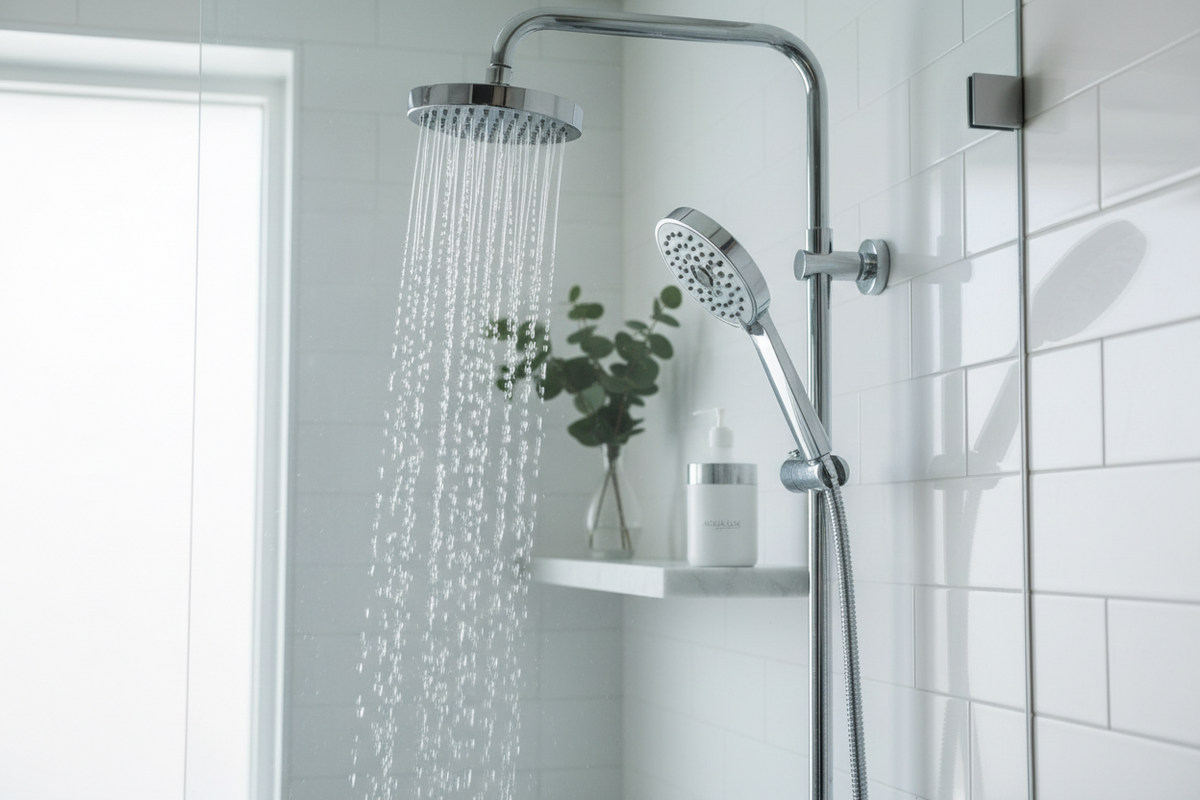
Walk into any home goods store or browse online, and you’ll see dozens of shower heads promising to "purify," "ionize," and "rejuvenate" your water. But before you buy into the hype, you need to understand the technology.
The difference between a "filter" and a "softener"
This is the most important distinction to make. A filtered shower head is not a water softener.
A true water softener uses a process called ion exchange to physically remove calcium and magnesium ions and replace them with sodium or potassium ions. This usually requires a large brine tank in your basement or garage.
A shower head filter, due to its small size, generally cannot "soften" water in the traditional sense. It cannot remove all the calcium and magnesium. Instead, it focuses on removing chlorine, heavy metals, and sediment. When companies claim their shower head "softens" water, they usually mean it makes the water feel softer by removing irritating chemicals, not by changing the mineral hardness.
Common filtration methods: KDF-55, Vitamin C, and Ion exchange beads
Most reputable shower filters use one of three methods, often incorporating calcium sulfite to further reduce chlorine levels:
-
KDF-55 (Kinetic Degradation Fluxion): This is a copper-zinc alloy that uses a chemical reaction to neutralize chlorine and remove heavy metals like lead and mercury. It’s highly effective at high temperatures, making it perfect for showers.
-
Vitamin C (Ascorbic Acid): These filters use a Vitamin C filter cartridge to neutralize chlorine and chloramines. They are incredibly effective at removing chlorine, which is a major cause of hair dryness, but they don't do much for mineral buildup.
-
Ion Exchange Beads: You’ll often see these as colorful little "stones" inside the handle of the shower head. While they can help slightly with pH balance, their capacity is very limited compared to a full-sized softener.
Why a shower head is not the same as a whole-home water softener
Think of a shower filter as a "screen" and a water softener as a "chemist." The screen can catch the big pieces of debris and neutralize some harsh chemicals, but it can’t change the fundamental mineral makeup of the water flowing through it at high pressure. If your water is extremely hard (above 7-10 grains per gallon), a shower filter will help, but it won't give you the same "slippery" feel as a whole-home softening system.
Will a New Shower Head Save Your Hair? The Honest Answer
If you’re looking for a "yes" or "no," the answer is: It depends on what your hair is actually suffering from.
When a filtered shower head is a game-changer
If your primary issue is chlorine sensitivity, a filtered shower head will be a revelation. Chlorine is essentially bleach; it strips the natural oils from your hair and skin. If your hair feels "squeaky" and dry, and your skin feels tight after a shower, a KDF-55 or Vitamin C filter will drastically improve your hair’s texture and reduce breakage almost overnight.
A filter is also a game-changer if you have city water that smells like a swimming pool. By removing the chemicals used to treat the water, you allow your hair’s natural moisture barrier to recover, which leads to more shine and fewer tangles.
The limitations: What a small shower filter simply cannot do
A shower filter will not "cure" male or female pattern baldness. It will not magically make hair grow from a dormant follicle. If your hair loss is caused by genetics, thyroid issues, or iron deficiency, a new shower head is simply a cosmetic band-aid.
Furthermore, if your water is "liquid rock" (extremely hard), a shower filter will likely clog quickly and fail to provide the soft-water experience you’re dreaming of. It cannot remove 100% of the calcium that causes that stiff, straw-like feeling.
Managing expectations for hair growth versus hair texture
The most realistic outcome of using a filtered shower head is a significant improvement in hair quality. You will likely see less breakage, more vibrancy in your color, and a scalp that feels less irritated.
Because you are reducing breakage, your hair will appear thicker and longer over time because the ends aren't snapping off. You aren't growing more hair; you are simply keeping the hair you already have. For many, that is more than enough to justify the purchase.
Beyond the Filter: Proven Strategies to Protect Hard Water Hair
If a shower head filter is only 50% of the solution, what constitutes the other 50%? To truly combat the effects of hard water, you need to change how you treat your hair outside the shower.
1. Chelating Shampoos: Your secret weapon for deep mineral removal
Regular clarifying shampoos, such as the KilgourMD shampoo remove oil and product buildup, which is critical for hair health. Chelating shampoos go a step further; they contain ingredients like EDTA (Ethylenediaminetetraacetic acid) or phytic acid that act like tiny magnets. These ingredients latch onto the minerals (calcium, magnesium, copper) and pull them off the hair shaft so they can be rinsed away.
Using a chelating shampoo once a week—or once every two weeks if your hair is very dry—is the single most effective way to "reset" your hair. It strips away the mineral mask, allowing your deep conditioners to actually reach the hair's core.
2. The Apple Cider Vinegar Rinse: A low-tech, high-impact pH balancer
As we discussed, hard water is alkaline, which forces the hair cuticle open. An Apple Cider Vinegar (ACV) rinse is highly acidic. By pouring a mixture of one part ACV to four parts water over your hair after shampooing, you instantly lower the pH.
This causes the hair cuticle to snap shut and lie flat. The result? Instant shine, fewer tangles, and a "seal" that helps keep moisture inside the hair. It’s the cheapest and most effective way to counteract the "shingle-lifting" effect of hard water.
3. Leave-in Protectors: Creating a barrier against the next shower
Once you’ve cleaned your hair, you want to prevent the minerals from the next shower from sticking. Using a leave-in conditioner or a lightweight hair oil (like argan or jojoba) creates a protective film. This film fills in the gaps in your hair cuticle, making it harder for calcium and magnesium to find a "grip" the next time you wash.
4. Temperature Control: Why lukewarm is your best friend
Hot water is a solvent; it opens up the hair cuticle and strips away the protective sebum (oil) your scalp produces. When the cuticle is wide open from heat, the minerals in hard water have a VIP pass into the inner layers of your hair.
Washing with lukewarm water and finishing with a cool rinse helps keep the cuticle as closed as possible during the mineral exposure. It’s a small change that makes a massive difference in how much mineral "weight" your hair carries after it dries.
Choosing the Right Filtered Shower Head for Your Bathroom
If you've decided to pull the trigger on a filter, don't just buy the first one with a 5-star rating. The market is flooded with cheap, ineffective products.
Red flags to watch out for in Amazon reviews
Be wary of filters that claim to "add minerals" back into the water for health benefits. Your hair doesn't need "added" minerals; it needs the minerals gone. Also, look out for "miracle" reviews that claim hair regrowth in three days. This is biologically impossible.
Avoid filters that are purely "bead-based" without any KDF-55 or activated carbon. The beads are often just a visual gimmick and have very little surface area to actually filter the volume of water used in a 10-minute shower.
Certifications that actually matter (NSF/ANSI)
If you want to know if a filter actually works, look for NSF/ANSI 177 certification. This is the industry standard specifically for shower filtration systems. It ensures the device effectively reduces free chlorine. If a company hasn't bothered to get their filter certified, they are likely selling you a plastic shell with ineffective filler.
Maintenance 101: Why a forgotten filter is worse than no filter
A filter works by trapping contaminants. Once the filter medium is saturated, it can no longer do its job. Worse, it can become a breeding ground for bacteria or mold.
Most shower filters need to be replaced every 3 to 6 months. If you notice the water pressure dropping or the "chlorine smell" returning, it's time for a change. A neglected filter is just a clogged pipe that is potentially adding more bacteria to your wash.
How to Test Your Water at Home Without Spending a Fortune
Before you invest in expensive systems, you need to know exactly what you’re up against regarding your home's water quality. Is your water "hard," or is it just "chlorinated"?
DIY kits vs. the "Soap Suds" test
The easiest way to check is the Soap Suds Test. Fill a clear plastic bottle halfway with tap water and add 10 drops of a basic liquid soap (like Ivory or Dawn, not detergent). Shake it vigorously.
-
Soft water: The bottle will be filled with fluffy, long-lasting suds, and the water underneath will remain relatively clear.
-
Hard water: There will be very few suds, and the water will look cloudy or milky.
For a more precise reading, you can buy a TDS (Total Dissolved Solids) meter or a pack of Hardness Test Strips online for under $15. These will give you a "grains per gallon" (GPG) reading.
-
0-3 GPG: Soft
-
3.5-7 GPG: Moderately Hard
-
7-10 GPG: Hard
-
10+ GPG: Very Hard
If you’re in the "Very Hard" category, a shower head filter will be a small help, but you might want to look into a portable "shower softener" (like the WaterStick) that uses actual salt-based ion exchange.
A Roadmap to Restoring Your Hair’s Vitality
If your hair is currently in "crisis mode," don't panic. You can reverse the effects of mineral damage with a consistent 30-day plan.
The 30-day "Soft Water" experiment
-
Day 1: Install your NSF-certified filter and perform a "Reset Wash" using a high-quality chelating shampoo. Follow up with a deep-conditioning mask.
-
Weeks 1-4: Use the filtered shower head for every wash. Use lukewarm water only.
-
Twice Weekly: Perform an Apple Cider Vinegar rinse after conditioning.
-
Ongoing: Apply a leave-in protector to damp hair.
By the end of the month, you should notice a significant change in how your hair feels when it’s wet (it should feel slippery, not "tacky") and how it looks when it’s dry (it should have more shine and less frizz).
When to stop DIY-ing and see a trichologist or dermatologist
If you follow this protocol for 30 days and you are still seeing excessive shedding (more than 100-150 hairs a day), or if you see visible patches of scalp or sudden thinning at the temples, the water is not your primary problem.
At this point, it’s time to see a professional. Hair loss is often a "canary in the coal mine" for internal health issues like iron deficiency, hormonal imbalances (PCOS or thyroid issues), or autoimmune conditions. A dermatologist can perform a "pull test" or a scalp biopsy to give you a definitive diagnosis.
Summary: Should You Hit "Buy" on That Filtered Shower Head?
So, will a new shower head save your hair?
If your hair is breaking, dull, and plagued by a dry, itchy scalp caused by city chlorine and moderate mineral buildup, then yes. A filtered shower head is one of the most cost-effective investments you can make for your beauty routine. It’s the equivalent of upgrading the fuel in your car; everything just runs smoother.
However, if you are expecting it to stop genetic hair loss or provide the "slick" feeling of a $2,000 whole-home softening system, you may be disappointed.
The Verdict: Buy the filter for the health of your strands, but use chelating shampoos and pH-balancing rinses for the health of your scalp. Together, these steps create a comprehensive defense against hard water, ensuring that the hair you have remains strong, shiny, and exactly where it belongs—on your head.