
How Long Does It Take to Grow Hair? The Realistic Timeline
April 15th, 2026
Dr James KIlgour, MD
This article is for you if...
If you have ever stood in front of a mirror, pulling at a strand of hair and wishing it would just reach your collarbone already, you are not alone. The desire for long, flowing hair is a universal beauty goal, yet the journey often feels like watching grass grow in slow motion. We live in an era of instant gratification, but biological processes follow their own stubborn clock.
The truth is that while you cannot "hack" your DNA to produce hair at a supernatural rate, you can certainly remove the obstacles that are slowing you down. To grow hair faster, you must first understand that hair growth isn't just about what happens at the ends—it’s a complex biological marathon happening beneath the surface of your scalp.
Understanding the Speed of Your Strands
Before we dive into serums and supplements, we need to ground ourselves in reality. Your hair is an appendage of your skin, made primarily of a tough protein called keratin. It grows from a bulb at the base of a follicle, which is fed by your bloodstream.
Think of your hair follicles as tiny, individual factories. These factories operate 24/7, but they have a maximum production capacity. On average, human hair grows about half an inch per month. This adds up to roughly six inches per year. If your hair seems stuck at one length, it’s rarely because it has stopped growing; it’s more likely that the rate of breakage at the ends is matching the rate of growth at the roots. Understanding this distinction is the first step toward achieving the length you crave.
The Anatomy of a Growing Hair: A Three-Phase Journey
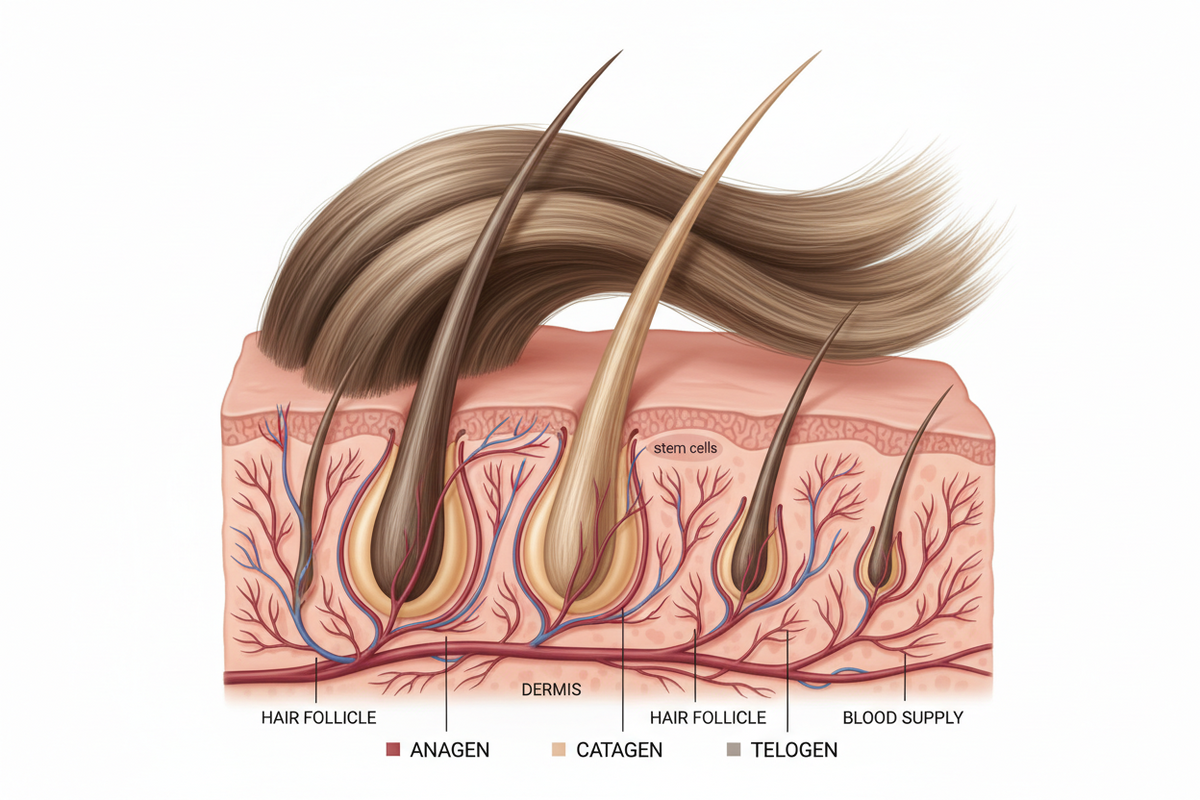
Every single hair on your head is at a different stage of its life cycle. If they were all on the same schedule, you would shed all your hair at once, like a forest losing its leaves in autumn. Instead, each follicle operates on a three-phase hair growth cycle loop.
1. Anagen (The Growth Phase)
This is the star of the show. During the Anagen phase, cells in the root of the hair are dividing rapidly. A new hair is formed and pushes up the follicle. This phase usually lasts between two to seven years. The length of your Anagen phase is determined by genetics and is the primary factor in how long your hair can physically grow. If your Anagen phase is long, you might be able to grow hair to your waist; if it’s short, your hair might "cap out" at your shoulders.
2. Catagen (The Transition Phase)
Once the growth phase ends, the hair enters a short transition period lasting about two to three weeks. During Catagen, the hair follicle shrinks and detaches from the dermal papilla (its blood supply). The hair is no longer growing, but it isn’t ready to fall out just yet.
3. Telogen (The Resting Phase)
The Telogen phase is a period of rest for the follicle, lasting about three months. While the old hair sits dormant, a new hair begins to form underneath it. Eventually, the old hair is shed (the Exogen phase) to make room for the new growth. At any given time, about 10% to 15% of the hairs on your head are in this resting stage.
The Realistic Timeline: What Science Says About Growth Rate
Science tells us that the "half-inch per month" hair growth rate is the gold standard, but it’s not a universal law. Some people may see nearly an inch of growth in a particularly healthy month, while others might struggle to see a quarter-inch.
If you are starting with a bob and aiming for mid-back length, you are looking at a two to three-year commitment. There are no overnight miracles. However, by optimizing your internal hair health and external habits, you can ensure that you are hitting that maximum half-inch potential every single month without losing progress to breakage.
What Factors Influence How Fast Your Hair Actually Grows?
If hair growth were a race, some people would be starting with a head start while others are running uphill. Several variables dictate your baseline speed.
Genetics and Biology
Your DNA is the blueprint. It determines the shape of your follicle (which dictates if your hair is curly or straight) and the duration of your Anagen phase. You cannot change your genetics, but you can ensure your environment allows your genes to perform at their peak.
Age and Hormonal Changes
As we age, the rate of cell division slows down. Furthermore, hormones play a massive role. Estrogen tends to keep hair in the Anagen phase longer—which is why many pregnant women experience thick, luxurious hair—while a drop in hormones or an increase in androgens can shorten the growth cycle and lead to thinning.
Nutrition and Internal Health
Your body views hair as "non-essential." If you are stressed, ill, or malnourished, your body will divert nutrients away from your hair follicles to prioritize your vital organs. This is why hair loss often follows a period of intense stress or a restrictive diet.
How to Optimize Your Scalp for Maximum Speed
Think of your scalp as the soil in a garden. If the soil is dry, compacted, or clogged with debris, the plants won't thrive.
The Power of Scalp Massages
One of the most effective, science-backed ways to encourage growth is simple scalp massage. Massaging the scalp increases blood flow to the hair follicles, delivering more oxygen and nutrients to the "factory." Studies have shown that just four minutes of scalp massage a day can lead to thicker hair over time by stretching the follicle cells and stimulating growth.
Choosing the Right Cleansing Routine
Cleanliness is vital, but over-stripping is a mistake. You want to remove sebum, sweat, and environmental pollutants without dehydrating the skin. Use a sulfate-free shampoo that focuses on the skin of the scalp rather than the lengths of the hair. A congested scalp can lead to folliculitis or inflammation, both of which are growth killers.
Addressing Inflammation and Buildup
Product buildup from dry shampoos and heavy silicones can literally "suffocate" the follicle. Using a clarifying wash or a gentle chemical exfoliant (like salicylic acid) once a week can ensure that your follicles are clear and ready to produce hair without obstruction.
Essential Nutrients: Feeding Your Hair from the Inside Out
You can put all the expensive serums you want on your head, but hair is built from the inside.
Biotin and B-Vitamins
Biotin is often touted as a miracle worker. While it won't make hair grow faster than your biological limit, a deficiency will certainly make hair brittle and slow to grow. B-vitamins, in general, help create red blood cells, which carry oxygen to the scalp.
Iron and Ferritin Levels
Iron deficiency (anemia) is one of the leading causes of hair thinning, especially in women. Ferritin is the stored iron that helps your body produce hair cell proteins. If your iron is low, your growth will stall.
Protein: The Building Block of Keratin
If you aren't eating enough protein, your body cannot produce keratin. Ensure you’re getting adequate amino acids from sources like eggs, fish, beans, and lean meats. Without the literal building blocks, your "hair factory" has no raw materials to work with.
Topical Treatments and Ingredients That Work
While the "inside-out" approach is vital, topical interventions can provide a much-needed boost.
Minoxidil and Medical Interventions
Minoxidil is the only FDA-approved over-the-counter ingredient proven to regrow hair. It works by widening blood vessels and extending the Anagen phase. It is a long-term commitment, however; if you stop using it, the progress often reverses.
Other topical serums like the KilgourMD system, use plant powered actives that have shown greater results than Minoxidil in clinical studies, without the side effects.
Rosemary Oil vs. Traditional Growth Serums
Recent studies have suggested that rosemary oil may be as effective as a 2% concentration of minoxidil for stimulating growth, without the itchy side effects. It works by improving circulation and having mild anti-inflammatory properties.
The Role of Caffeine and Peptides
Caffeine is a vasodilator that can stimulate the hair bulb. Peptides, on the other hand, focus on strengthening the follicle's "anchor," making the hair less likely to shed prematurely.
Managing Breakage: Why Retention Is Just as Important as Growth
This is the "secret sauce" of long hair. Most people don't have a growth problem; they have a retention problem. If your hair grows an inch but half an inch breaks off the bottom, you’ve only netted half an inch of progress.
The "Dusting" Technique: Trimming Without Losing Length
The old advice to "cut your hair to make it grow" is a myth—hair grows from the scalp, not the ends. However, split ends will eventually travel up the hair shaft, causing the strand to snap. "Dusting" involves trimming only the very tips (the literal dust) every 12 weeks to stop splits in their tracks without sacrificing length.
Protective Styling and Material Choices
Cotton pillowcases act like Velcro, creating friction that snaps fragile strands while you sleep. Switch to silk or satin. Similarly, avoid tight elastics that create "tension breakage" in the same spot every day.
Heat Management and Chemical Processing
Heat tools and bleach degrade the protein structure of your hair. When the internal structure is compromised, the hair becomes "mushy" or brittle. If you must use heat, always use a protectant, and try to keep your chemical services to a minimum.
Common Myths Debunked: What Won't Make Your Hair Grow Faster
We’ve all heard the old wives' tales. No, brushing your hair 100 times a day will not help; in fact, it will likely cause breakage. No, cutting your hair during a specific moon phase has no biological impact on your follicles. And no, "inverted hanging" (hanging upside down to rush blood to the head) has very little scientific backing compared to a simple, safe scalp massage.
Patience and Consistency: Creating Your Personalized Growth Plan
The best hair care and growth routine is the one you can actually stick to. You won't see results from a scalp massage you do once every two weeks. You won't see results from a vitamin you take occasionally.
Create a "Growth Calendar." Mark your "dusting" trims, set a daily reminder for your scalp massage, and commit to a nutrient-dense diet. Take "before" photos every month. Because hair growth is so slow, we often miss the progress until we look back at where we started.
Key Takeaways: Your Realistic Roadmap to Longer Hair
Growing long hair is a marathon of maintenance and health. To summarize your roadmap:
-
Respect the cycle: Accept that half an inch per month is the standard.
-
Fuel the factory: Prioritize protein, iron, and vitamins.
-
Stimulate the site: Use scalp massages and rosemary oil to boost blood flow.
-
Protect the progress: Treat your ends like antique lace. Minimize heat, use silk, and trim strategically.
By focusing on both the health of your scalp and the integrity of your ends, you stop fighting against your biology and start working with it. Be patient, stay consistent, and eventually, the mirror will reflect the length you’ve worked so hard to achieve.