
Can Women Use DHT Blockers? What the Science Says About Hair Loss
June 30th 2026
Dr James Kilgour MD
This article is for you if...
If you have noticed your ponytail feels thinner or your part line is widening, your first instinct might be to search for the same solutions men use. You’ve likely stumbled upon the term "DHT blocker" and wondered if these powerful medications are a viable escape from thinning hair.
The short answer is yes, women can use DHT blockers, but the path is significantly more nuanced than it is for men. While the biological mechanism of hair loss often overlaps between the sexes, the female endocrine system is a delicate web of feedback loops. Introducing a DHT blocker isn't just about saving your hair follicles; it’s about recalibrating your hormonal health. This guide will walk you through the science, the safety, and the reality of using these treatments to reclaim your hair density.
Understanding the Role of DHT in Women’s Hair Loss
To understand how to stop hair loss, we have to identify the antagonist of our story: Dihydrotestosterone (DHT). While often dismissed as a "male" hormone, every woman’s body produces androgens (male-type hormones), including testosterone. When an enzyme called 5-alpha reductase meets testosterone, it converts it into DHT—a much more potent version of the hormone.
What is DHT and How Does it Affect the Scalp?
Think of DHT as a relentless uninvited guest at a dinner party. In your scalp, your hair follicles are the hosts. In women genetically predisposed to Female Pattern Hair Loss (FPHL), certain follicles are hypersensitive to DHT. When DHT binds to the receptors in these follicles, it triggers a process called "miniaturization."
During miniaturization, the hair's growing phase (anagen) gets shorter, and the resting phase (telogen) gets longer. With each cycle, the follicle physically shrinks. The hair produced becomes finer, shorter, and more translucent until eventually, the follicle stops producing a visible hair altogether. DHT doesn't kill the follicle instantly; it slowly chokes the life out of it, turning a robust terminal hair into "peach fuzz" or vellus hair.
The Crucial Difference Between Male and Female Pattern Baldness
While the villain is the same, the crime scene looks different. In men, DHT sensitivity usually follows a predictable map: a receding hairline or a bald spot on the crown. In women, the hairline almost always stays intact. Instead, women experience "diffuse thinning." You might notice your scalp becoming more visible through your hair, particularly at the top and sides, or a "Christmas tree" pattern where the thinning is most aggressive along the center part.
Crucially, women’s hair loss is rarely caused by high testosterone levels alone. Many women with thinning hair have perfectly normal blood levels of testosterone but have follicles that are exceptionally sensitive to even tiny amounts of DHT. This is why "blocking" the hormone at the source becomes such a critical strategy.
Can Women Safely Use DHT Blockers?
When you walk into a pharmacy, you’ll see aisles of products for men containing DHT blockers. For women, the shelves are often bare or limited to Minoxidil. This discrepancy leads many to wonder if these drugs are inherently dangerous for the female body.
The Short Answer: It’s Complicated
Yes, women can safely use DHT blockers, but they must do so under strict medical supervision. Unlike men, who can often get a prescription for Finasteride with a quick consult, women face a higher barrier to entry. Most DHT blockers are used "off-label" for women. This means that while the FDA has approved the drug for one use (like high blood pressure or male hair loss), doctors prescribe it for female hair loss based on clinical evidence and professional judgment.
Why FDA Approval Varies Between Genders
The primary reason for the lack of FDA-approved DHT blockers for women is reproductive safety. Most systemic DHT blockers interfere with the development of male fetuses. Because the FDA maintains rigorous standards for drugs that could potentially cause birth defects, the clinical trial process for women of childbearing age is incredibly complex. Consequently, many pharmaceutical companies choose not to seek formal approval for female use, leaving it to the realm of specialized dermatology.
The Science of Systematic DHT Blockers for Women
If you decide to move forward with systemic (oral) treatment, you aren't just taking a "hair pill." You are taking a medication that shifts your internal chemistry. Here are the four most common players in the field.
1. Spironolactone: The Off-Label Gold Standard
Spironolactone is the most common DHT blocker prescribed to women. Originally developed as a blood pressure medication and a diuretic, it was discovered to have a "side effect" of blocking androgen receptors.
It works in two ways: it slows down the production of androgens in the adrenal glands and ovaries, and it physically blocks DHT from binding to the hair follicle receptors. For women with PCOS or hormonal acne, Spironolactone is often a "holy grail" because it clears the skin while protecting the hair.
2. Finasteride: Why Results Differ for Women
Finasteride (Propecia) is the most famous DHT blocker in the world. It works by inhibiting the 5-alpha reductase enzyme, preventing testosterone from becoming DHT in the first place. In men, a 1mg dose is standard.
However, studies show that women often require a much higher dose (usually 2.5mg to 5mg) to see significant regrowth. Because women have lower baseline testosterone, the enzyme inhibition needs to be more aggressive to move the needle on hair density. For post-menopausal women, Finasteride has shown promising results in stabilizing the "see-through" look of the scalp.
3. Dutasteride: A More Potent Alternative?
If Finasteride is a locked door, Dutasteride is a brick wall. While Finasteride blocks one type of the 5-alpha reductase enzyme, Dutasteride blocks both Type I and Type II. It is significantly more potent and stays in the body’s tissues much longer. It is usually reserved for women who have not responded to Spironolactone or Finasteride. Because of its potency and long half-life, the safety precautions regarding pregnancy are even more stringent.
4. Oral Contraceptives and Their Impact on Androgens
Not all birth control is created equal for hair health. Some older progestins are actually "androgenic," meaning they can mimic DHT and potentially worsen hair loss. However, specific oral contraceptives like Yaz or Diane-35 contain progestins (like drospirenone) that act as anti-androgens. For many women, a combination of a "hair-friendly" birth control and Spironolactone provides the internal environment needed for hair to thrive.
The Safety Profile: Risks and Side Effects to Consider
Transitioning to DHT blockers is a commitment. Because these medications are systemic, they affect more than just your scalp.
The Teratogenic Risk: Why Pregnancy is a Hard "No"
This is the most critical safety point: DHT blockers should never, under any circumstances, be used by a woman who is pregnant or planning to become pregnant in the near future. DHT is essential for the development of male sex organs in a fetus. Blocking DHT during pregnancy can lead to severe developmental abnormalities. Most doctors will require women of childbearing age to be on a reliable form of birth control while using these medications.
Hormonal Fluctuations and Mood Changes
Because you are altering the androgen-to-estrogen ratio in your body, side effects like breast tenderness, irregular periods, or spotting are common. Some women also report mood swings or a decrease in libido. Think of it as a slight recalibration of your hormonal thermostat—sometimes it takes a few months for the body to find its new "normal."
Physical Side Effects: Electrolyte Imbalance and Breast Tenderness
Specifically with Spironolactone, which is a potassium-sparing diuretic, there is a risk of elevated potassium levels (hyperkalemia). While rare in healthy young women, your doctor will likely monitor your blood work to ensure your kidneys and electrolytes stay in balance. You might also find yourself visiting the bathroom more frequently, as these drugs encourage the body to shed excess water.
Natural and Topical DHT Blockers: A Gentler Approach?
For those wary of systemic side effects, the world of topical treatments and natural supplements offers a secondary line of defense.
Topical Minoxidil vs. Topical DHT Blockers
Minoxidil (Rogaine) is not a DHT blocker; it is a vasodilator that keeps the follicle in the growth phase longer. However, many compounding pharmacies now create "dual-action" formulas that mix Minoxidil with topical Finasteride or Spironolactone. This allows the DHT blocker to work directly at the follicle site with minimal absorption into the bloodstream, significantly reducing the risk of systemic side effects.
Ketoconazole Shampoo: More Than Just Anti-Dandruff
Commonly known by the brand name Nizoral, Ketoconazole is an antifungal. However, studies have shown that it also has mild anti-androgenic properties. When massaged into the scalp and left for several minutes, it can help disrupt the DHT binding process locally. It’s often called the "Big Three" of hair loss prevention when paired with Minoxidil and a systemic blocker.
The Truth About Saw Palmetto and Pumpkin Seed Oil
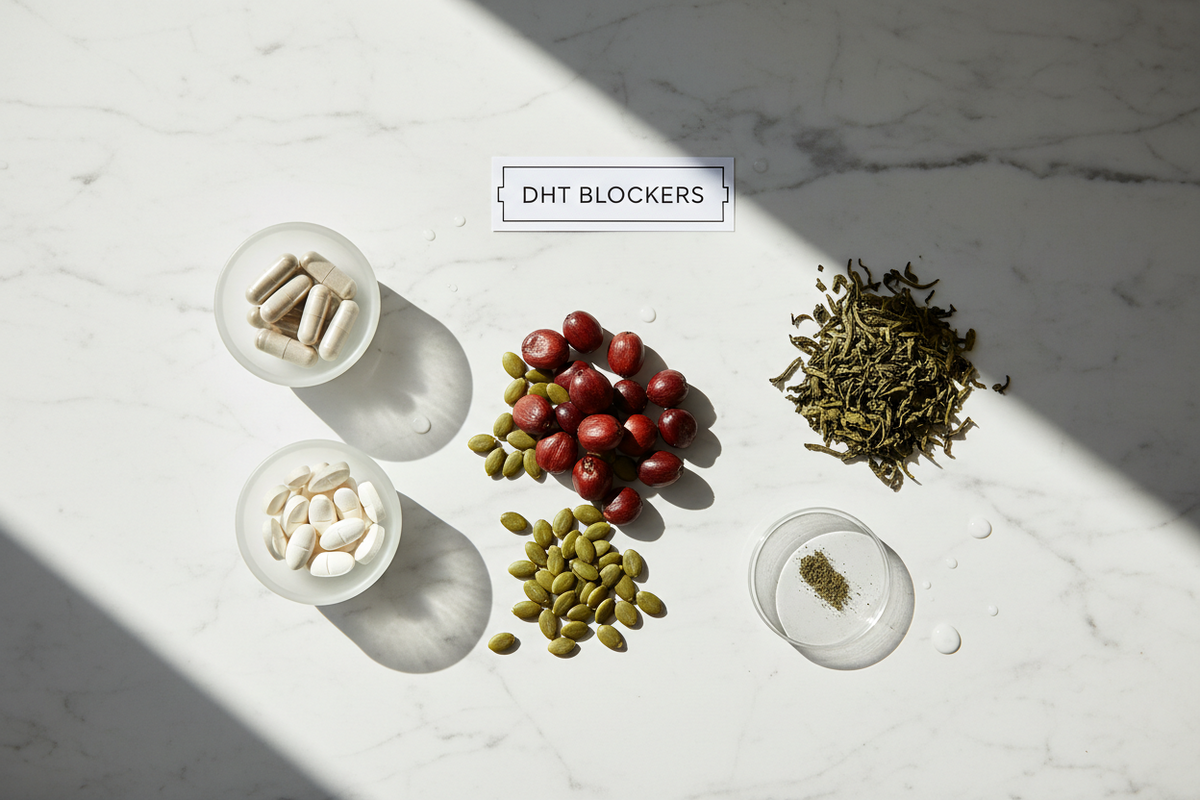
If you prefer a holistic route, Saw Palmetto is the most researched natural DHT blocker. It is believed to act as a weak version of Finasteride. Pumpkin seed oil has also gained traction after small studies suggested it could block 5-alpha reductase. While these are "gentler," they are also less potent. They may be effective for very early-stage thinning, but they rarely provide the dramatic results seen with pharmaceutical intervention.
When DHT Blockers Aren't the Answer
One of the biggest mistakes women make is assuming all hair loss is DHT-related. If you use a DHT blocker for a non-hormonal issue, you will see zero results and experience all the side effects.
Identifying Telogen Effluvium and Nutritional Deficiencies
If your hair is falling out in large clumps suddenly (after a fever, surgery, or intense stress), you likely have Telogen Effluvium (TE). DHT blockers do nothing for TE. Similarly, low iron (ferritin), Vitamin D, or B12 deficiencies can cause diffuse thinning that looks identical to hormonal hair loss. If your "soil" is nutrient-depleted, no amount of hormone blocking will make the "grass" grow.
The Role of Polycystic Ovary Syndrome (PCOS)
In women with PCOS, hair loss is a symptom of a larger metabolic issue. While DHT blockers help, addressing insulin resistance through diet and medication (like Metformin) is often just as important for stopping the hair from thinning in the first place.
Thyroid Health and Hair Density
Both hypothyroidism and hyperthyroidism can lead to dry, brittle, and thinning hair. Since the thyroid regulates the metabolism of every cell in your body—including hair follicles—an undiagnosed thyroid issue can mimic androgenic alopecia. Always check your TSH levels before starting a DHT blocker.
Creating a Comprehensive Treatment Plan
Healing hair loss is a marathon, not a sprint. You need a strategy that covers all bases.
Step 1: Get Your Labs Done (What to Ask Your Doctor)
Don't guess; test. Ask your dermatologist or endocrinologist for a full panel, including:
-
Total and Free Testosterone
-
DHEA-S (an adrenal androgen)
-
Androstenedione
-
Iron/Ferritin levels
-
TSH (Thyroid)
-
Vitamin D
Step 2: Combining Therapies for Maximum Efficacy
The most successful patients use a multi-pronged approach. This might look like:
-
Internal: Spironolactone to lower DHT production.
-
External: Topical Minoxidil to stimulate growth.
-
Mechanical: Scalp massage or low-level laser therapy (LLLT) to increase blood flow.
-
Nutritional: A high-protein diet with specific supplements to support the building blocks of hair.
Step 3: Managing Expectations and Timelines
Hair grows at a rate of about half an inch per month. When you start a DHT blocker, you aren't just waiting for the hair to grow; you're waiting for the follicle to "retool" itself. You will likely see an increase in shedding during the first 2–8 weeks as the "weak" hairs are pushed out to make room for stronger ones. Do not panic. You usually need 6 to 12 months of consistent use to see a visible difference in density.
Frequently Asked Questions About Women and DHT
Will a DHT blocker mess up my period?
It can. Spironolactone, in particular, is known for causing breakthrough bleeding or changes in cycle length. This is why many doctors prescribe it alongside a birth control pill to keep the cycle predictable.
Can I take DHT blockers after menopause?
Yes. In fact, post-menopausal women are often the best candidates for stronger blockers like Finasteride because the risk of pregnancy is eliminated. As estrogen drops during menopause, the "relative" power of DHT increases, making blockers very effective during this life stage.
How long before I see new hair growth?
Patience is your best friend. You might notice decreased shedding within 3 months, but visible "filling in" of the scalp usually takes 6 to 9 months. The full benefit is typically seen at the 12-to-18-month mark.
Are there permanent side effects?
For the vast majority of women, side effects are reversible upon stopping the medication. Unlike some reports in men, long-term sexual dysfunction is not widely reported in women using these treatments for hair loss.
Final Thoughts: Taking Control of Your Hair Health
Hair loss can feel like a loss of identity, but science has progressed to a point where you no longer have to simply "accept it." DHT blockers are powerful tools, but they are not magic pills. They require a partnership with a knowledgeable healthcare provider, a commitment to consistency, and a healthy dose of patience.
By understanding the "why" behind your thinning, you move from a place of frustration to a place of empowerment. Whether you choose a systemic blocker, a topical solution, or a natural approach, the key is to start early. The best time to protect a hair follicle was five years ago; the second best time is today.
Our Research Methodology and Medical Review Process
This article was synthesized from clinical studies on androgenic alopecia, FDA prescribing guidelines for anti-androgens, and dermatological standards of care. We prioritize peer-reviewed research from journals such as the Journal of the American Academy of Dermatology (JAAD) and clinical trials exploring off-label uses of Finasteride and Spironolactone in female populations. Always consult with a board-certified dermatologist before beginning any hormonal treatment.