

A Stanford Dermatologist Warns: Quitting Your GLP-1 Because Of Hair Loss Is A Lose-Lose

Every woman on a GLP-1 who sits across from me describes the same two moments her hair comes out.
The shower. And the brush.
And from the thousands of women I’ve seen — between my training at Stanford and the patients since — the shedding almost always comes down to the same thing they were never told. Something they could have changed the moment they saw that first handful.
Some are at the very beginning. Month three on the medication, the first clump in the shower, still telling themselves it’s stress.
Some are months in — ponytail half what it was, part widened, the brush unrecognizable.
What starts as a little more shedding than usual at month three becomes a thinner ponytail by month six. A widening part by month nine. Visible scalp at the temples by the one-year mark.
And most of them tell me they’ve already made the decision.
They’re going to quit the medication. Or cut to half-doses. Or take a break until the hair stabilizes.
But quitting the GLP-1 is a lose-lose. You gain the weight back — and the hair can still take years to grow back to its original density, if it ever does.
And let me tell you something personal.
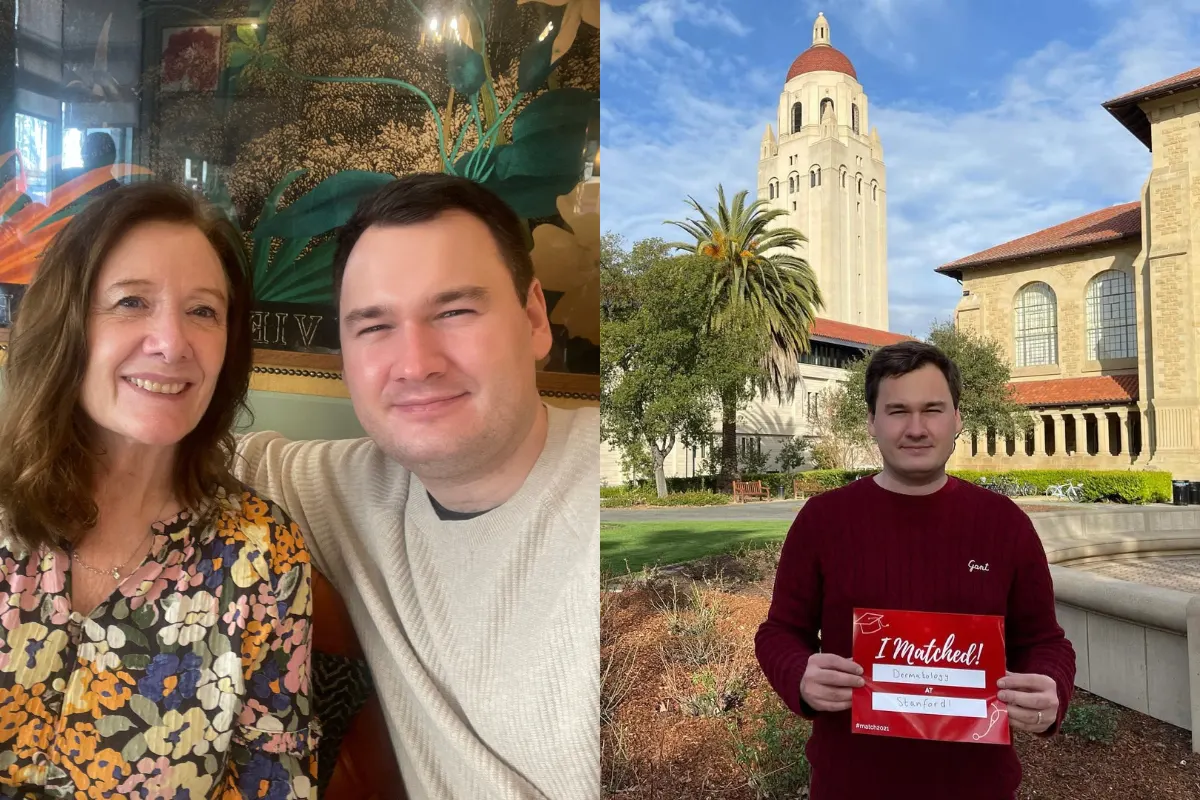
My mother is on a GLP-1 as we speak, for her health. Even if she had gone completely bald, quitting would never have been an option. It would have been dangerous.
She’s 68 now. Most of my patients on GLP-1s are between 40 and 60 — and I am not letting them live the rest of their lives with hair they don’t love. Hair they have to hide, or style around, or think about every morning.
Because a GLP-1 isn’t something new. It’s a gut hormone that evolved over millions of years to manage digestion. It’s not as if we don’t know what it does in the body.
And yet nobody had ever built a solution for GLP-1 hair loss.
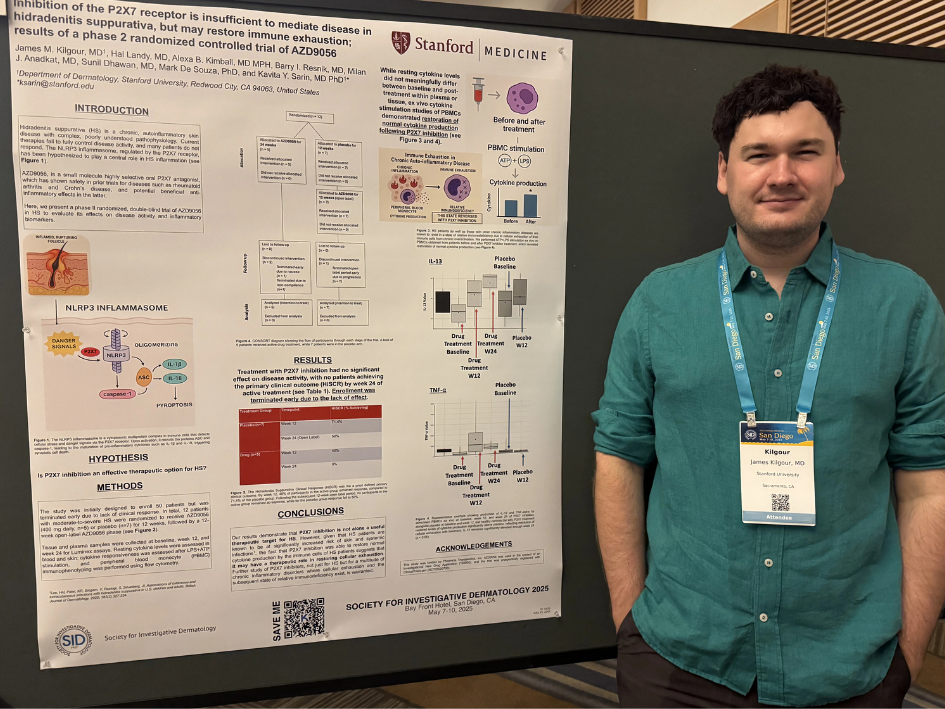
So last year I commissioned an independent clinical lab — with my own money — to find out what was actually happening, and what could be done about it.
It was the first study of its kind.
They counted every single strand a woman lost, by hand, from her brush and her wash, before and after. And they measured what was still growing.
The hair coming out in the brush and the shower dropped by 68%. The hair still on her head had twice as much in the growth phase, filling the density back in where it had thinned. And 95% of the women were shedding less within the first six weeks.
The trial was peer-reviewed and accepted by the Journal of Drugs in Dermatology for their June 2026 issue.
And the reason I’m writing to you now is a second study out of Washington — half a million people on these shots, pulled from hundreds of clinics. It showed just how common this hair loss really is, and worse: GLP-1 users were 62% more likely to have it turn long-term — the kind that doesn’t come back on its own.
So I want to explain exactly what’s happening on your scalp, and exactly what the women in my trial used to reverse it.
The Hair In Your Brush Is Dead
Try this. Take a piece of your hair halfway down, and slide your fingers to the very tips.
Feel that? Nothing. No sensation, no life.
The hair you can see and brush and lose is already dead — everything that decides whether you keep it happens at the root, where you can’t feel a thing.
So the hair in your brush didn’t “die.” It was a young, healthy strand — years of life left in it — that the root let go of years too early.
That’s what’s really happening on a GLP-1.
Somebody told you to eat more protein. Take biotin. The gummies.
And I get it — but all that only does anything if you’re actually deficient, and even then it only changes the new hair you build going forward. It never reaches back and holds a strand your root already let go of.
So you can do everything right and still watch it come out in the shower.
And that’s part of what pushed the researchers to look closer — so many women were doing everything by the book, perfect macros, slow and steady weight loss, and still losing their hair.
Which means the real question isn’t why the strand died. It didn’t. It’s what made a young, healthy root let go of it years early.
And that’s the pattern half a million records, across hundreds of clinics, would go on to confirm.
Your Hair Either Grows or Sheds
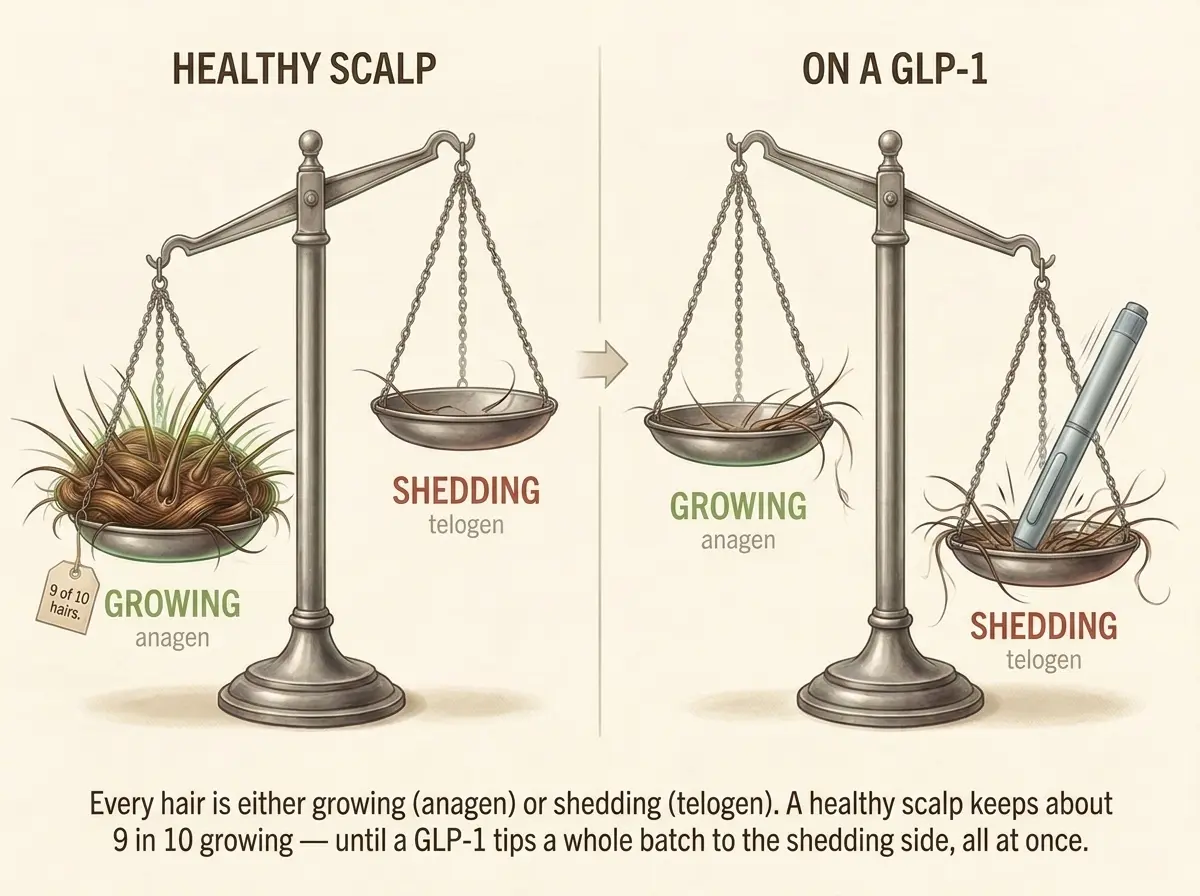
At any given moment, every hair on your head is doing one of two things. It’s either growing, or it’s on its way out.
We’ve got fancy words for them — anagen and telogen — but forget those. Growing, or shedding. That’s all you need.
And normally the math is heavily in your favor. On a healthy scalp, about nine out of every ten hairs are growing at once, quietly getting longer for years at a time. Only a small handful are resting and about to let go.
That’s why you never notice — a few fall out each day, and there’s a whole army still growing to cover for them.
A GLP-1 flips that balance. It takes a big batch of those growing hairs — hairs that had years left — and quietly flips them over to the shedding side, all at once. Suddenly it’s not a few strands a day. It’s a clump in the shower, a brush you don’t recognize, a ponytail that’s lost its weight.
And that’s exactly the pattern the Washington data confirmed.
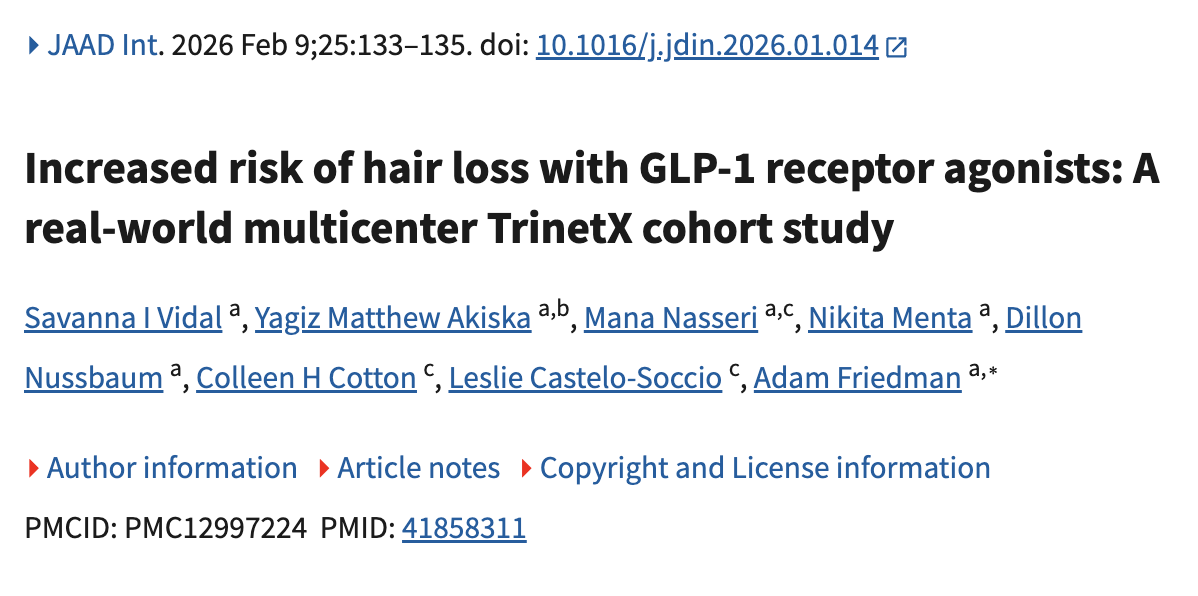
Across hundreds of clinics and half a million people, the ones on a GLP-1 were far more likely to have their hair make that flip — out of growing, into shedding.
The pattern
For 8 out of 10 women whose hair was thinning on the shot, it traced back to this exact flip — hair leaving the growing phase early and dropping into shedding. Anagen to telogen. That’s it. The same switch thrown the wrong way, in hundreds of thousands of women at once.
Nothing “died.” Nothing broke. Your hair just got told to stop growing and start letting go, far more of it than nature ever intended, all at the same time.
And once you see it that way, the whole thing gets simple. If the problem is too many hairs flipped over to the shedding side — then the fix isn’t feeding your hair or quitting your shot. It’s flipping them back. Getting your hair growing again.
Patient 1 — My Mother
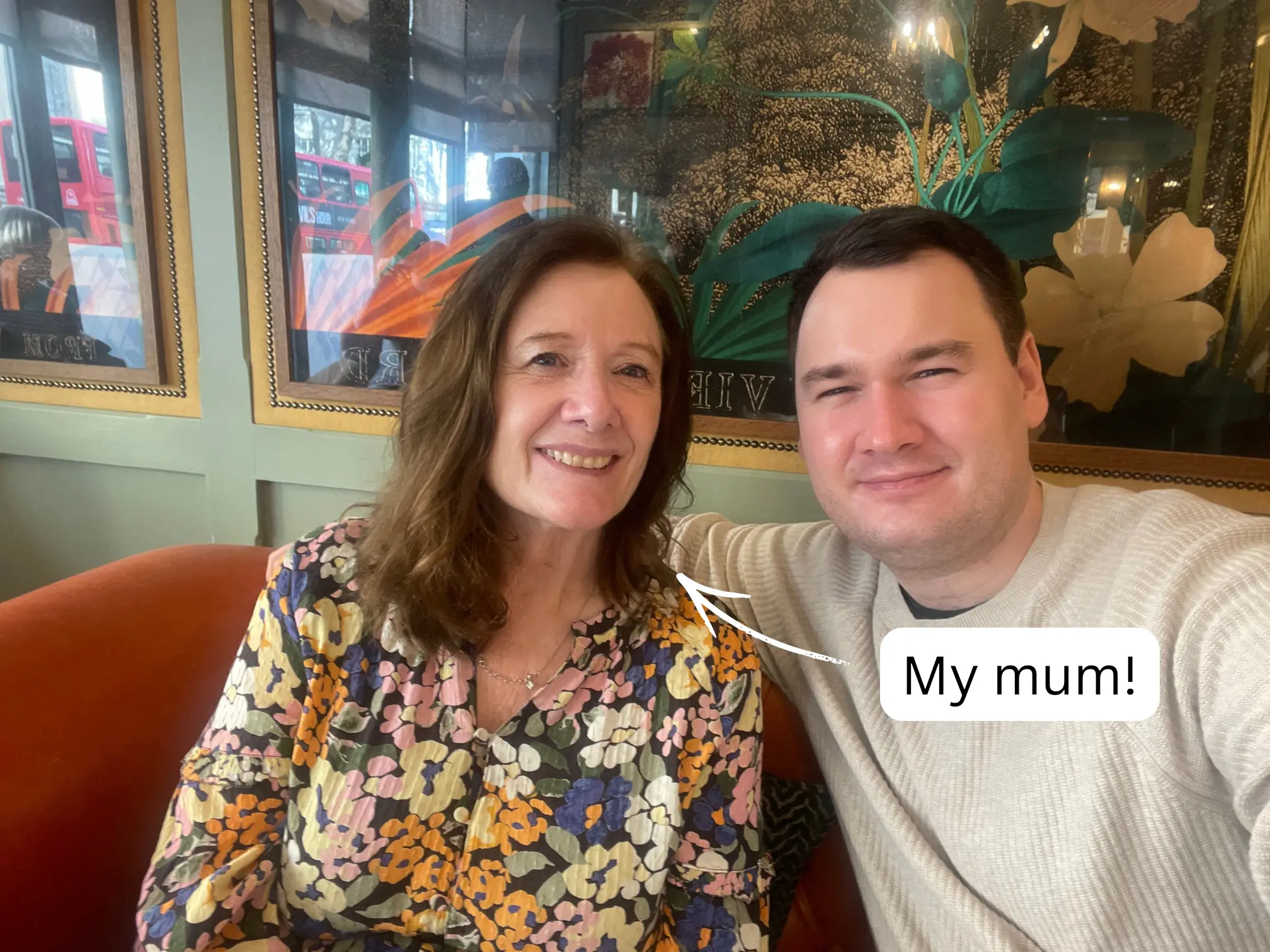
I had Stanford behind me, so I did the thing I know how to do. I went looking for what nobody had put together yet.
Not the same old ingredients everyone throws at hair — the biotin, the minoxidil, the things built for a completely different problem.
I went after actives that targeted the exact thing going wrong on a GLP-1: a grow signal that had been shut off, and healthy hair falling before its time.
And I found them.
One that can nearly double the amount of hair in the growing phase — actually turning the grow signal back on at the root, instead of just hoping.
One that makes the new hair come in stronger and rooted deeper — up to 35% longer, because it feeds the follicle the raw material it needs to build.
And then a set of actives to do the other half — lock the hair you still have in place so it stops falling early, and protect the follicle while it rebuilds. All without hormones, and without the side effects of the drugs women usually get handed.
But I was racing something. Leave a follicle shut off too long and it goes dormant — past a point, it just doesn’t come back. That’s the lasting kind Washington measured.
And every month my mother’s stayed quiet, more of hers slipped toward it. I couldn’t afford to get this wrong slowly.
So I didn’t. I worked nights, I worked weekends, every hour I wasn’t seeing patients — because the clock wasn’t ticking on some study. It was ticking on her.
Until I had it. One thing. A serum. Thirty seconds on the scalp at night.
And she was the first person I ever put it on.
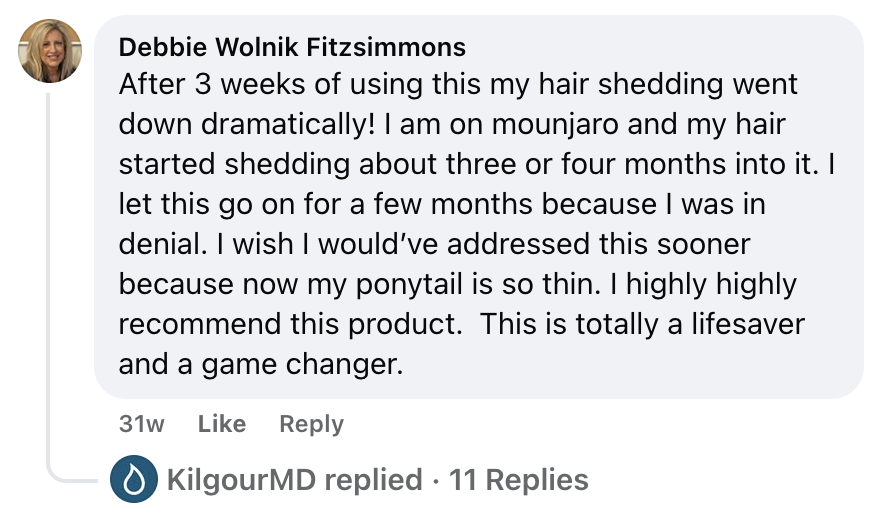
Her shedding was the first thing to go quiet — the handfuls in the shower slowed, then stopped.
Then, slowly, the part she’d stopped showing anyone started filling back in.
She never came off her medication. Not for a day.
That’s when I knew I couldn’t keep it to one patient. I had to prove it.
“This Is The First Trial To Cease Shedding, Not Slow It”

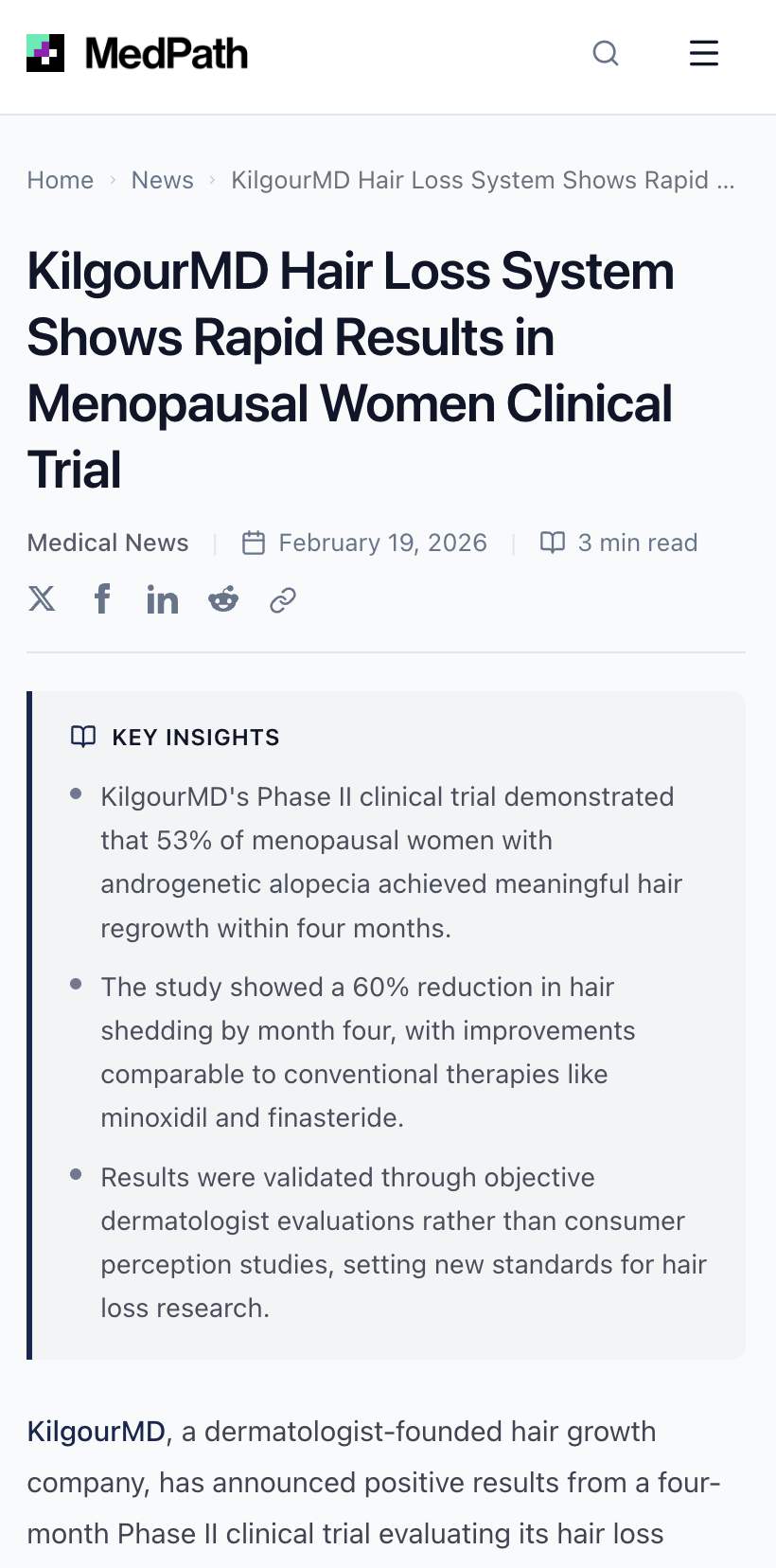
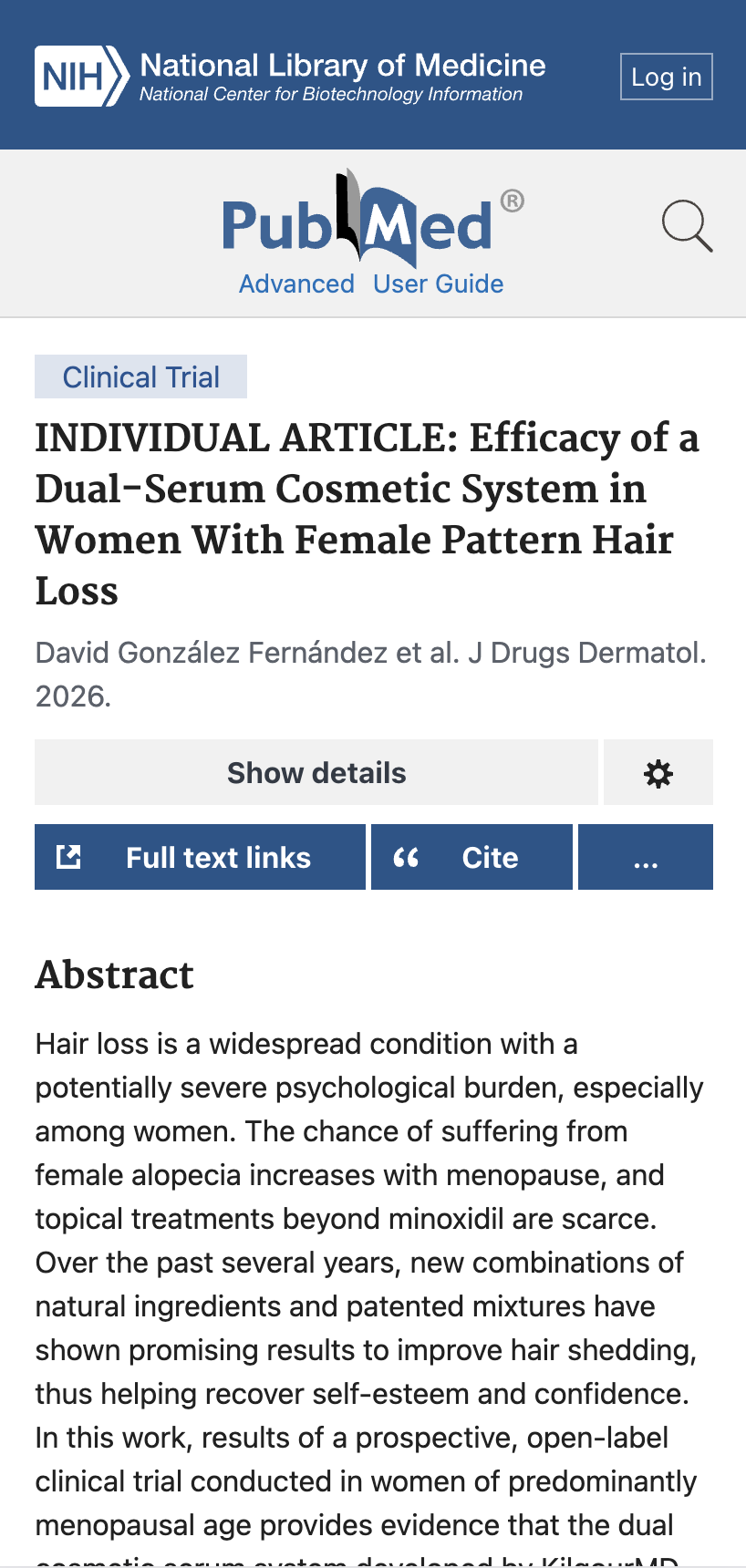
The trial enrolled women between 40 and 65 with verified hair loss.
Each woman followed the same thirty-second protocol on her scalp every night before bed.
Then the lab measured what was actually happening.
Wash Day Shedding
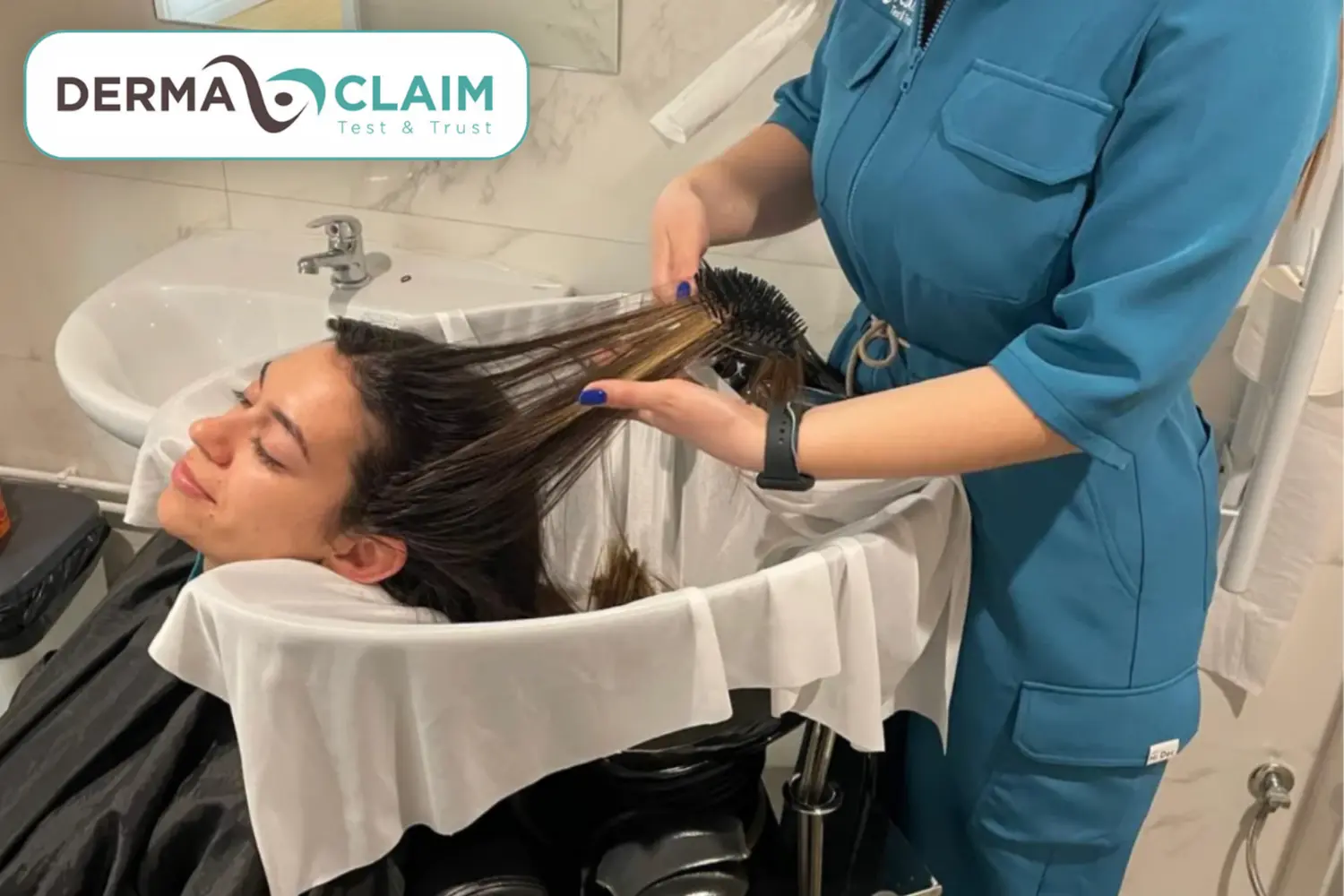
Each woman washed her hair in a clinical sink. Two consecutive washes. Five minutes each. A neutral, sulfate-free shampoo. A mesh fabric below the basin caught every strand released during the lather and the rinse.
Counted by hand. Photographed. Documented. Same protocol before the trial. Same protocol at week six.
The result: the wash count dropped by 68%.
Density Score
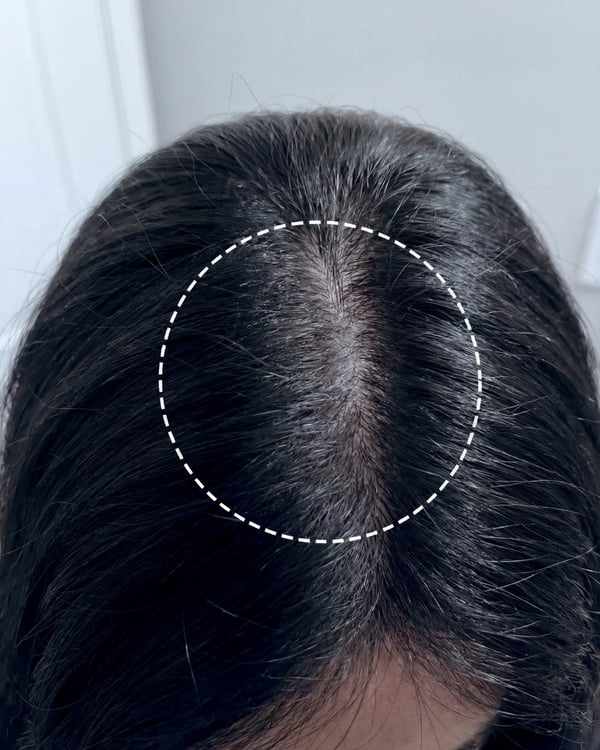
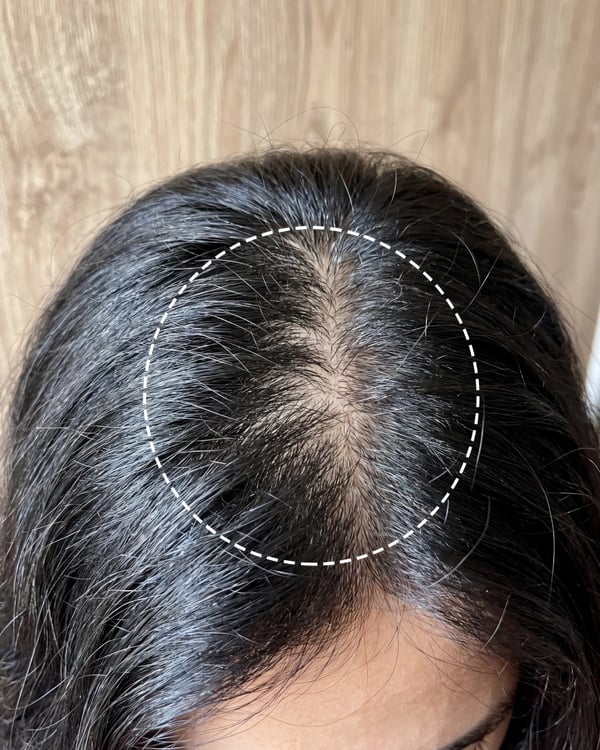 BeforeAfter
Counting what falls out tells you the shedding slowed. It doesn’t tell you whether the hair still on her head is winning or losing.
So the lab used the Ludwig scale — think of it as a density score, the standard dermatologists use to grade female hair loss from Type I to Type III. The same scale I’d use on a patient in front of me. Every woman was graded before the protocol, and again at week 18.
The Ludwig grade reflects the thing underneath all of it: how much of her hair is growing versus how much has flipped to shedding. Climb the scale, and more hair is falling out of growing. Come back down, and the growing is winning again.
That’s what they saw. Women moved back down the scale — part narrowing, crown filling — their hair flipping back from shedding into growing. Density came back about 3× faster than women typically see on minoxidil — without a drop of it.
In total, 95% of the women were shedding less within six weeks — their hair flipping back out of shedding and into growing.
The trial was peer-reviewed and accepted by the Journal of Drugs in Dermatology for publication in their June 2026 issue.
And it isn’t just my trial standing behind this. Leading nutritionists recommend it — Jennifer Hanway, an advisor to L’Oréal and Johnson & Johnson, and Ilyse Schapiro, MS, RD, with twenty years in practice. And more than 1,400 clinicians now use it with their own patients through FrontRowMD.
How It Achieved It
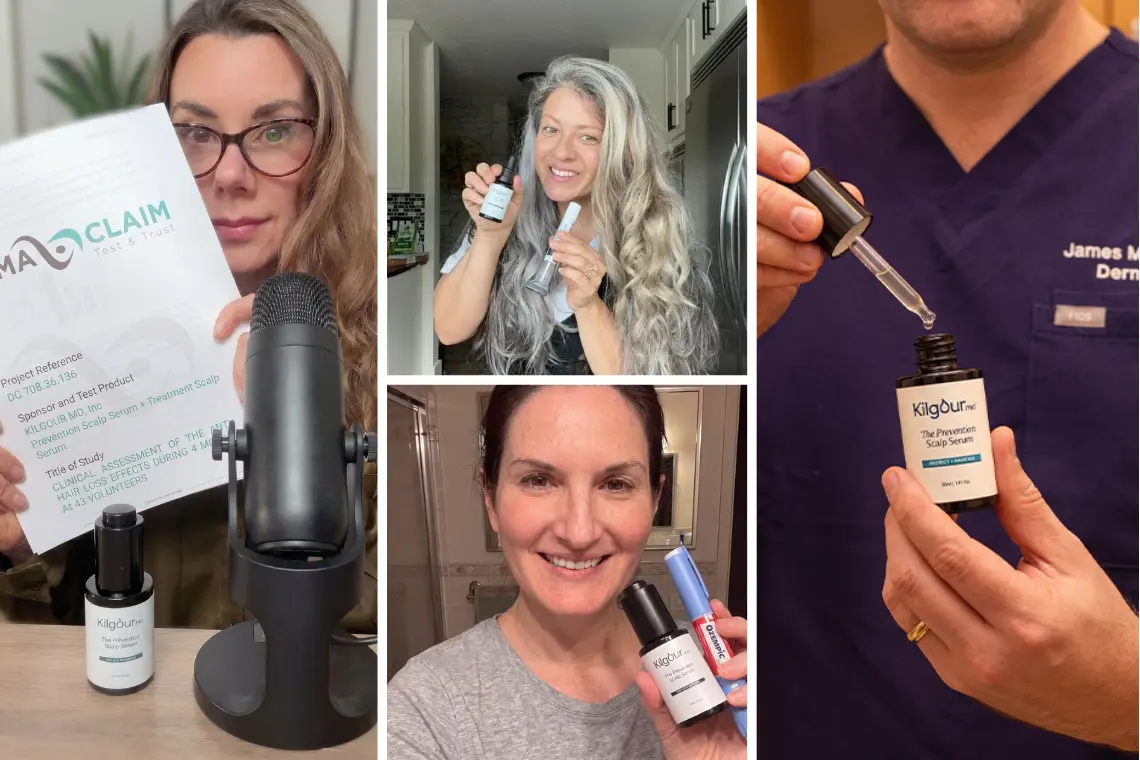
Five actives, each targeting a different part of what a GLP-1 does to your hair. It’s lightweight — not a heavy oil that sits on your scalp or weighs your hair down. You part your hair, apply it straight to the scalp, and that’s it. Thirty seconds, every night before bed.

Nearly doubles the amount of hair in the growing phase. It raises FGF-7 — the signal that tells your follicle to grow — by 56%, and lifts Noggin by 85%, shutting off the “stay asleep” signal a GLP-1 leaves stuck on.

Improves the growing-to-shedding ratio by 46%. It rebuilds the root that anchors each strand, so new hair comes in up to 35% longer and thicker — rooted deep enough to hold this time.

Cuts hair fall by up to 46%. It reinforces the anchoring proteins at the base of the follicle — the exact grip a GLP-1 loosens — so the healthy strands you still have stop letting go early.

Reduces shedding by 31% in two months. A basil root extract that calms the follicle and wakes up the dermal papilla, the engine that drives growth — no hormones, no side effects.

Supports the collagen the root is anchored in, and shields the follicle from the oxidative stress that comes with rapid weight loss — so the recovery holds.
Not one of these is a drug. They just hand the follicle back the signals and the raw material a GLP-1 quietly took away.
Hair Recovery Stories From Women on GLP-1s
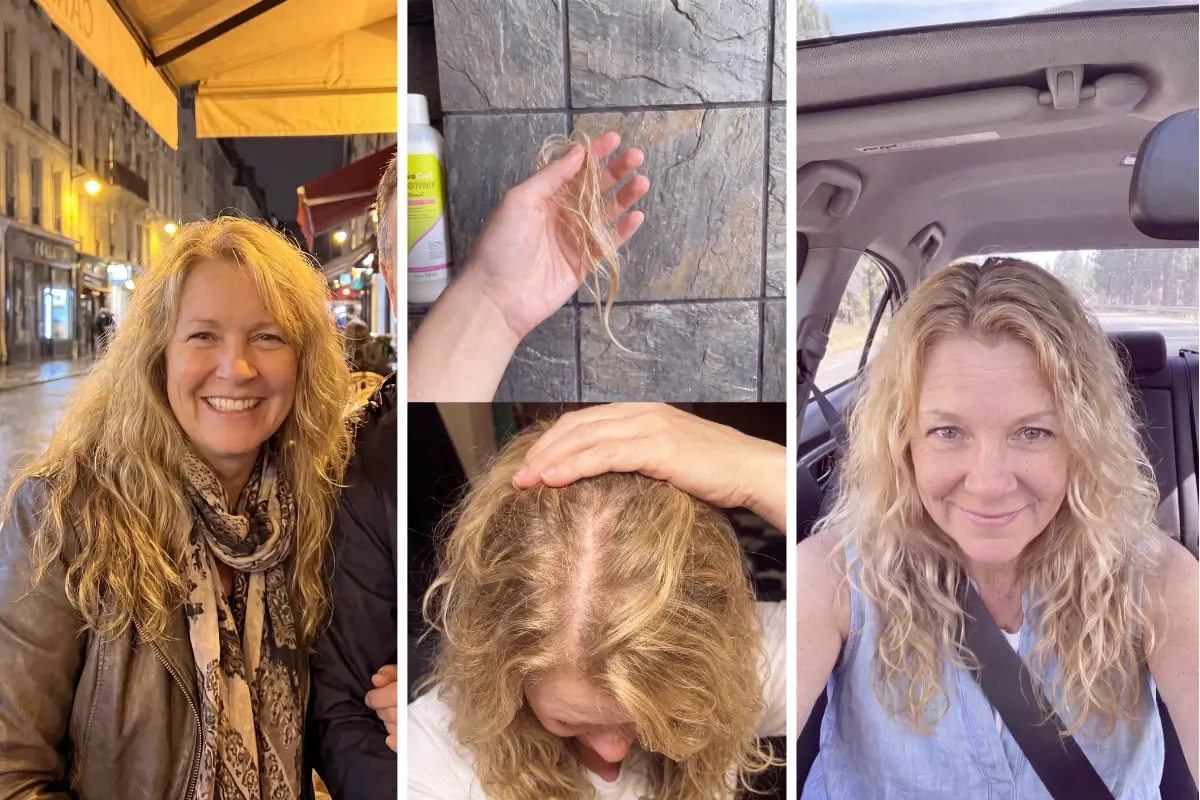
Okay I don’t normally do this but I have to share because I know so many of you are going through the exact same thing. That first photo is me and my husband in Paris a few years back — right before I started my shots. I’d been wanting to lose the weight for years, and it was finally happening. My hair? Thick, full. Didn’t think twice about it.
Then a few months into the GLP-1 it started.
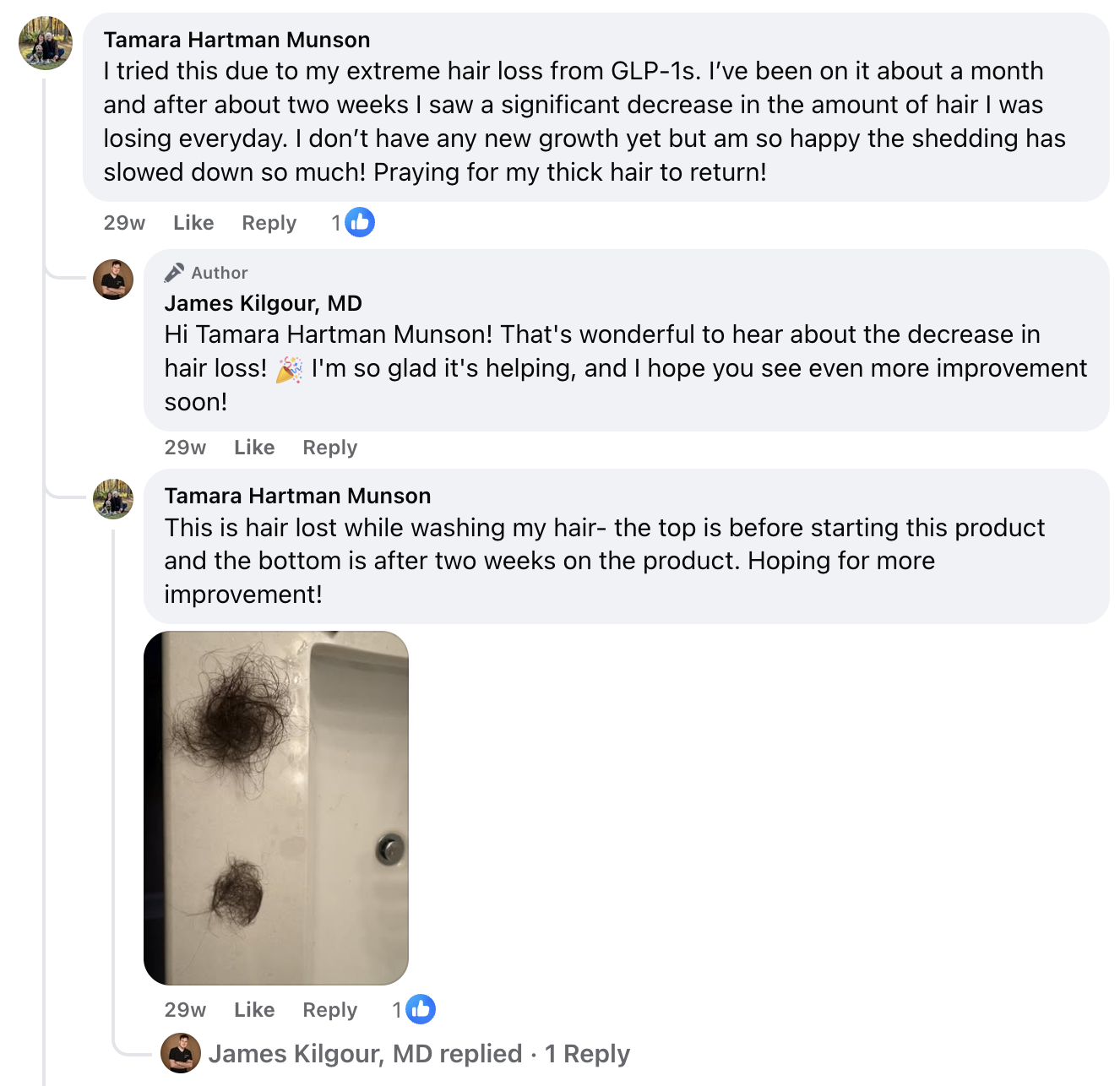
The second photo is what I’d pull out of my hair in the shower — every single wash, a handful like that. And the worst part was the top of my head, you can see in the photo how you could see right through to my scalp at the part. I stopped parting it in the middle. I started wearing it up so people wouldn’t notice from above. I cried in the car more than once. I honestly thought about quitting the medication over it — but I’d worked so hard for the weight.
I tried a few things — a couple of shampoos everyone swears by, more protein, a supplement my sister sent me. Nothing touched it. I genuinely thought I had to pick: my weight or my hair.
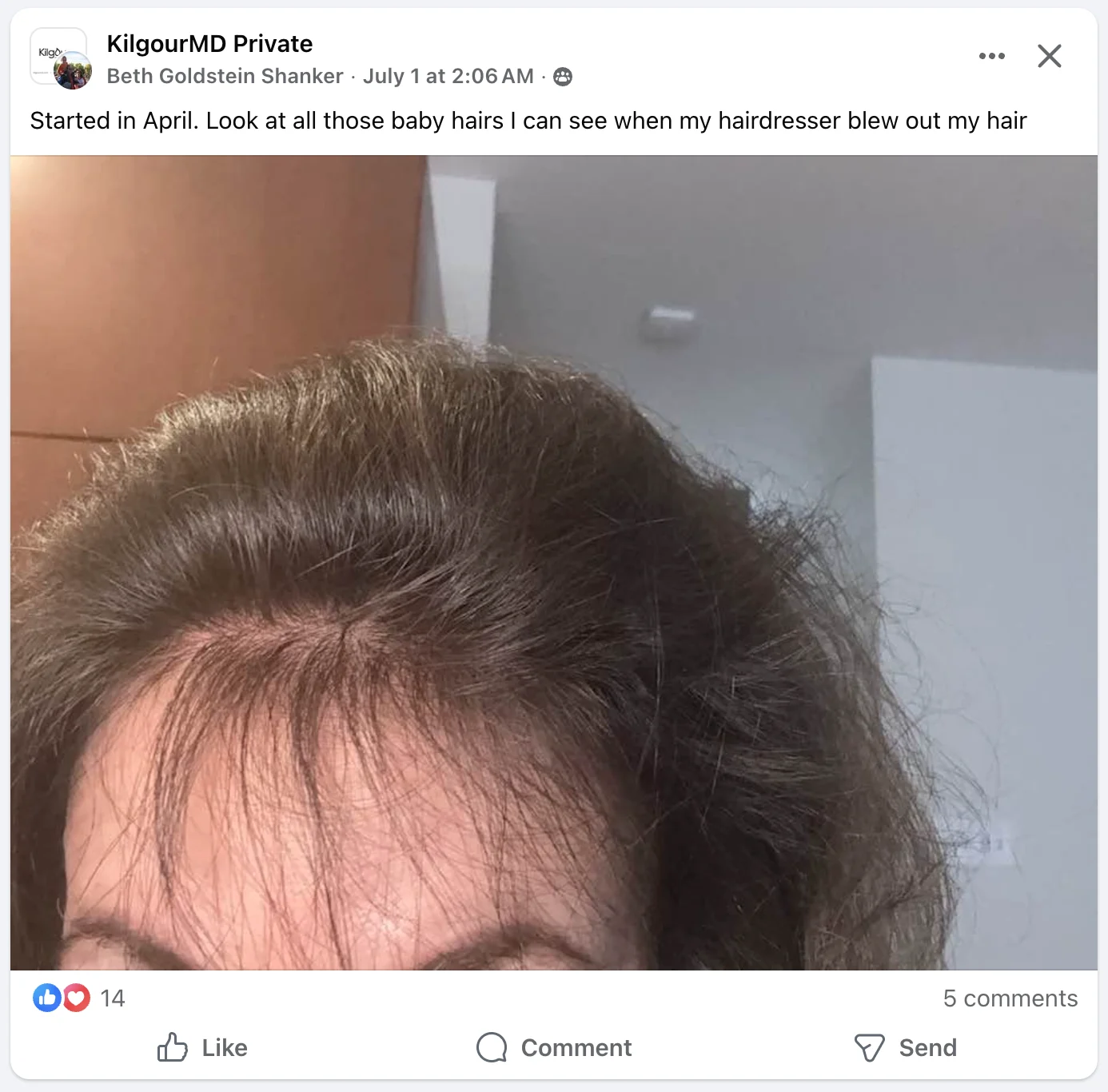
The third photo is me last week. I’ve been using the prevention serum (the scalp one) every night, takes me 30 seconds, and I never came off my medication. The shedding stopped first — that was the thing that made me cry happy tears, not finding it all over the shower anymore. And then it just slowly came back. My part filled in. It feels like MY hair again.
I’m 57. If you’re sitting there thinking you have to choose between your weight loss and your hair — that’s exactly what I thought. You don’t. Please don’t wait as long as I did. 💛
Ninety nights. My risk, not yours.
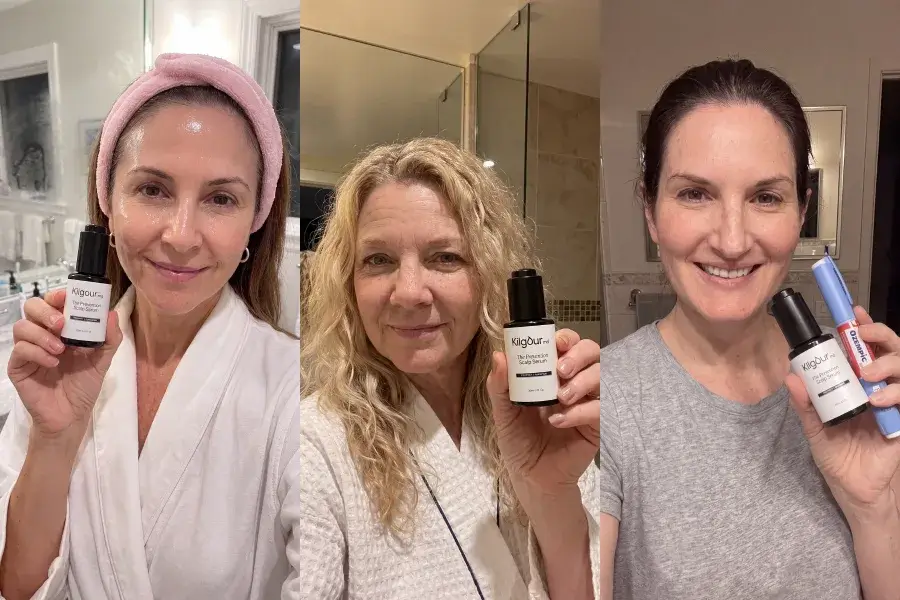
Use it every night for 90 days while you stay on your GLP-1. If your part isn’t filling back in — if you’re not seeing less hair in the drain and new growth at the hairline — email my team and you get every penny back. Keep the bottles. No forms, no return, no questions.
I can make that promise because I’ve watched it work — on my patients, and before any of them, on my own mother. I’m not asking you to trust a claim. I’m asking you to test it, on my dime.
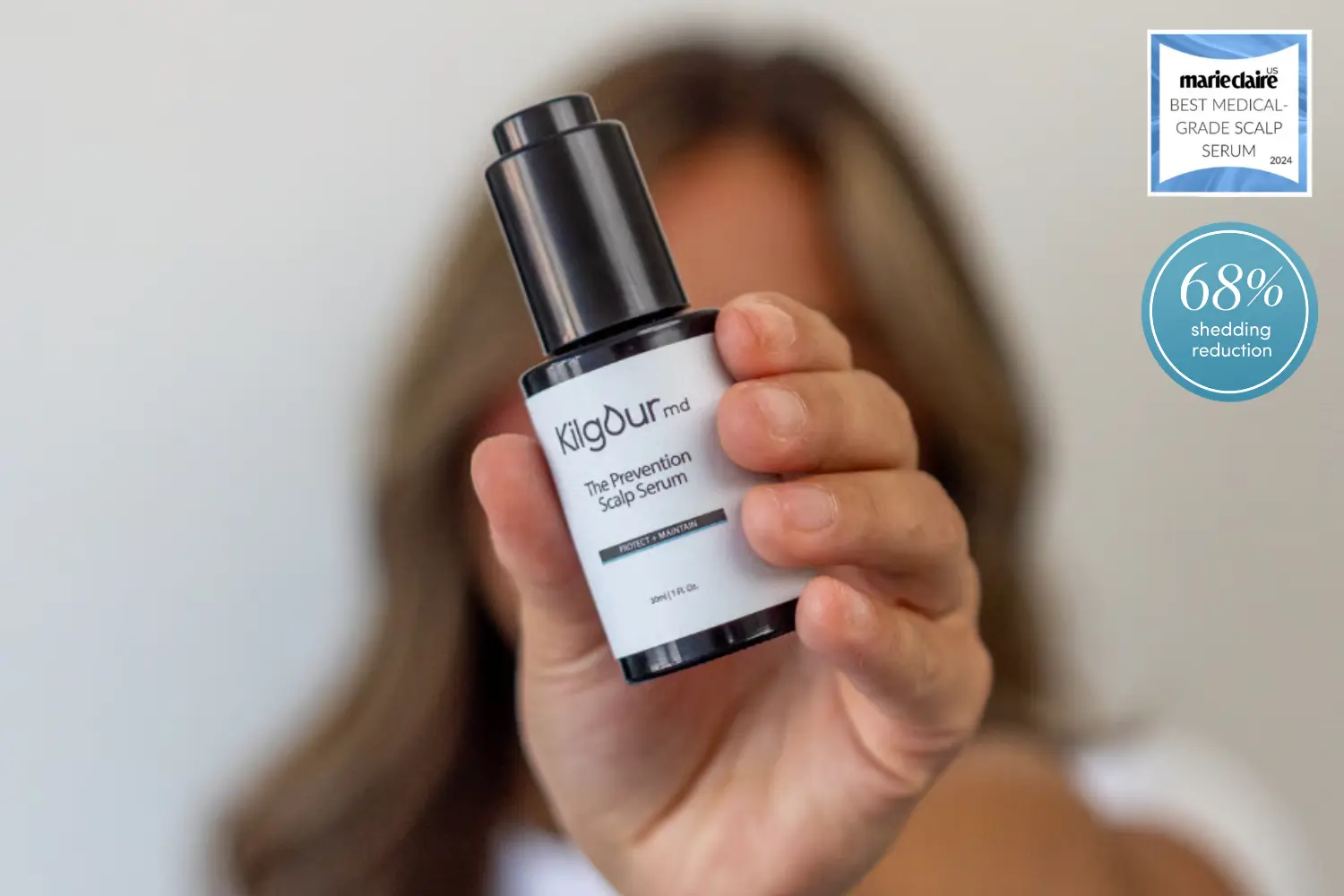
A thank-you to the women who participated in the trial, the researchers who reviewed it, and readers finding this at the moment the work becomes part of the medical literature. Runs while the publication batch lasts.
From here, there are two roads.
Everything I’ve told you comes down to one thing: on a GLP-1, the grow signal gets starved — and while it’s down, the hair already on the edge keeps falling.
The shot keeps working, the signal stays down, and the part that’s widening now keeps widening — month three to month six to the one-year mark — until the resting follicles slip into the lasting kind that doesn’t come back on its own.
You give the follicle its signal back and hold the hair that’s still there while it catches up — without touching the shot, without giving back a pound. The follicle isn’t dead. It’s waiting for the one thing it lost. You hand it back.
One road costs you nothing today, and your hair over the next year. The other costs you one bottle and a few minutes a night.
I know which one I’d want my mother on.
One warning before you order.
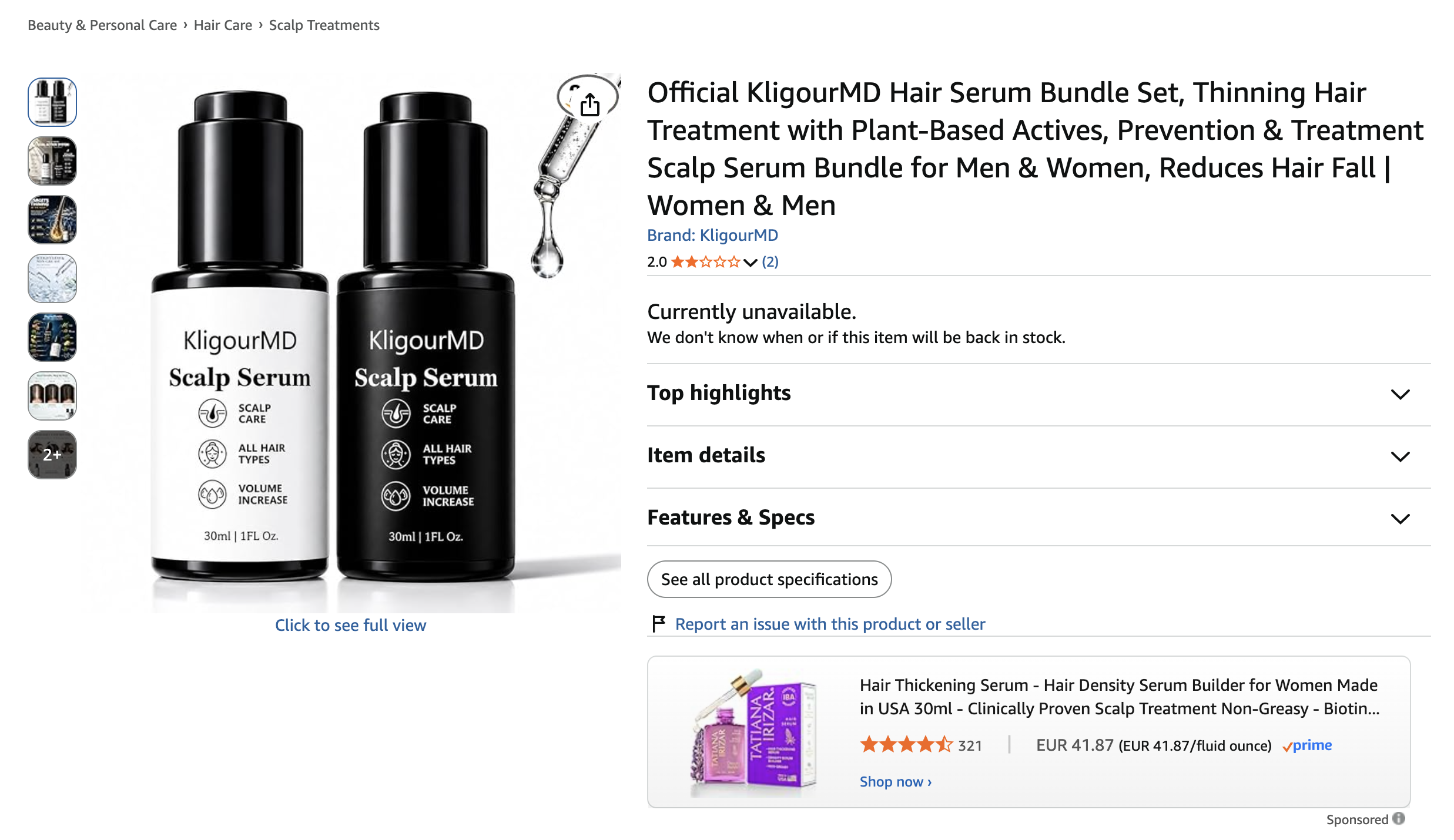
Because of the results, copycats have shown up on Amazon and marketplace sites in near-identical bottles — one even misspelled “Kiligour,” another “Kilgore.” They are not this formula, they were never through the trial, and the guarantee doesn’t cover them. There’s one place to get the real thing: the official KilgourMD site, from the blue button below. Order nowhere else — you’d be putting a stranger’s mixture on your scalp every night.
— Dr. James Kilgour, MD