


A Stanford Dermatologist's Simple At-Home Test Reveals How Much "Hidden" Hair Your Scalp Is Holding Back — and How 98% of Women in a New Trial Got It Growing Again
Next time you clean your brush, don't throw those hairs away.
Pick one up. Hold it between your fingers. Roll it slowly. Look at it under your bathroom light.
Notice anything strange?
The strand is smooth. Strong. Not split, not brittle, not damaged in any obvious way. If you ran it under a microscope, you'd see intact cuticle layers. Healthy keratin structure. A perfectly normal hair that could have kept growing for years.
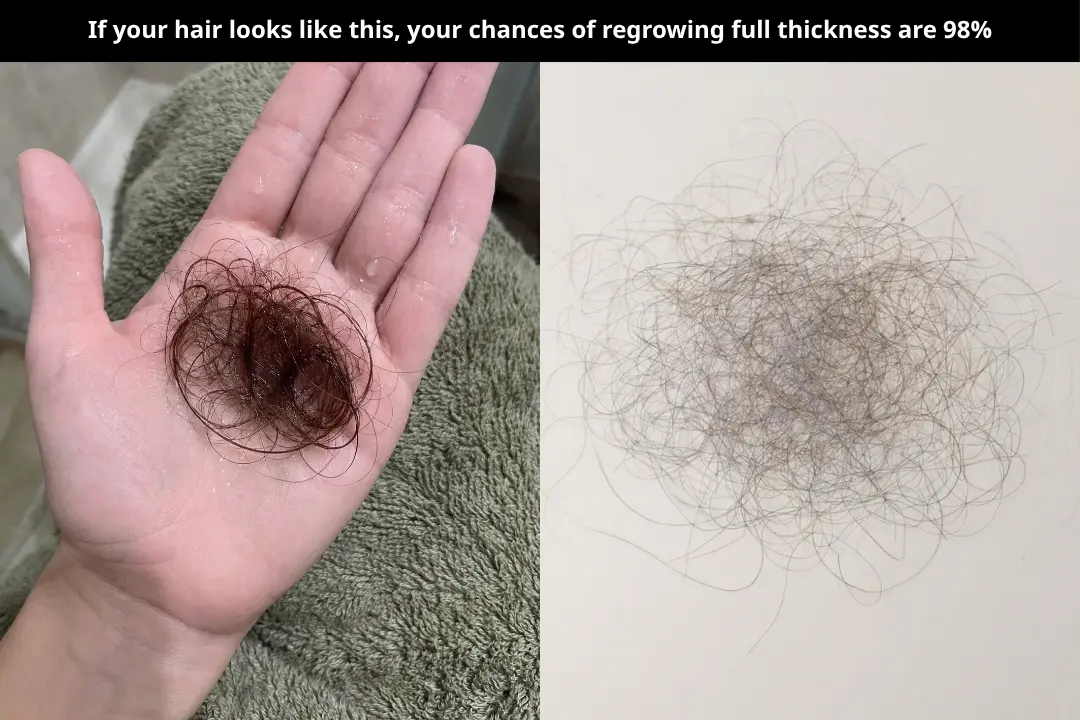
Does that look like a weak hair to you?
It's not. It's a healthy hair. A hair that should still be on your head right now.
So why did it fall out?
Because the tissue surrounding that follicle — your scalp — couldn't support it anymore. The environment that hair lived in failed. And once the environment fails, it doesn't matter how strong the strand is. It's coming out.
But here's what changes everything:
That follicle isn't dead. It's still there. Right beneath your scalp. Intact. Alive. It's entered what dermatologists call the kenogen phase — a holding pattern where it's not growing, not cycling, just sleeping. Waiting for a signal your scalp can no longer send.

Research shows up to 25% of your follicles can be sitting in kenogen right now. To put that in perspective — that's roughly 25,000 individual hairs. The equivalent of four full hair transplants worth of growth, sitting right beneath your scalp, doing nothing. Not because those follicles can't grow hair. Because the tissue surrounding them has deteriorated too far to send the signal to start.
The hair you've lost isn't gone. It's paused.
I Watched This Happen to My Mother
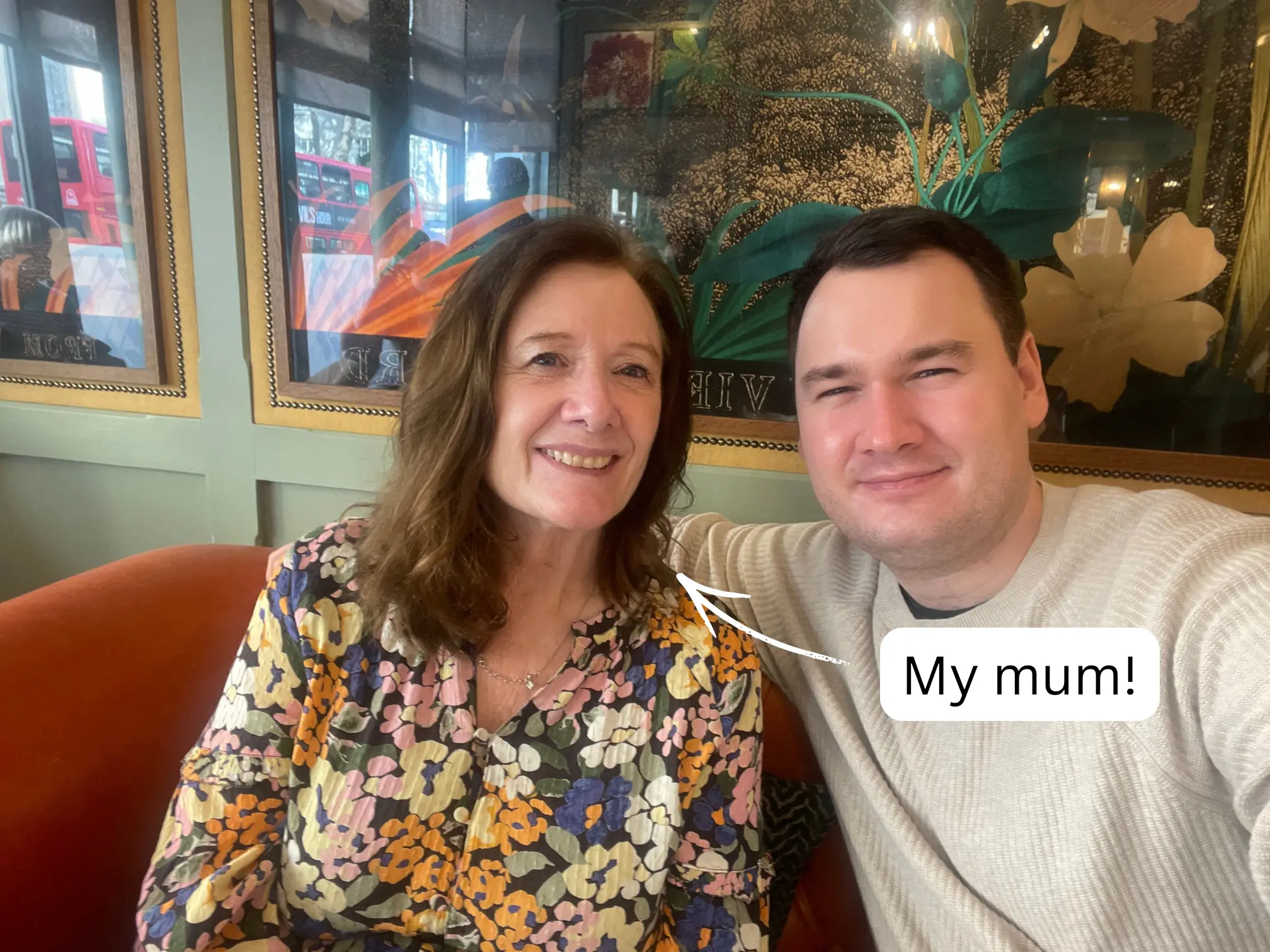
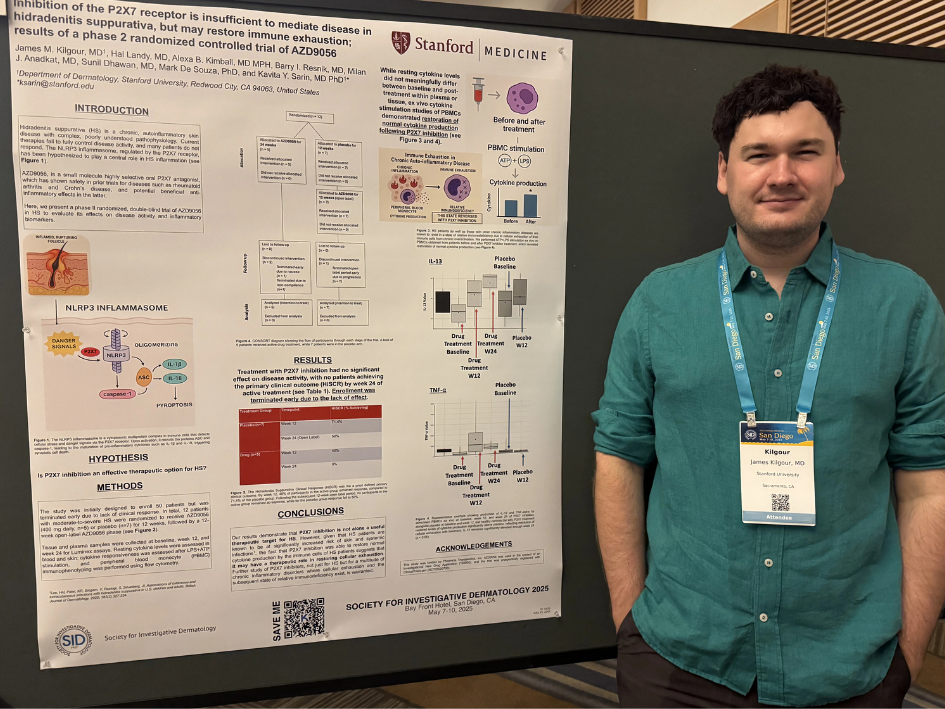
I'm a dermatologist. I trained at Stanford. I've spent my career studying hair and skin at the cellular level. I've read thousands of studies, run clinical trials, and understand the biology of hair follicles the way most people understand the layout of their own home.
None of that prepared me for standing in my mother's bathroom doorway, watching her cry in front of the mirror.
Her hair had started thinning during menopause. At first it was subtle — a few more hairs in the drain, a ponytail that felt slightly thinner between her fingers. She told herself it was stress. She told herself it was seasonal.
Then she couldn't tell herself anything anymore. Her part line widened. Her temples thinned. She could see her scalp under bright lights. And the brush — the brush was the worst part. Every morning, more hair. Every morning, that quiet panic.
She tried biotin supplements for months. Nothing changed. She tried prescription shampoos that cost a small fortune and smelled like a chemistry lab. Nothing. She bought volumizing products, thickening sprays, everything the beauty aisle had to offer.
Her doctor prescribed minoxidil. Do you know what minoxidil actually is? It's a blood pressure drug. From the 1980s. Originally designed for men. Someone noticed it grew hair as a side effect and thought, "Close enough."
It made her shed even MORE hair for the first three months. Her doctor said, "That's normal. It's called a dread shed. Give it time."
She gave it time.
During that time, she also stopped going out to dinner with friends. Stopped taking photos at family events — or if she was in them, she'd angle her head so you couldn't see the thin spots. She avoided mirrors. She avoided reflections in store windows. She started wearing hats she'd never worn before.
And I knew — from everything I'd studied at Stanford, from every paper I'd read, from every trial I'd analyzed — that the problem was solvable. The science existed. The ingredients existed. Someone just hadn't put it together for women like her.
What One Study Changed Everything
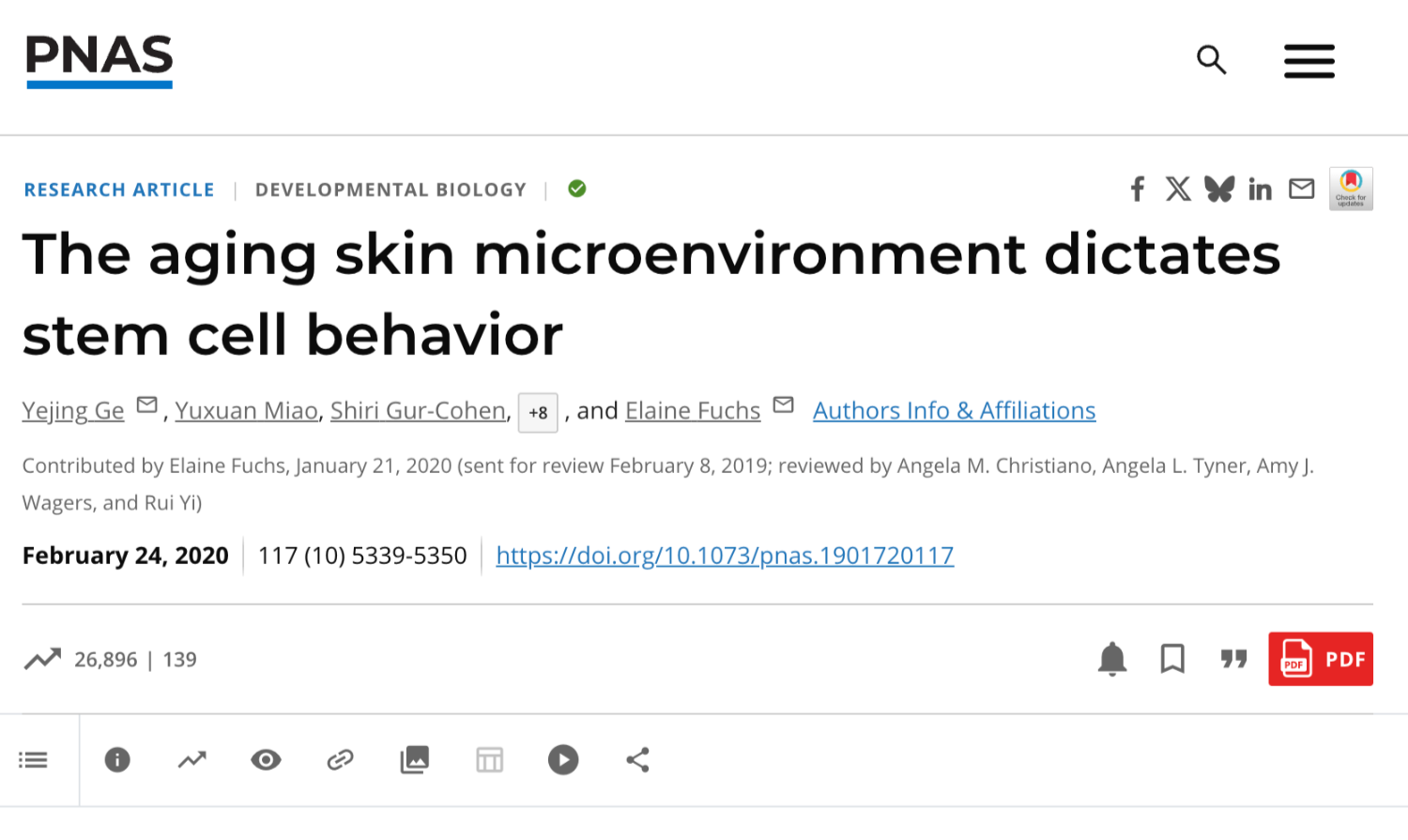
There's a study from PNAS — one of the most prestigious scientific journals in the world — that rewired how I thought about my mother's hair loss.
Researchers took follicles from balding scalp and transplanted them into young, healthy tissue.
They grew back.
Then they took healthy, active follicles and placed them into aged, deteriorating tissue.
They died.
The same follicle. Alive or dead based entirely on the tissue surrounding it. The hair didn't decide anything. The scalp decided everything.
I went home that weekend and watched my mother cleaning her brush. And for the first time, I didn't see hair that was failing her. I saw a scalp that was failing her hair. Every strand she pulled out of those bristles was healthy. Strong. Her scalp just couldn't hold onto it anymore.
And I realized something else that day — something that would take me 18 months to fully solve. There weren't just one thing going wrong on her scalp. There were two. Two completely different biological problems happening simultaneously, interfering with each other, requiring two completely different solutions.
But I'm getting ahead of myself.
Before I could solve anything, I had to face a problem that made me genuinely angry.
The Best Ingredients in the World Existed. They Were Barely Tested on Women.
I went hunting. Not for new science — the science was already there. I was looking for the most clinically validated compounds on the planet for hair loss. The ones with published studies. Measurable outcomes. Real data.
I found them. And they were remarkable.
The first came from a kitchen garden. A pea sprout extract that boosted two critical growth signals — one by 56%, another by 85% — in 14 days. Follicles that had been sitting in kenogen for years started cycling back into production. The fastest-acting compound I'd ever seen in the literature.
But waking follicles up wasn't enough. I needed them to actually grow.
A molecule derived from tree bark in European forests did something I'd never seen. It communicated directly with dormant follicle stem cells — not indirectly, not through some downstream pathway. It spoke to the stem cells at the base of sleeping follicles and told them to turn back on. In clinical testing, it produced over 10,200 new hairs in 84 days and a 214% increase in growth.
But new hair means nothing if it falls right back out.
A compound from the leaves of something you'd find on a Mediterranean dinner table matched nearly a year of the most powerful prescription hair loss drug ever created — in a fraction of the time. Except that drug, Finasteride, is so dangerous for women it's essentially kept behind a locked cabinet door. This compound did the same thing. Safely. From a leaf.
I kept going.
A compound grown in a bioreactor from actual plant stem cells added a second layer of defense against the hormone that attacks follicles. Another nearly tripled a critical anchoring protein — the protein that physically holds each hair inside your scalp so it can't be pushed out. In a triple-blind trial, it matched minoxidil head to head.
I was staring at a complete toolkit. Stop the shedding. Wake up dormant follicles. Grow over ten thousand new hairs. Protect them from the hormone that shut them down. Anchor every strand so firmly the hair doesn't just grow back — it stays. Thick enough to feel in a ponytail. Full enough to stop avoiding mirrors. Real enough to stop wearing hats.
Then I looked at who these ingredients had actually been tested on.
Study after study — the majority of participants were men. Young men. Men in their twenties and thirties with receding hairlines. Not because the ingredients wouldn't work for women. Not because someone proved they couldn't help a 58-year-old woman watching her part line widen every month.
Nobody thought to ask.
The entire hair loss research apparatus built itself around men. Then the industry took those same ingredients, put them in prettier bottles, and handed them to menopausal women with a shrug. "It works for men. It's probably fine for you too."
That's how my mother ended up on minoxidil. A blood pressure drug from 1988. Designed for men. Repurposed because someone noticed hairy arms as a side effect and thought that was close enough.
Dread shed. Facial hair growth. Lifetime dependency — stop using it and everything falls out again. That's what they gave my mother. That's what they give millions of women every year. Not because it's the best option. Because it's the only option anyone bothered to build.
I decided to build something else.
18 Months. Two Problems. Two Serums.
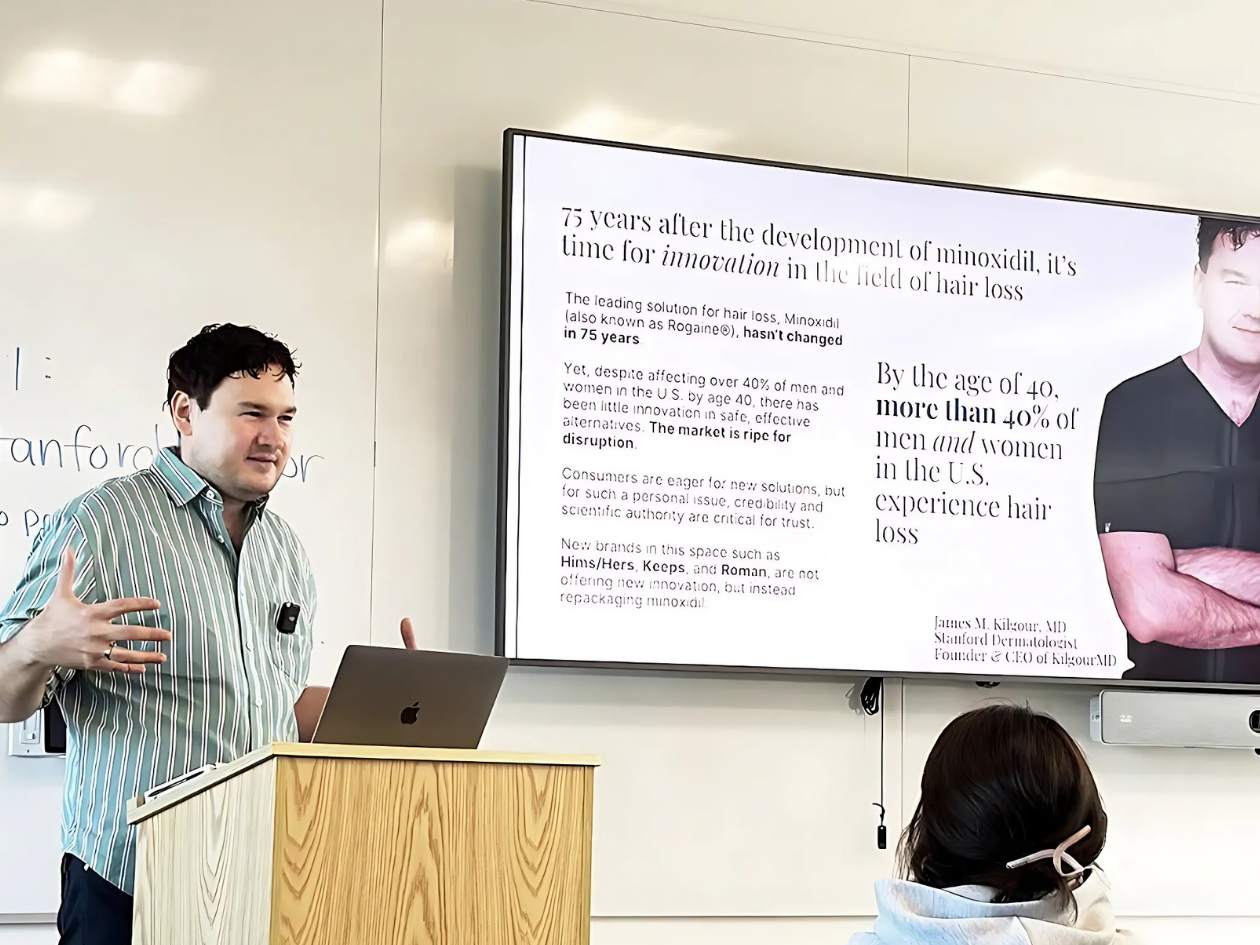
I took the 11 most promising compounds I'd found. The tree bark molecule that woke up stem cells. The kitchen garden extract that boosted growth signals in two weeks. The Mediterranean leaf that made Finasteride irrelevant. The bioreactor stem cells. The anchoring protein multiplier. All of them.
But I didn't do what every other company does — throw everything into one bottle, slap a label on it, and call it a "complete solution."
Here's what the PNAS study and the kenogen research told me together: there are two distinct biological problems happening on your scalp right now. And they interfere with each other if you try to solve them the same way.
The first problem is active deterioration. This starts during perimenopause and accelerates through menopause and beyond. Estrogen is vacating your follicle receptors. An enzyme called 5-alpha reductase is converting testosterone into DHT — a molecule that slowly suffocates each follicle from the outside in. Your anchoring proteins are degrading. The tissue environment that the PNAS study proved controls everything — it's collapsing. And every day it continues, more healthy hair gets pushed out of a scalp that can no longer hold it.
This needs to be STOPPED.
The second problem is kenogen. Those thousands of follicles sitting beneath your thinning areas — the ones the research says are alive but paused, waiting for a signal your scalp can no longer send. They need energy. Nutrients. A direct wake-up call to the stem cells at their base. Without it, they'll sit in kenogen indefinitely. Years. Decades. Until the follicle miniaturizes beyond recovery.
These need to be REACTIVATED.
Prevention and treatment aren't two steps of the same process. They're two different jobs requiring two different tools. The compounds that defend and anchor work through completely different biological pathways than the ones that reactivate and regrow. Mixing them into a single serum dilutes both.
So I built two serums. One to prevent further loss. One to treat what's already happened. Separated by design. Two problems. Two solutions. One protocol.
And then I did what nobody else in this industry had considered worth doing.
I tested them on women. Women in perimenopause, menopause, and postmenopause. The ones who'd been ignored by every clinical trial. The ones who'd been handed repurposed men's drugs and told to be patient. The ones like my mother.
What Happened When We Finally Tested It on Women
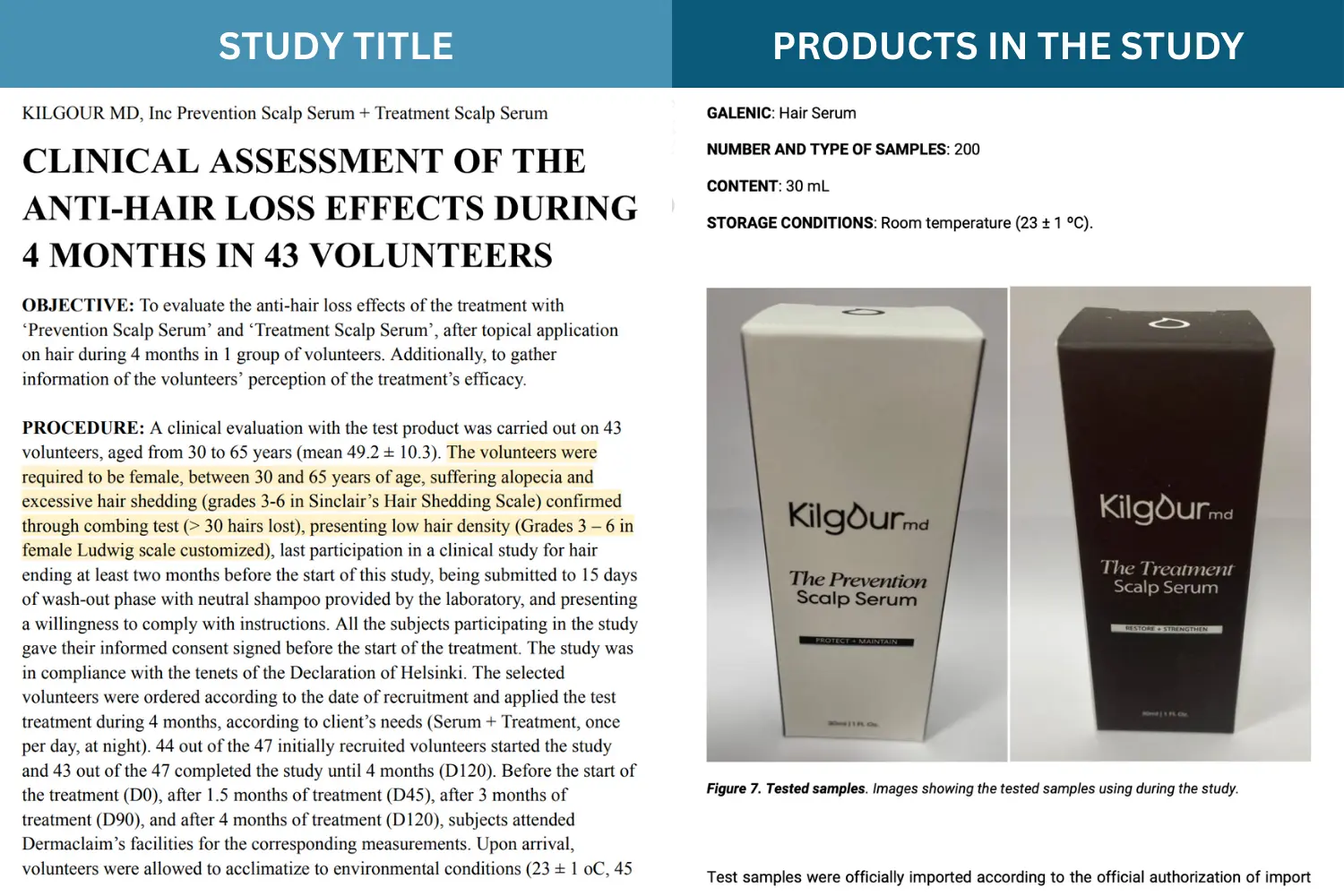
43 women. Menopausal and postmenopausal. Real hair loss. Real thinning. The kind of thinning that changes how you move through the world.
I knew the ingredients worked individually. But I also knew that most of the published data came from studies where the majority of participants were men. So we did something almost nobody in the hair care industry bothers to do.
We tested the full protocol on the women it was actually built for. And we had the results evaluated by Dermaclaim — an independent third-party clinical testing organization. Not my lab. Not my team. An outside group with zero stake in the outcome.
Not 50%. Not 70%. Ninety-eight out of every hundred women saw measurable improvement. The drug most doctors prescribe — the blood pressure medication from 1988 — hovers around 40%. And that's in the studies on men. Women like you were never even part of the equation.
But the response rate wasn't what stopped me in my tracks.
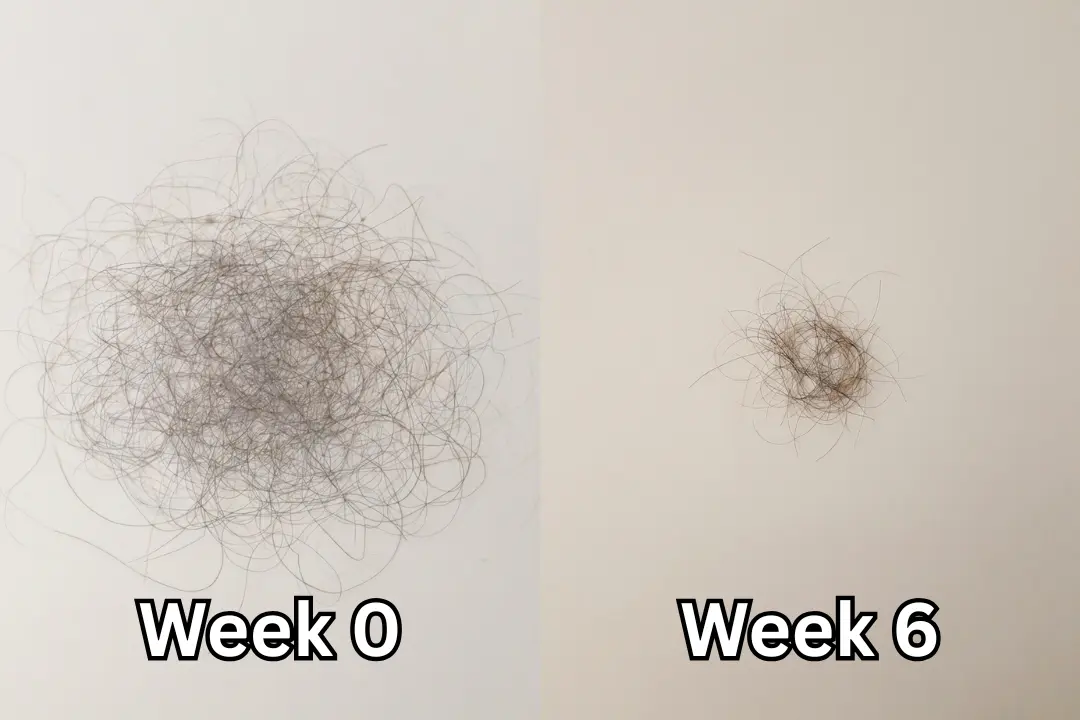
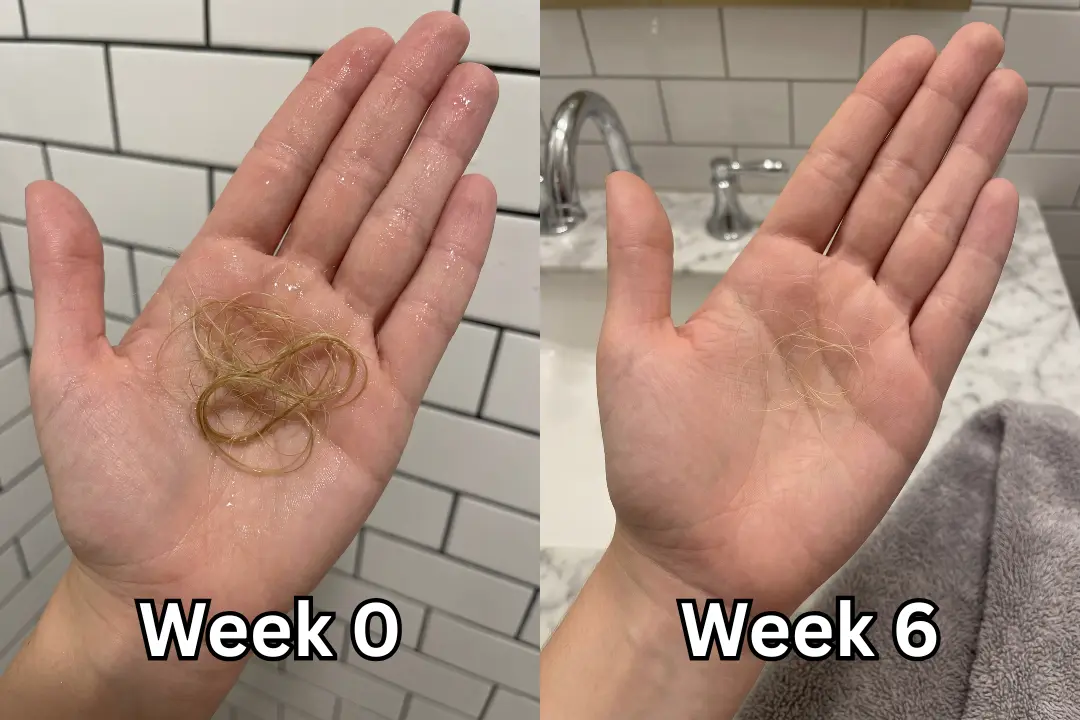
Not month six. Not month twelve. Six weeks. Remember the hair in your brush — the healthy strand that shouldn't have fallen out? By week six, women in the trial said the brush looked different. Less hair. Every morning. Less.
If you've spent months watching the shedding get worse — being told "that's normal," being told "give it time" — imagine looking at your brush six weeks from now and seeing almost nothing in it.
That's what 95% of these women experienced.
But shedding stopping is only half the equation. The other half is what comes back.
The follicles stuck in kenogen — the ones the PNAS study proved were alive and waiting — they started waking up. And they produced visible new growth three times faster than the only drug most doctors offer women. Without the dread shed. Without the facial hair. Without the dependency.
Women who had been thinning for years — women who had tried everything, spent thousands, given up — were seeing new hairs along their part line in months. Not years. Months.
Zero. No dread shed. No facial hair. No scalp irritation. No dependency. You're not forcing hair to grow with a repurposed blood pressure drug. You're restoring the tissue environment your follicles need. When the environment is healthy, the hair stays — because your scalp can finally do what it was designed to do.
My mother was one of the 43.
She stopped wearing hats. She stopped avoiding mirrors. She started showing up in photos again — front and center, not angled to hide the thin spots.
She got her hair back. And more than that, she got herself back.
She wasn't special. She wasn't an outlier. She was one of 98%.
And if you're reading this — if you've seen it in your brush, felt it in your ponytail, avoided the mirror under bright lights — there's no biological reason you can't be one too.
The Protocol Is Called KilgourMD.
Two serums. Not one. Two — because the science demands it.
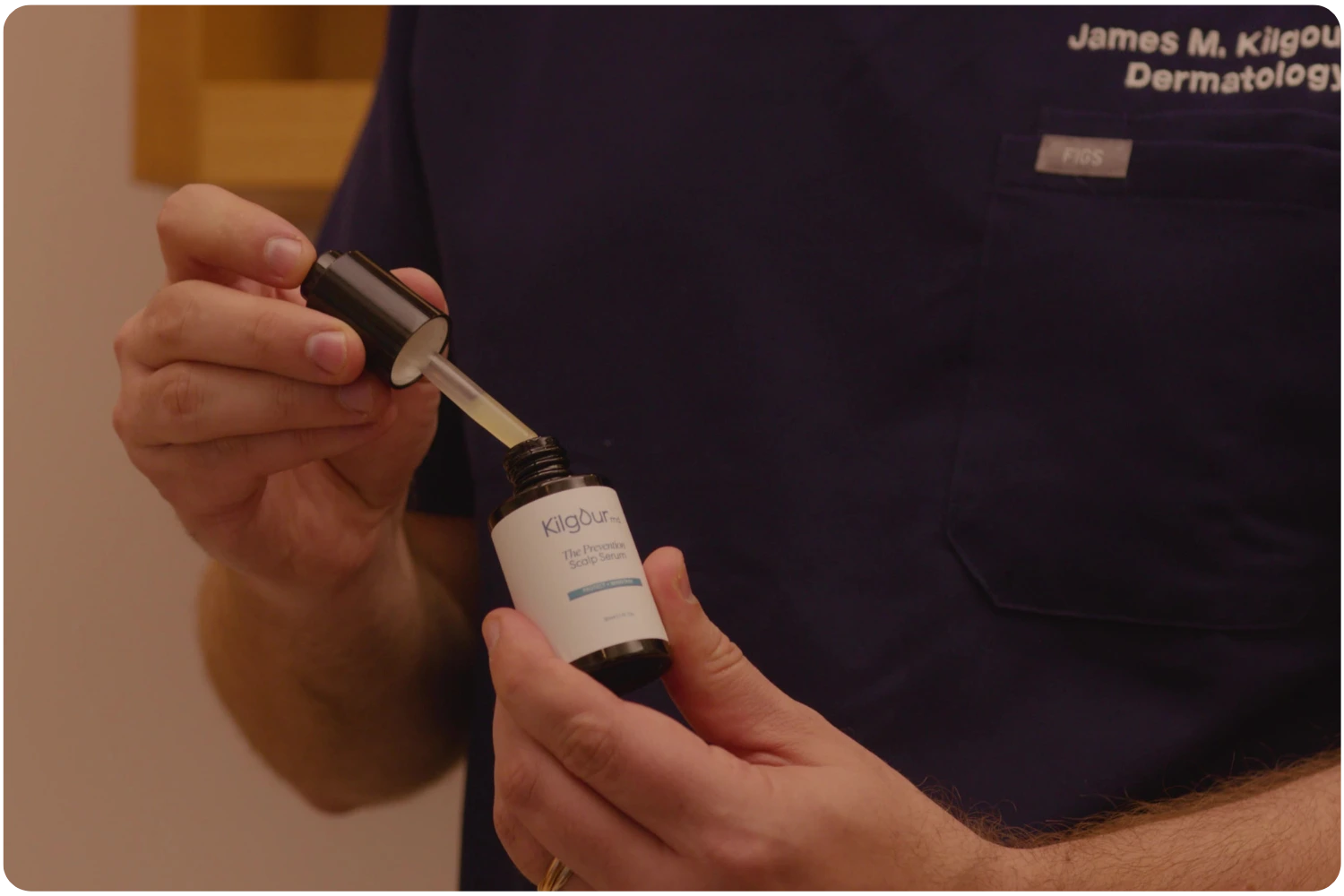
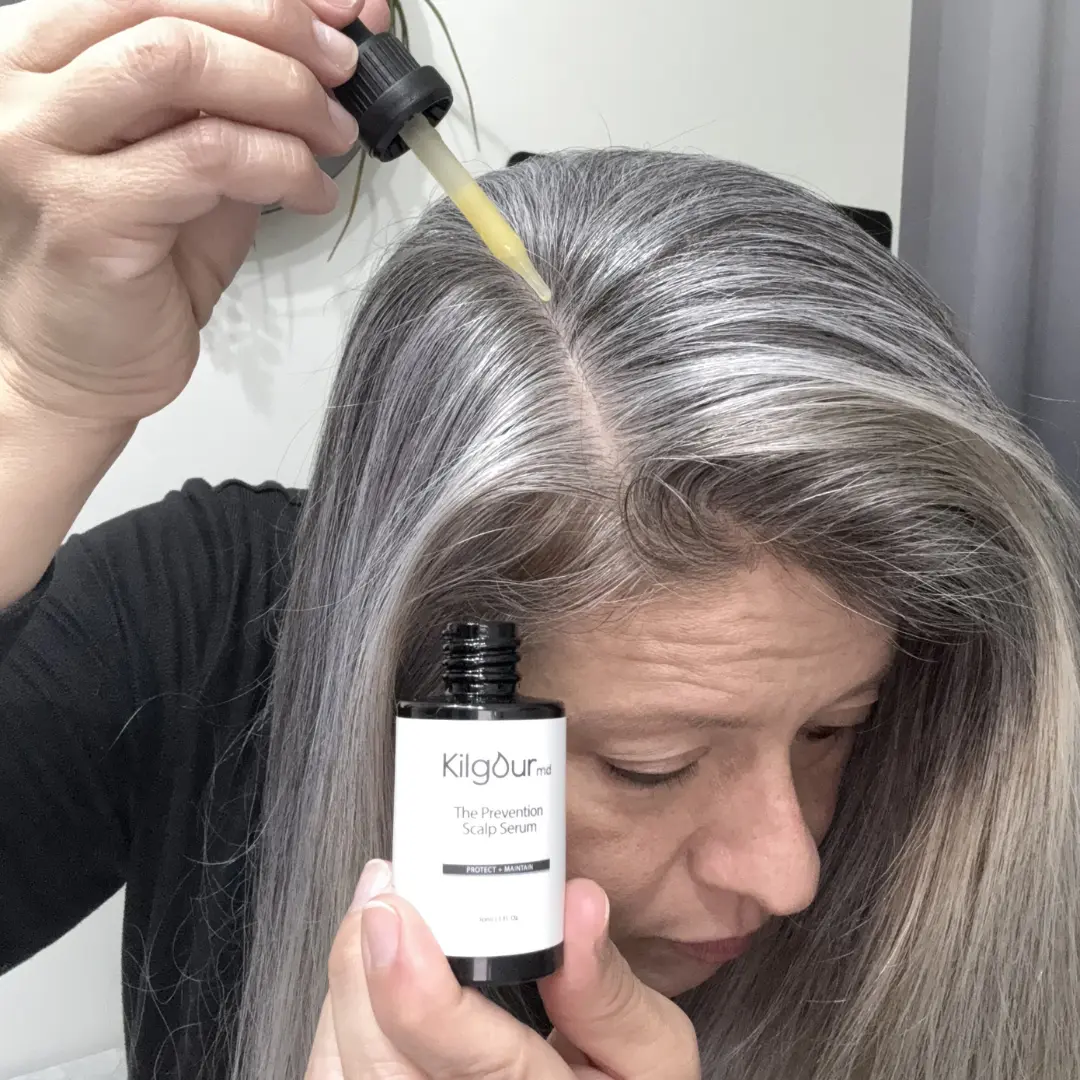
The Prevention Serum stops the active deterioration. It fills the estrogen receptors being vacated by menopause, blocks the DHT that's suffocating your follicles, strengthens your scalp's anchoring capacity, and protects the tissue environment that the PNAS study proved controls everything. This is the shield. Without it, nothing else matters.
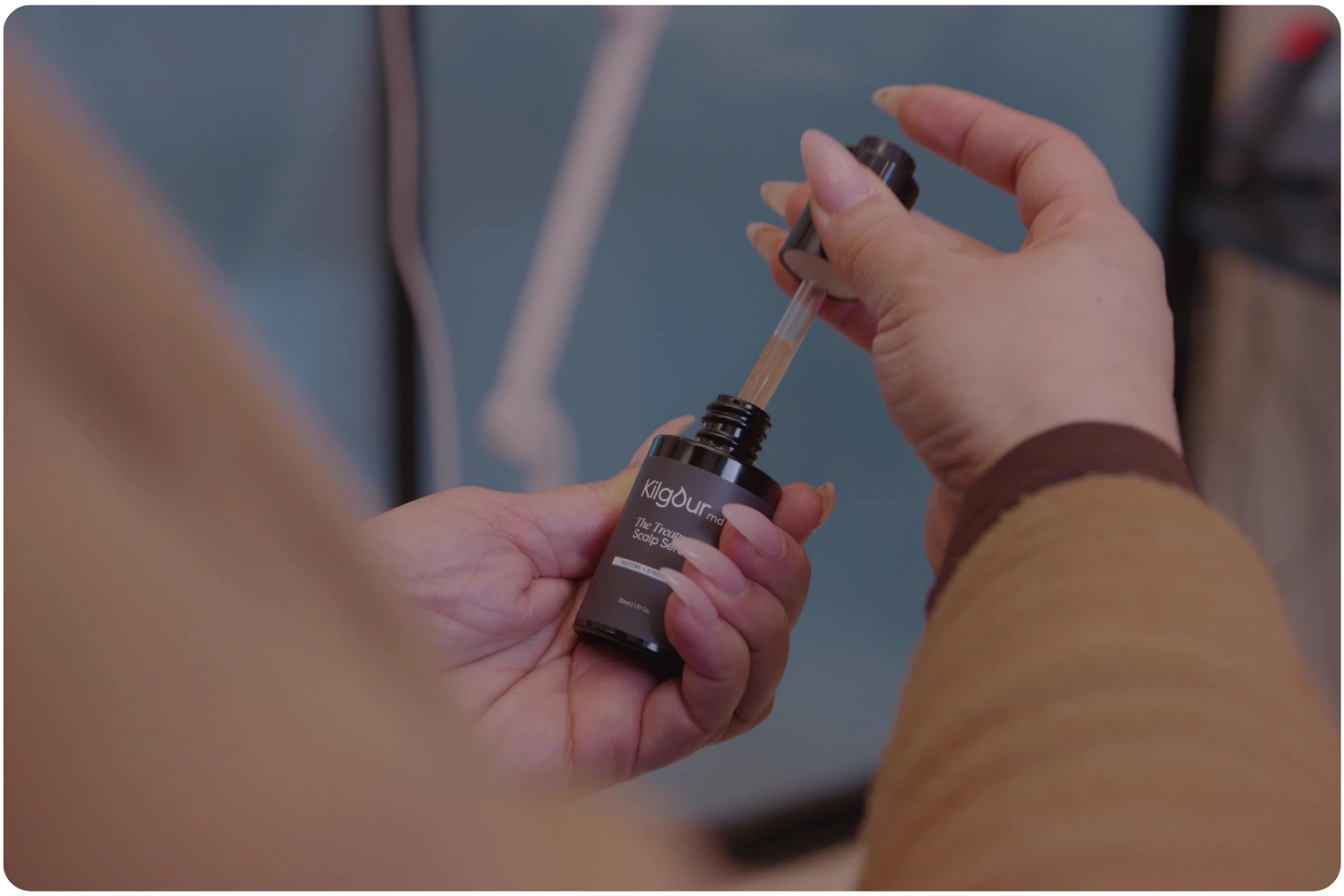
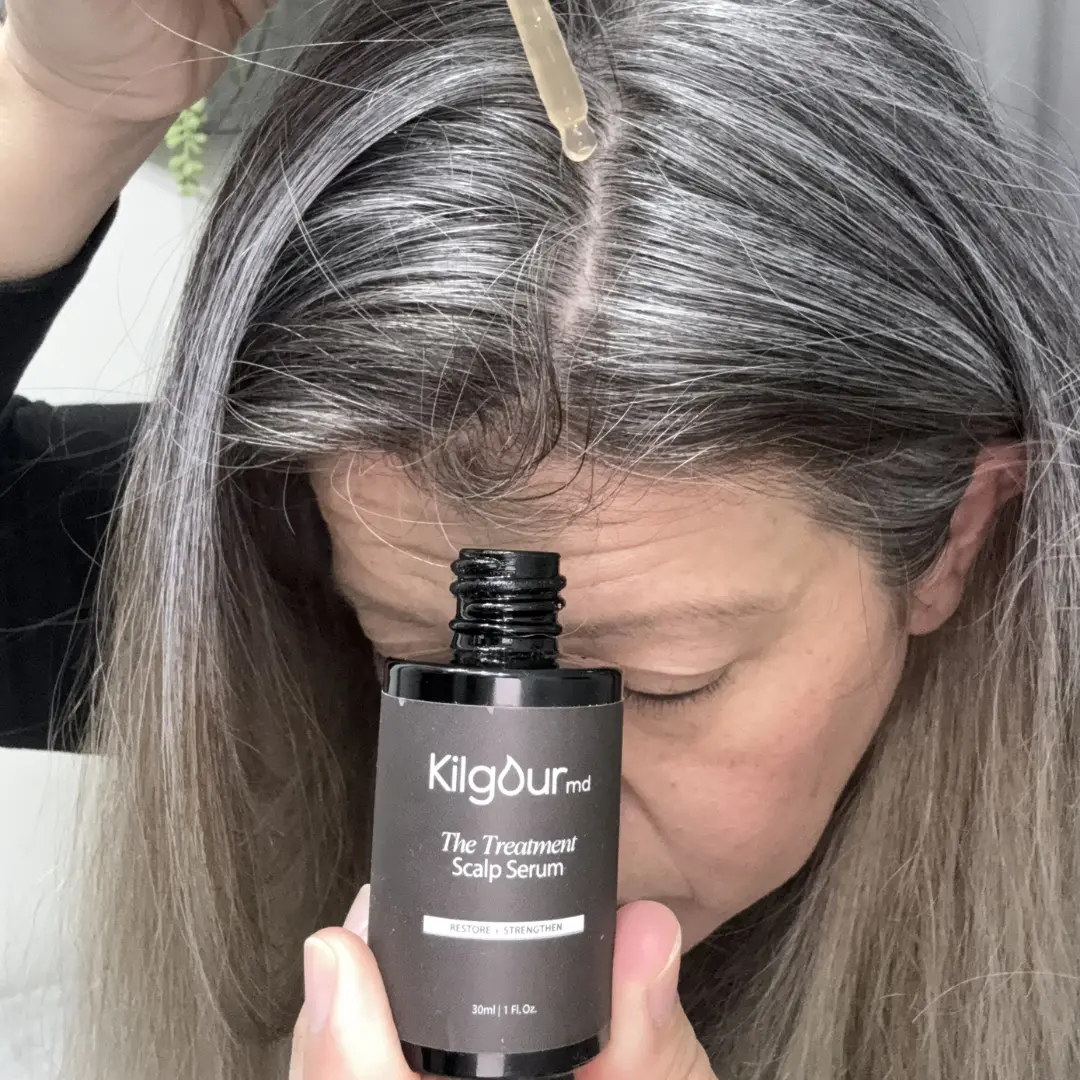
The Treatment Serum wakes up kenogen. It sends direct signals to dormant follicle stem cells, floods them with cellular energy, delivers the keratin building blocks they need to produce real hair, and manages the inflammatory response that comes when thousands of follicles surge back into production at once. This is the wake-up call.
Together, they're the first hair loss protocol specifically built and clinically tested for women in perimenopause, menopause, and postmenopause.
I didn't build this for a product launch. I built it in my mother's bathroom, for my mother, because no one else was going to.
The Routine Takes 30 Seconds
Once a day. In the evening. Prevention Serum first — stabilize the environment. Treatment Serum on top — wake up what's been sleeping.
30 seconds. Before bed. You do it once, you go to sleep, and the compounds go to work while you're not thinking about them.
No dread shed. No facial hair. No dependency — miss a night and your hair doesn't fall out the next morning. This isn't minoxidil. It's not punishing you for skipping a day.
Two serums because the science demands two serums. But the routine is simpler than brushing your teeth.
What Experts Are Saying
I didn't ask these professionals to endorse KilgourMD. I asked them to evaluate the clinical data and the formulation. Their responses were theirs.

"In 19 years advising for L'Oréal, Johnson & Johnson, and working with everyone from Olympic athletes to the British royal family — I've never seen anything hit women's hair as hard as menopause. But when you treat the root cause early, women keep their density and their confidence. Nothing comes close to KilgourMD for that."

"As a PA who's worked directly in hair restoration, I've seen firsthand what happens when the scalp tissue can't support follicles — transplants fail, treatments fail, everything fails. Most topicals target one pathway and ignore the tissue underneath. What stands out about KilgourMD is that it's the first protocol I've seen that addresses the full follicular environment — the inflammation, the collagen scaffolding, the circulation. That's why 98% responded. The follicles weren't dead. The environment was. KilgourMD rebuilt it."

"After nearly 20 years as a dietitian, the biggest misconception I see with menopausal hair loss is that the hair itself is the problem. It's not. It's the cumulative effect of hormonal shifts, metabolic changes, and scalp health declining all at once. KilgourMD is the first thing I've seen that addresses the full picture of the scalp environment."
What Women Are Saying
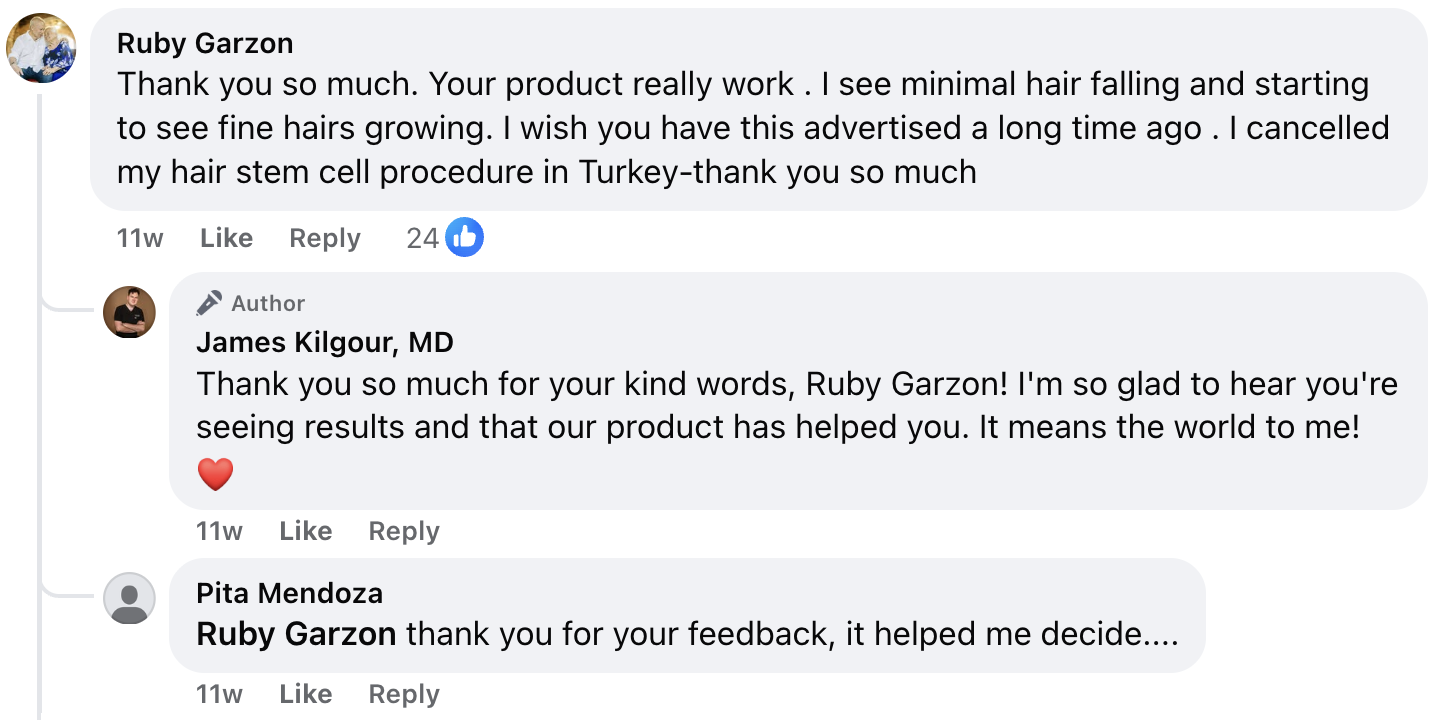
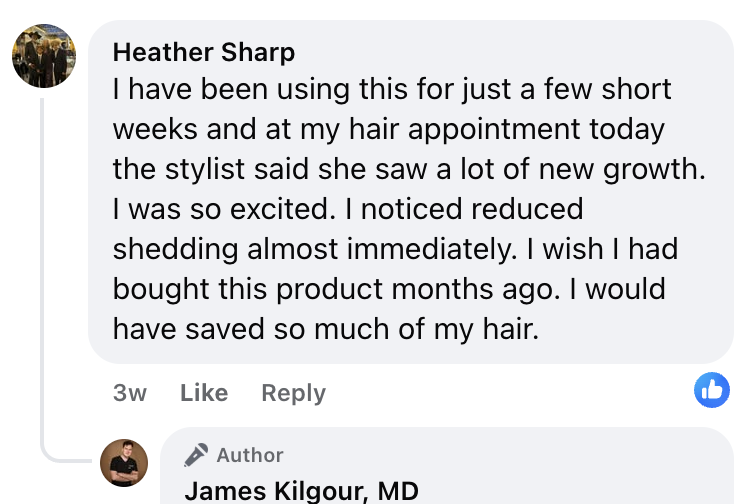
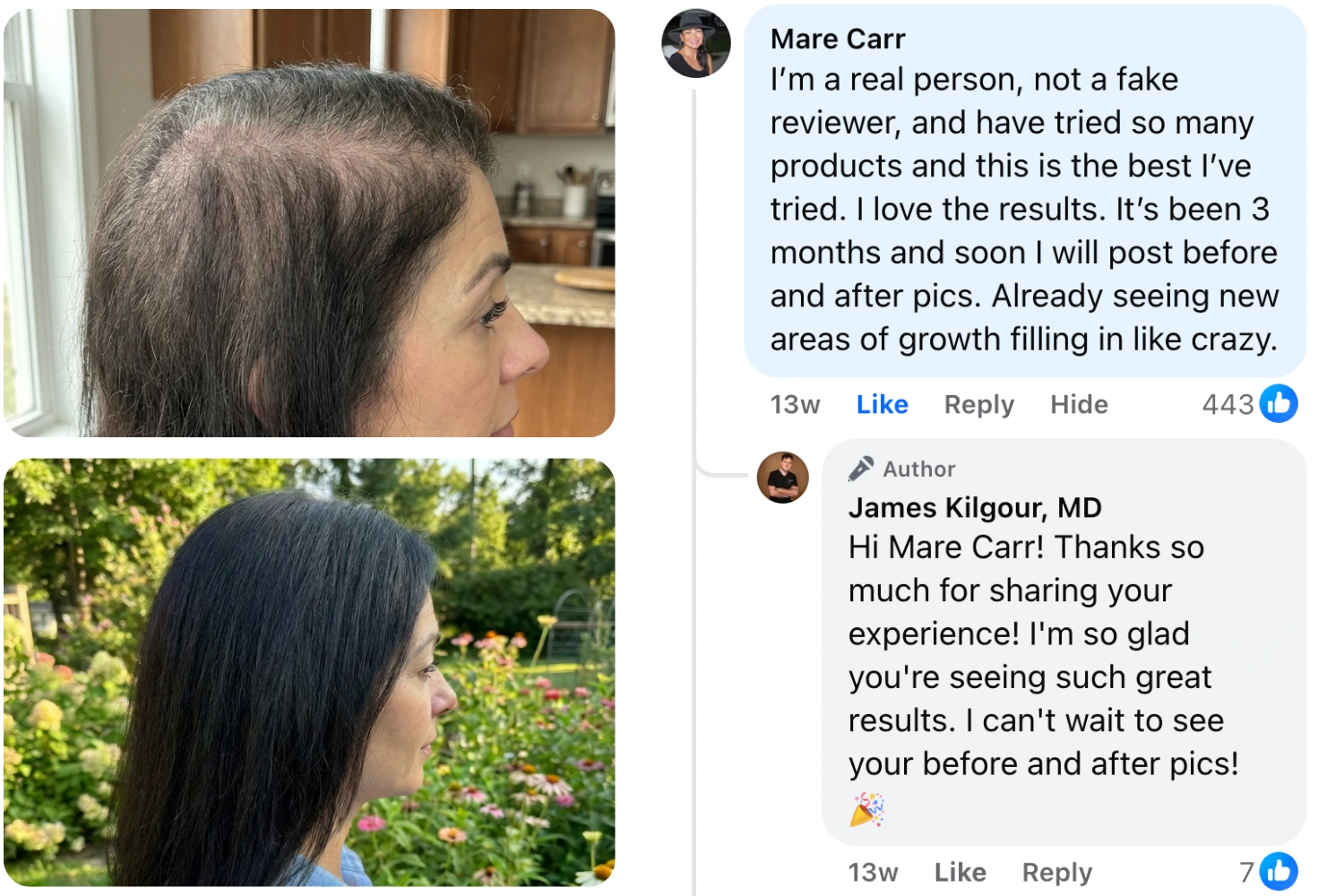
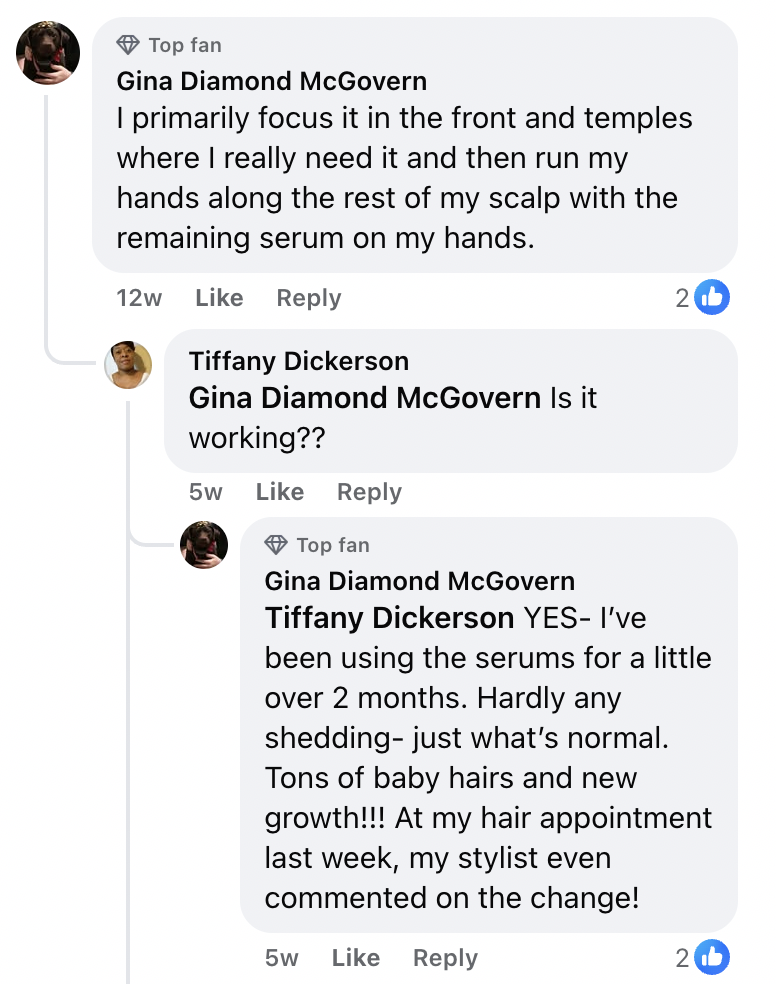
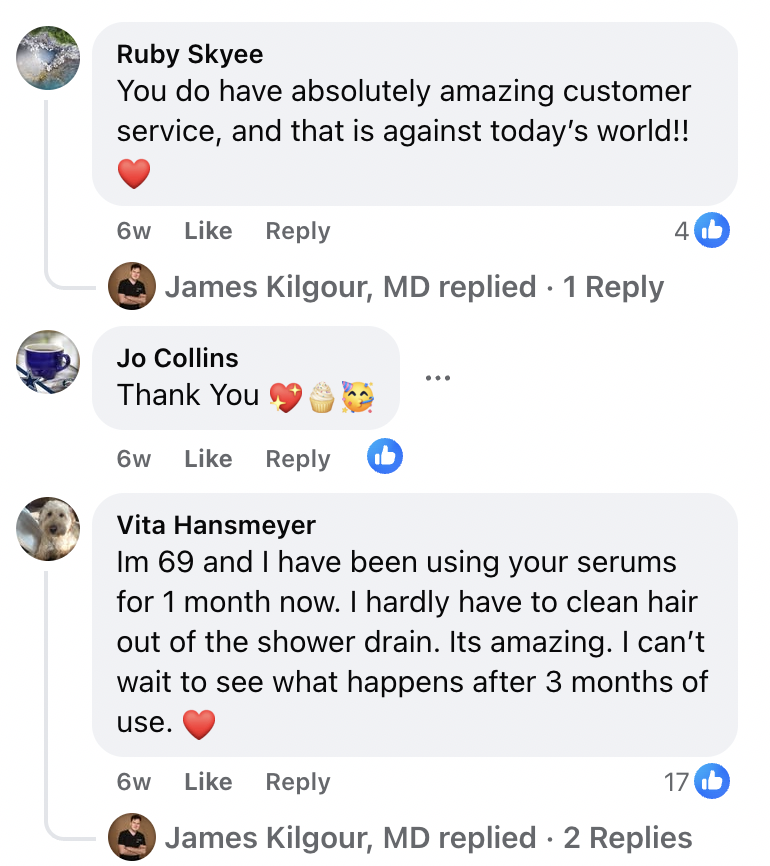
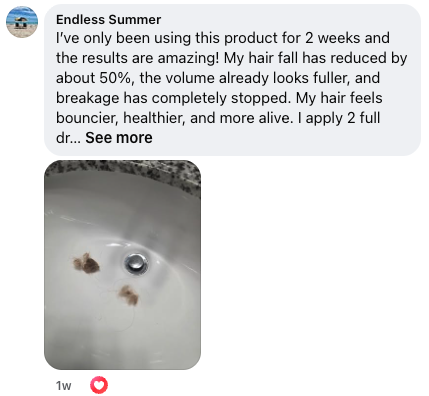
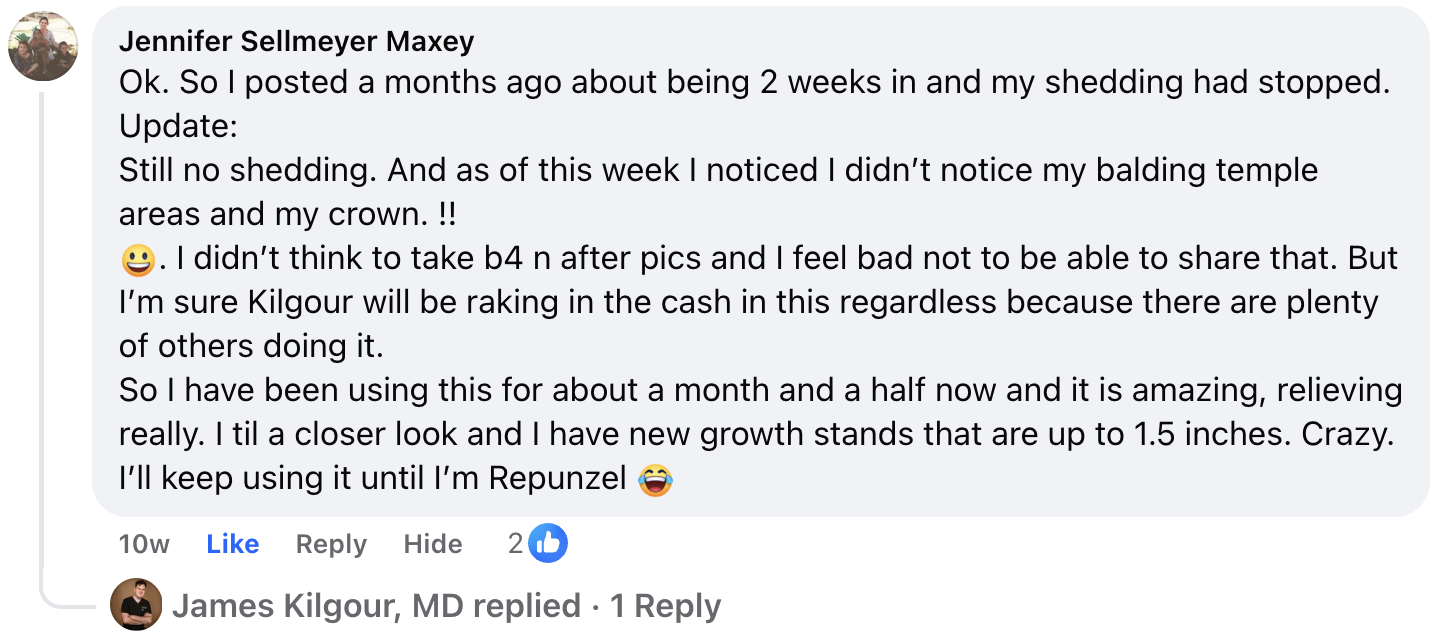
These are real comments from women using the protocol right now.
What Happens If You Start Today
Here's what the clinical data and real-world usage tell us about the timeline. Every woman is different, but this is what the majority of women in our 43-person trial experienced:
Right now, while you're reading this, here's what's still happening on your scalp. DHT is suffocating follicles. Estrogen receptors are sitting empty. Anchoring proteins are degrading. Follicles in kenogen are drifting deeper into dormancy. Every day without intervention is another day the tissue environment deteriorates — and another day the window between "dormant" and "gone" gets narrower.
You open the box. Two serums. That evening, you apply them for the first time — Prevention first, Treatment on top. 30 seconds. Before bed. While you sleep, the pea sprout extract is already boosting two critical growth signals — one by 56%, the other by 85%. Your follicles are receiving a wake-up call they haven't gotten in years. You won't see anything yet. But it's already starting.
The Prevention Serum is rebuilding the tissue environment around your follicles. Estrogen receptors are being filled. DHT is being blocked. Anchoring proteins are strengthening. The deterioration that's been accelerating since perimenopause is slowing for the first time. Beneath the surface, kenogen follicles are receiving sustained signals to reactivate.
This is when most women notice something. Less hair in the brush. Not dramatically — but enough that you stop, look at it, and think "huh." Less in the drain. Less on the pillow. The shedding is decelerating because your scalp can finally hold onto the hair it has.
In our clinical trial, 95% of women saw shedding dramatically decrease by this point. The brush looks different. The drain looks different. The quiet morning panic — the one where you count the strands and try not to think about it — starts to ease. Your scalp isn't pushing out healthy hair anymore. The environment the PNAS study proved controls everything is finally stabilizing.
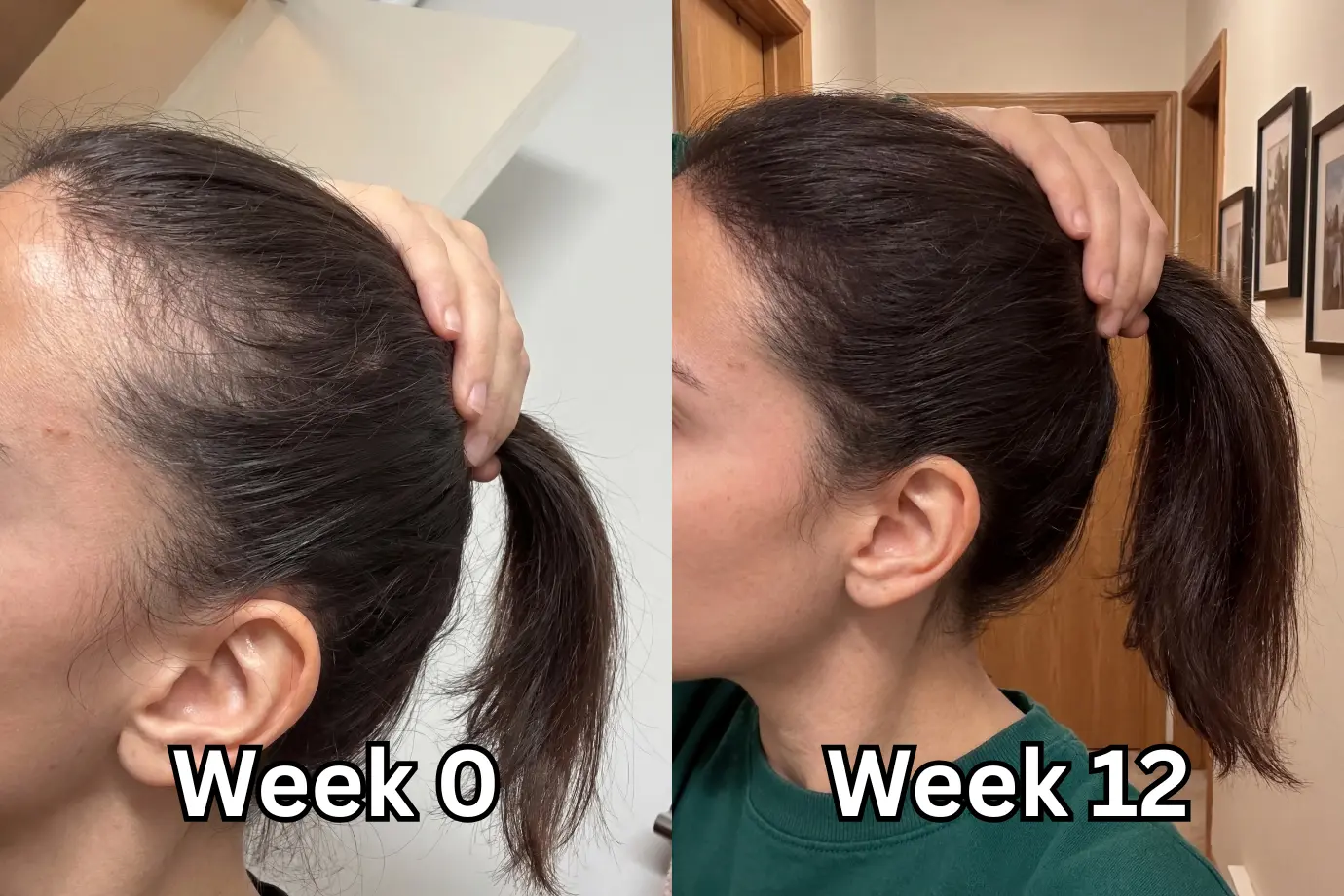
Baby hairs. Fine, short strands along your part line, your temples, the areas that had been thinning for years. These are kenogen follicles — the ones that were alive but paused — producing their first new hair. In the trial, regrowth came 3× faster than minoxidil. And remember — the tree bark compound alone produced over 10,200 new hairs in 84 days. You have 11 compounds working together.
Visible density. A fuller part line. Hair that moves differently because there's more of it. This is what 98% of women in the trial experienced — measurable, visible improvement. Not from a drug. Not from surgery. From a 30-second bedtime routine that restored what your scalp needed to grow hair on its own.
You Have 90 Days to Prove Me Wrong
I'm not asking you to believe me. I'm asking you to test me.
Use both serums. Follow the protocol — Prevention first, Treatment on top, 30 seconds before bed. Do it for 90 days. The same 90 days the clinical trial ran. The same timeline you just read through. Day 4 through Week 12. Every milestone.
If your brush doesn't look different by week six — if you don't see new growth along your part line — if you don't have your own mirror moment by week twelve — email my team. Full refund. Every penny. No forms. No hoops. No "store credit." Your money back.
I can make this promise because 98% of women in our trial responded. When 98 out of 100 women see results, a 90-day guarantee isn't generous. It's obvious.
The only way you lose is by not starting.
The KilgourMD Protocol
The full protocol is two serums. Prevention and Treatment. They work together because the science demands it — you can't solve two biological problems with one formula.
Prevention without Treatment means you stop the deterioration but never wake up the 25,000 follicles sitting in kenogen. Treatment without Prevention means you reactivate follicles into the same hostile environment that shut them down. They need each other.
Right now, the bundle is 38% off.

The same two serums that produced a 98% response rate in a 43-woman clinical trial. Evaluated by Dermaclaim — an independent third-party organization with zero stake in the outcome. 95% saw shedding drop by week six. Regrowth 3× faster than minoxidil. Zero side effects.
30 seconds. Before bed. That's the routine.
If you've read this far, you already know something is wrong. You've seen it in your brush every morning. You've felt your ponytail getting thinner between your fingers. You've tilted your head in the bathroom mirror trying to avoid the light that shows your scalp.
That's not damage. That's kenogen. Up to 25,000 follicles — four full hair transplants worth of hair — paused right beneath your scalp. Waiting for a signal your scalp can no longer send.
This protocol is that signal.
Built by a Stanford dermatologist who watched his mother go through the same thing you're going through right now. Tested on women in perimenopause, menopause, and postmenopause — not men in their twenties. Not repurposed. Not "probably fine for you too."
Built for you. Tested on women like you. Working for women like you right now.