


A Stanford Dermatologist Warns: Your Shampoo Is Triggering the Exact Hair Loss It Claims to Prevent
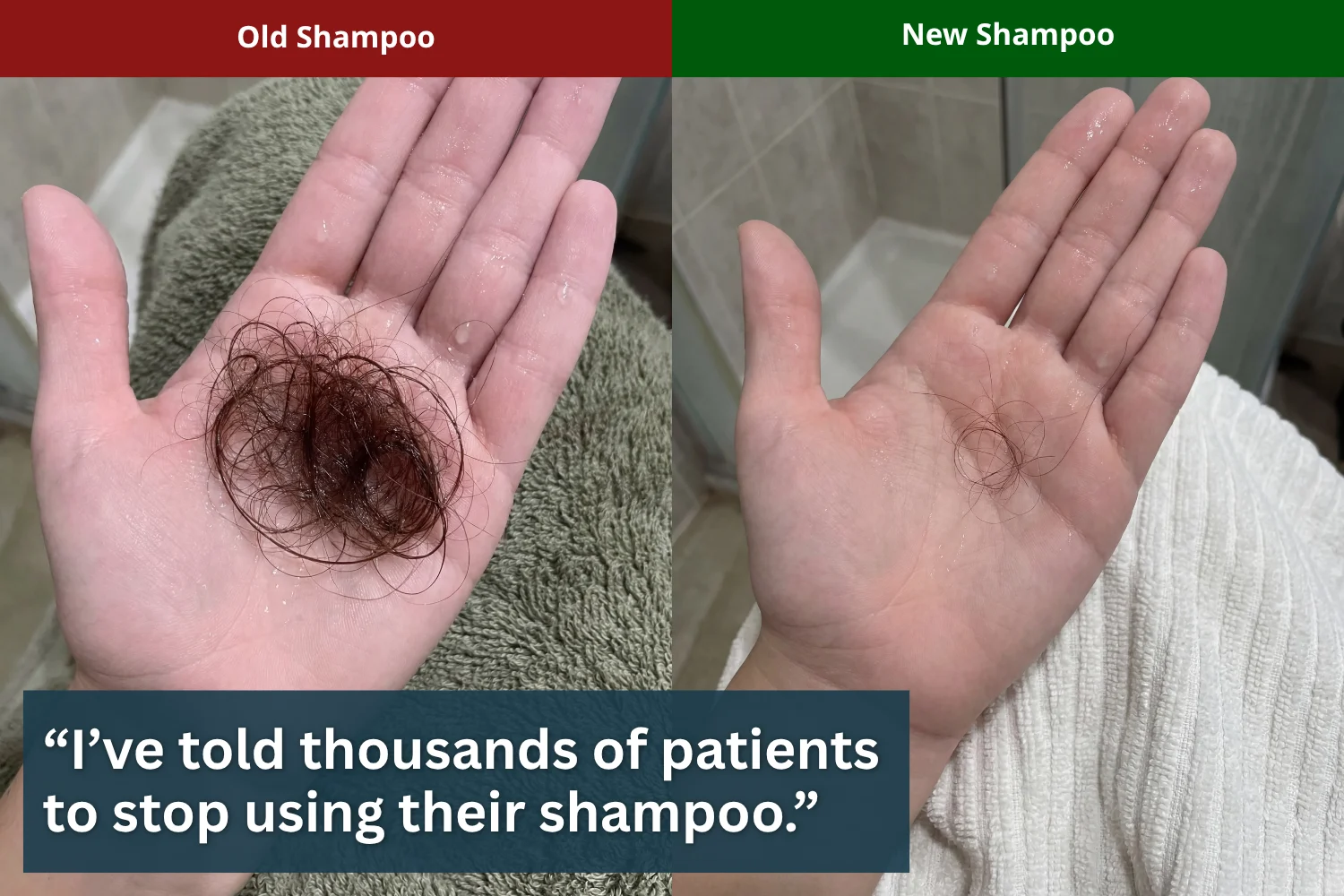
Every week I talk to women about their hair. Thousands of them at this point.
And something keeps coming up that I can’t stay quiet about anymore.
They sit across from me and the first thing they describe — before the thinning, before the part line, before any of it — is wash day.
They tell me they’ve changed how they wash. They’re gentler now. Fingertips instead of nails. They don’t scrub the way they did at 30. They rinse carefully, tilting their head so the water runs down instead of pushing through.
And when they’re done — before they reach for the towel — they look down.
The drain.
They count. They don’t mean to. They just do. And they do the math in their head and tell themselves it’s normal. Fifty to a hundred hairs a day. They read that somewhere.
But then they tell me the thing that made them book the appointment.
It’s always worse on wash day.
The days they don’t wash — dry shampoo, hair up, skip it — the shedding is manageable. Almost forgettable. Then they wash. And it’s in their hands during the lather. Sliding down their forearm in the rinse. The drain. The brush afterward.
They’ve noticed this pattern so clearly that they’ve done the logical thing: they wash less often. Stretched from every day to every other day. Maybe every three days.
When I hear this — and I hear it every single week — I ask them one question.
What’s in your shower right now?
And the answer is always the same. A “volumizing” or “strengthening” shampoo. A silicone conditioner. Maybe a “scalp care” rinse. Products from brands you’d recognize instantly. Products that cost anywhere from $8 to $60. Products that say “menopause-friendly” or “age-defying” or “clinically tested” on the label.
And every single time, I can trace the shedding back to what’s in those bottles.
Their shampoo is causing a shedding event every time they wash. And it’s been doing it since their estrogen started to drop.
And the reason why has nothing to do with what’s printed on the label — and everything to do with what’s happening underneath your scalp right now. Something that changed years ago that nobody told you about.
What’s Actually Happening on Your Scalp Every Time You Wash

When estrogen begins to decline — and this starts in perimenopause, years before menopause is official, which means most women have been dealing with this longer than they realize — three things change on your scalp at the same time.
The first is inflammation. Your scalp shifts into chronic, low-grade inflammation — up to six times higher than before estrogen dropped. You can’t see it. You can’t feel it most days. But it’s there, surrounding each follicle, feeding an enzyme called 5-alpha reductase that converts testosterone into DHT. DHT is the molecule that shrinks follicles cycle after cycle until the hair they produce is too thin, too weak, and too poorly anchored to survive a wash.
The second is your barrier. Estrogen maintained a lipid layer on your scalp — a protective seal that kept moisture in and irritants out. When estrogen drops, that barrier breaks down. Your scalp becomes exposed, reactive, defenseless.
The third is your growth window. Every strand used to get four to six years to grow — to come in thick, anchor deep, build density. That window collapses to two to three years after estrogen drops. Your follicles aren’t producing fewer hairs. They’re producing hair that doesn’t have time to finish.
Now here’s what your shampoo does to all three of those problems.
Sulfates — the foaming agents in virtually every shampoo, including most that say “gentle” or “color-safe” on the label — are industrial degreasers. They’re in your dish soap. They’re in your car wash solution. And three to four times a week, you massage them into a scalp that’s already inflamed, already barrier-compromised, already struggling to hold onto hair.
Every wash: sulfates strip the barrier. Inflammation floods in unopposed. The enzyme activates. DHT attaches to the follicle. The follicle loosens. The hair comes out in your hands.
Then you condition. Your conditioner coats every surviving strand in silicone — a heavy polymer designed to fake smoothness. On hair that’s already lost up to 30% of its diameter, that silicone is dead weight on a weakened structure. Your hair looks full for an hour after the blow-dry. Collapses by lunch. Limper by dinner than before you washed.
And the two ingredients every “hair loss” shampoo uses instead? One treats a condition you don’t have. The other needs a mineral your body stopped delivering years ago.
I Started Testing What My Patients Were Washing With
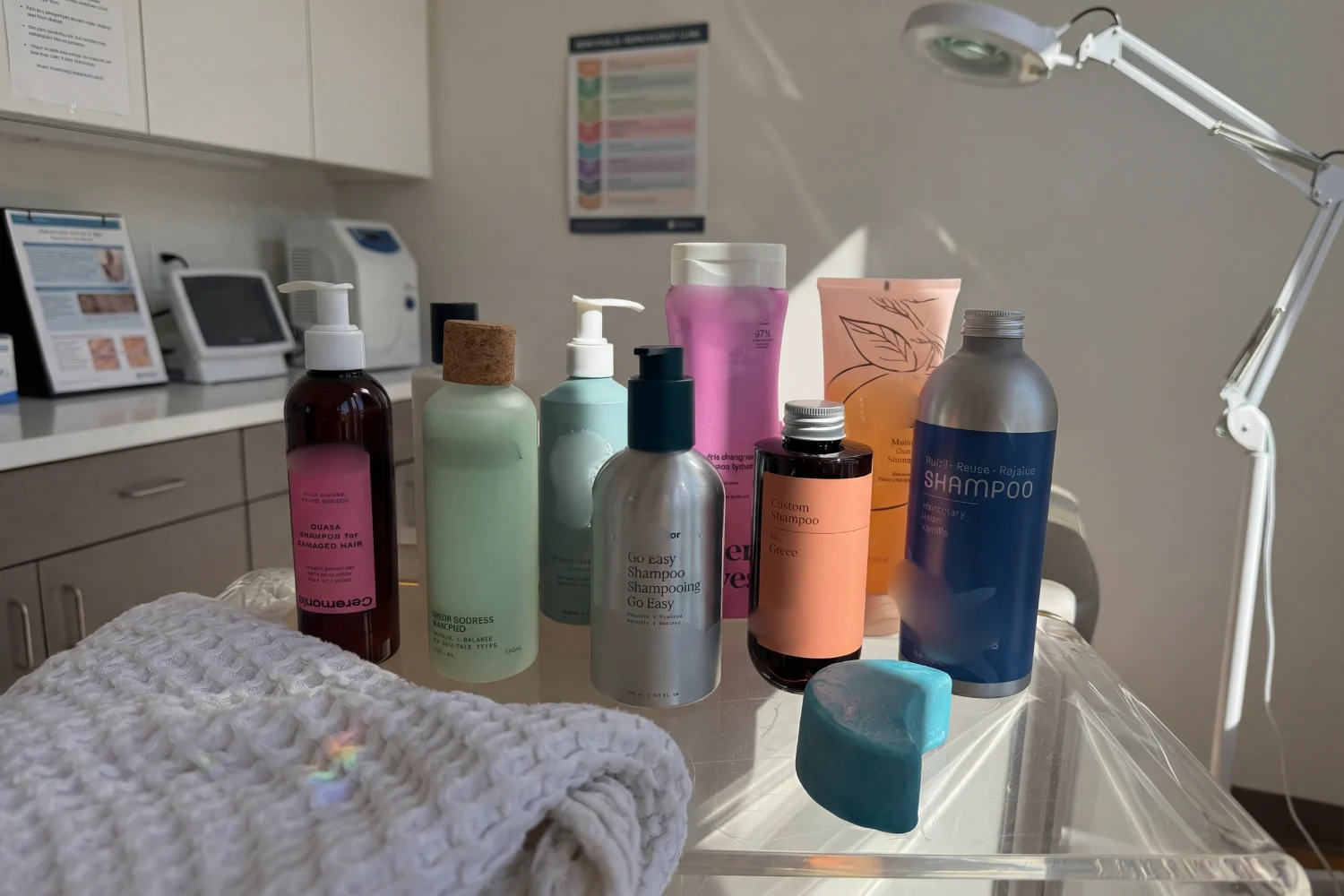
I didn’t start with a formula. I started with shower caddies.
I asked my patients to bring in their bottles. Not tell me the brand — bring in the actual products. And I broke down every ingredient list against what I knew was happening on their scalps.
The same ingredients kept appearing. Over and over. In every bottle from every brand at every price point.
And not a single one addressed inflammation. Not a single one blocked DHT. Not a single one rebuilt the barrier. Not a single one was designed for a scalp undergoing hormonal decline.
What I found instead made me angry. Not because the science wasn’t there. Because nobody had bothered to look.
Let me show you what’s actually in your shampoo right now — and what should be there instead.
Your Shampoo Uses Sulfates. Here’s What Should Be There Instead.
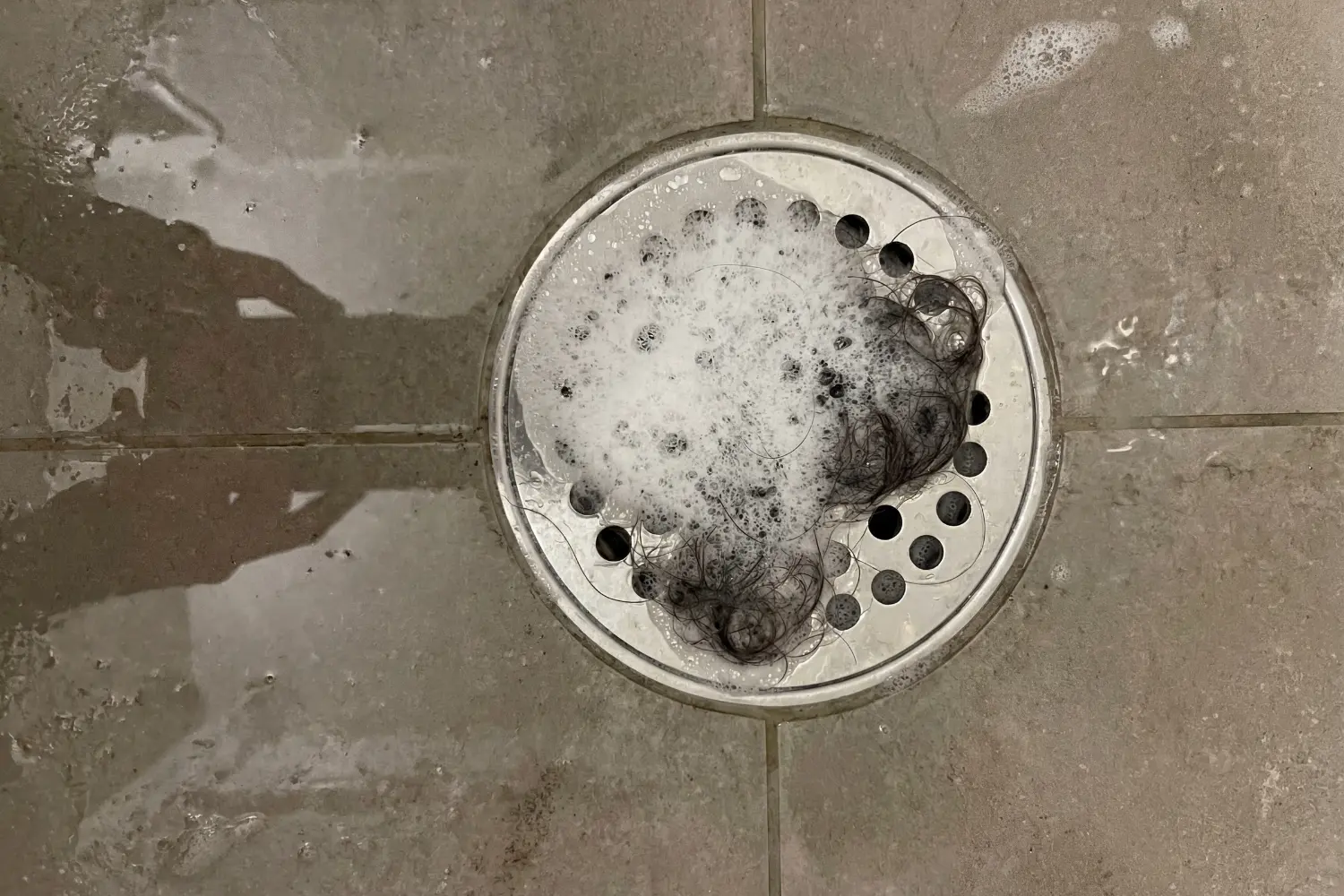
Sulfates foam. That’s why the industry uses them. Foaming feels like cleaning.
But on a scalp with six times more inflammation and a broken lipid barrier, sulfates are gasoline on a fire. You already know what happens next — the cascade I just described. Barrier stripped. Inflammation flooding in. DHT activated. Follicle loosened. Hair in your hands.
“Sulfate-free” brands remove sulfates. That’s it. They don’t replace them with anything that addresses what’s actually happening on your scalp.
So the question becomes: what SHOULD be there instead? What compound could calm the inflammation AND block the enzyme it was activating — at the same time, during a normal wash?
That compound exists. It’s called CutiBiome CLR.
It’s a plant-derived complex that was tested specifically on inflamed scalp tissue. Not skin. Not generalized redness. Scalp tissue. In clinical testing, it reduced scalp inflammation by 74.5% in four weeks. And it blocks 5-alpha reductase — the enzyme that converts testosterone into DHT — topically, from a plant complex, during a normal wash.
One compound. Two mechanisms. Calms the fire AND cuts off the DHT production that the fire was fueling.

Plant-derived complex. Blocks 5-alpha reductase topically. Calms chronic scalp inflammation.
Why isn’t this in every shampoo on the market?
Because sulfates are cheaper. And they foam.
The Two “Hair Loss” Ingredients That Aren’t Solving Hair Loss
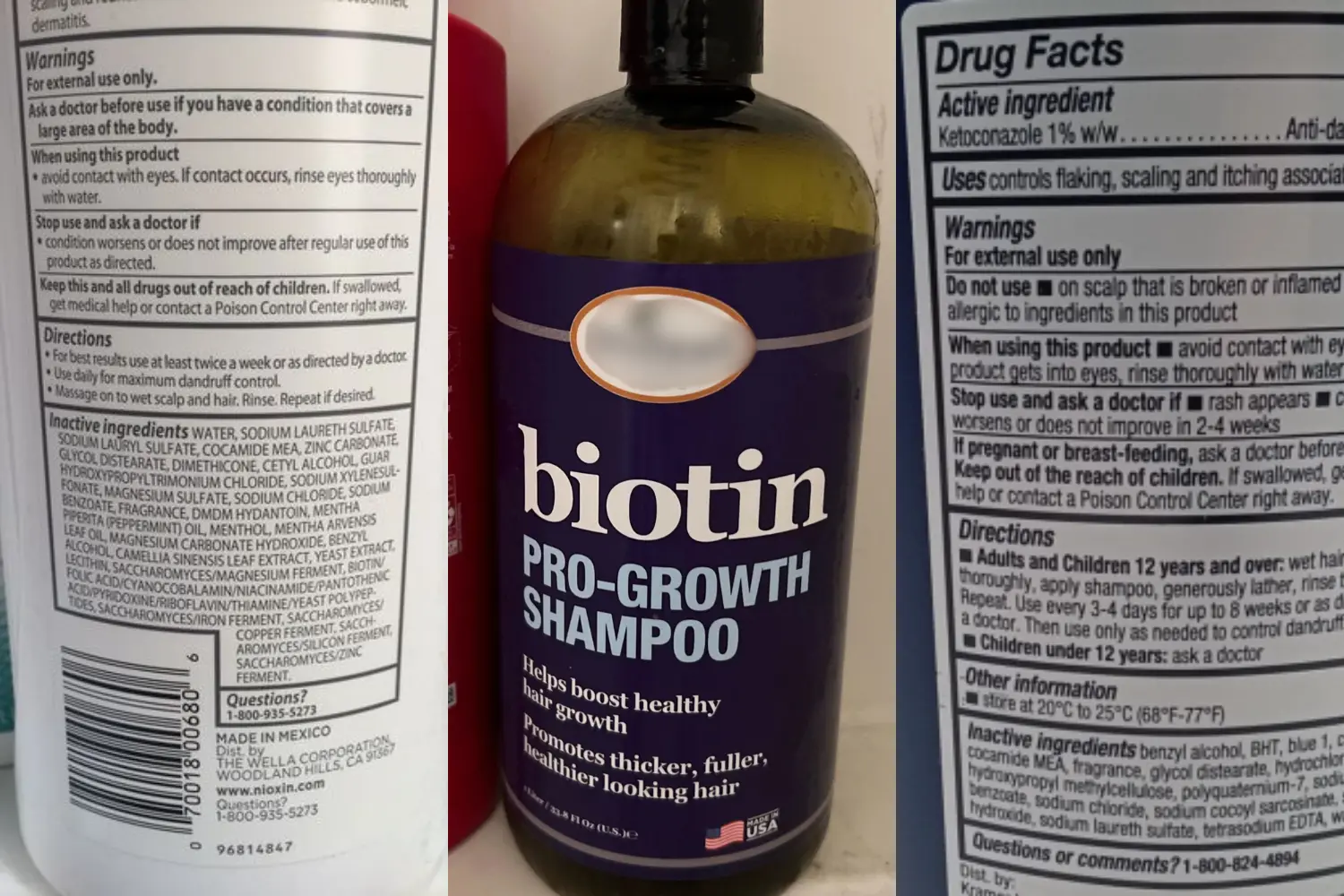
When my patients tell me they’re using a “hair loss” shampoo, it almost always contains ketoconazole or biotin.
Ketoconazole is an antifungal. It treats dandruff — a fungal condition caused by a yeast called Malassezia. If your scalp has been dry or flaky since your early forties, someone probably told you that’s dandruff. It’s not. It’s hormonal. Estrogen maintained a lipid layer. The layer broke down. Your scalp is dry because of a hormone, not a fungus.
You’ve been treating the wrong condition with the wrong ingredient. Three to four times a week.
Biotin builds keratin. But keratin needs building blocks — zinc, iron, copper. After estrogen drops, your body sends those minerals to your heart first. Your hair gets whatever’s left over. Which is almost nothing. Biotin without those minerals is like hiring builders and giving them no materials.
These are the two most common ingredients in “hair loss” shampoos in America. And neither one addresses inflammation, DHT, or barrier breakdown. Not even close.
So what should replace ketoconazole?
A compound called Piroctone Olamine. It was tested head-to-head against ketoconazole in a six-month clinical study. 150 women. Published, peer-reviewed. It won on every measure. 7.9% more hairs in active growth phase versus ketoconazole’s 4.4%. A 7.7% thicker shaft versus ketoconazole’s 4.0%. Not by treating a fungal infection you don’t have — by directly extending the window each strand gets to grow before the follicle pushes it out.

Extends the growth window each strand gets before the follicle pushes it out.
And the barrier? The lipid layer that every anti-dandruff shampoo ignores because the industry still thinks dryness means fungus?
There’s a compound called Patchoul’Up that is the first ingredient I’ve ever found designed specifically for menopausal scalp dryness. Not repurposed from dandruff research. Not borrowed from eczema studies. Built for this. It restores sebum production by 39% and rebuilds the moisture barrier from the inside. Closes the door inflammation has been walking through every wash.

Rebuilds the lipid barrier estrogen used to maintain. First compound designed for menopausal scalp.
Three compounds that exist right now in published research. CutiBiome CLR for inflammation and DHT. Piroctone Olamine for the growth window. Patchoul’Up for the barrier. Three problems solved.
Not one of them is in the shampoo sitting in your shower right now.
But even if the shampoo problem were solved, the conditioner would undo it within sixty seconds.
Your Conditioner Is Crushing What’s Left
Every patient I see with volume loss is using a silicone conditioner. Every single one.
And every single one tells me the same thing: it looks good for about an hour after the blow-dry. Then it’s gone.
Here’s why.
Estrogen used to maintain a natural protective coating on every strand. When estrogen dropped, that coating disappeared. Instead of replacing it, the conditioner industry said: “Here’s some silicone.”
On hair that’s already lost up to 30% of its diameter, silicone is dead weight on a weakened structure. You blow-dry it, the heat puffs the silicone for an hour — that’s your “volume.” Then gravity wins. Because it was always going to win.
And the moisture? Silicone doesn’t moisturize. It seals the cuticle shut so nothing gets in or out. Smooth in the shower. Straw-like by morning. The silicone wore off. The dryness was there the whole time.
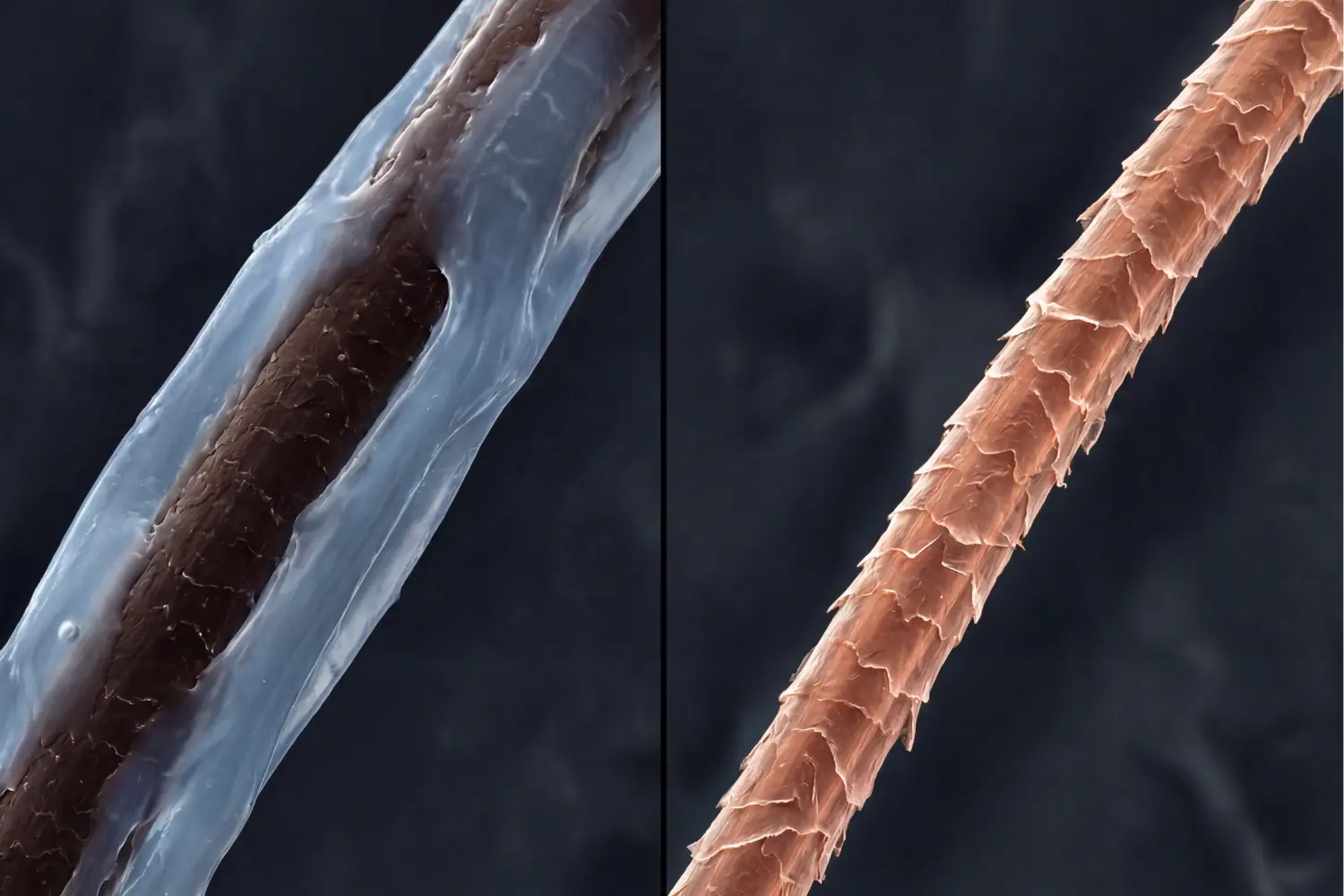
What should a conditioner actually be doing? Two things. Getting real moisture inside the strand. And replacing the protective coating estrogen used to maintain.
There’s a hyaluronic acid that was engineered to do something no conditioner ingredient has ever done — get INSIDE the strand. Not coat it. Not seal it. Penetrate it.
It’s called ResistHyal. It’s a low-molecular-weight hyaluronic acid engineered to penetrate the cuticle and reach the cortex — the interior of the strand. Raman spectroscopy — laser imaging that shows exactly where a molecule ends up inside the hair — confirmed it penetrates 5.9 times deeper than conventional hyaluronic acid. It locks 189 times more moisture into the strand than silicone delivers on the surface. And the strand physically plumps. 48% more volume. Not from coating. From hydration within the cortex. Structural. There at dinner. There the next morning.

Low-molecular hyaluronic acid. Penetrates the cuticle. Hydrates from inside the cortex.
But moisture and volume don’t solve the coating problem. The protective layer estrogen used to maintain is still missing. Every strand is hydrated but exposed.
The compound that solves this has eluded the beauty industry for decades — because they kept using synthetic versions of something that only works in its bioidentical form.
It’s called Silkgel Neo. It’s a recombinant silk protein — bioidentical to the proteins that naturally coat healthy hair. It bonds to the cuticle the way the estrogen-maintained coating used to bond. Repairs 72% of thermal damage. Zero buildup. The two-week carousel where a new conditioner feels amazing then your hair goes heavy and dull — that’s silicone accumulating. Silkgel Neo doesn’t accumulate. It bonds and it stays.

Recombinant silk protein. Replaces the protective coating estrogen used to maintain.
One gets inside the strand and restores diameter from within. The other coats the outside and replaces what estrogen maintained. Together, they do what silicone has been pretending to do for twenty years.
Neither one is in the conditioner sitting in your shower right now.
The Baby Hairs That Never Make It
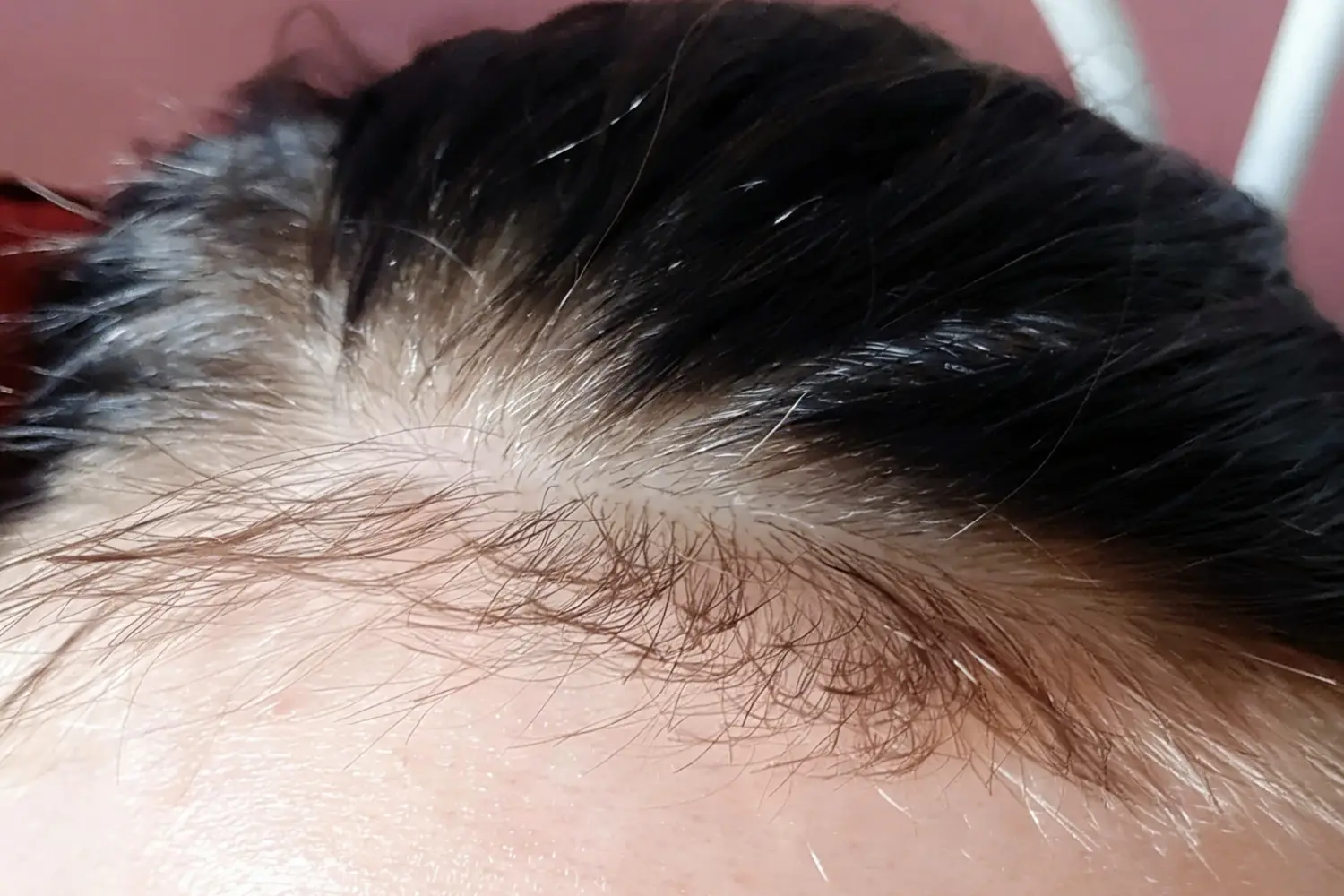
This is the one that gets me.
A woman comes in. The shedding has calmed down. The volume is starting to come back. She’s hopeful for the first time in years.
Then she shows me her hairline. These tiny hairs — quarter inch, half inch — growing in. New growth. The follicle is actually producing again.
And she asks me: will these make it?
Most won’t. Not because the follicle failed. Because after estrogen drops, the internal structure of each strand — the cortex, the load-bearing interior — becomes depleted. Almost hollow. The strand grows in but it can’t survive daily life. Brushing. A pillowcase. Wind. It snaps off before it ever reaches visible length.
There’s one compound I’ve found that changes the answer to that question. It’s called Kerashaft V, and it does something no conditioner ingredient was designed to do — it rebuilds the interior of the strand from within. It penetrates the cuticle and bonds within the cortex, filling the structural gaps estrogen depletion left behind. In testing, it thickened the shaft by 17% and reduced breakage by 64%.
Those baby hairs reach half an inch. An inch. Two inches. They become real hair.
That’s the difference between “new growth” and “new hair.” Growth is what the follicle produces. Hair is what survives long enough to see.

Penetrates the cortex. Rebuilds internal keratin structure estrogen depletion hollowed out.
The Mineral Problem Biotin Can’t Fix
Remember what I said about biotin needing minerals your body isn’t delivering?
After estrogen drops, your body initiates nutrient triage. Heart gets minerals first. Then brain. Then bones. Then immune system. Your hair is dead last. Gets whatever’s left over. Which is almost nothing.
This is why oral supplements don’t work the way the industry promises. You swallow the minerals. Your body absorbs them. Then sends them to every organ that outranks your hair. The supplement industry knows this. They sell biotin at enormous margins because it sounds scientific and it’s cheap to produce.
You can’t supplement your way past a priority queue. The only way to bypass it is to skip the queue entirely — deliver the minerals directly to the strand, topically, during a normal wash.
The compound that makes this possible is called Bio-Chelate 5 PF. Five essential minerals — zinc, iron, copper, silicon, magnesium — in chelated form. Delivered topically, directly to the strand, during a normal wash. Bypasses the digestive system entirely. Bypasses the prioritization queue entirely. Biotin finally has its building materials. Not from a supplement that gets rerouted. From a delivery system that skips the line.

Five essential minerals delivered topically, bypassing your body’s nutrient triage.
Nine Compounds. Zero Products.

That’s what kept stopping me.
Nine compounds. All published. All clinically tested. All sitting in research journals that nobody in the hair care industry was reading.
And not a single shampoo or conditioner on the market uses any of them. Not the $8 drugstore bottles. Not the $60 salon brands. Not the “menopause-friendly” lines. None of them.
Every brand is still formulating with sulfates, silicones, ketoconazole, and biotin. Ingredients designed for a scalp that doesn’t exist anymore after 40.
I couldn’t tell one more patient to “try a gentler shampoo” knowing what I knew. So I spent a year building it myself. I sourced every compound at the concentrations used in the published studies — not trace amounts for a label claim. I worked with manufacturers who’d never been asked to put the most patented ingredients for any wash routine in a single wash system before.
The result is two bottles.
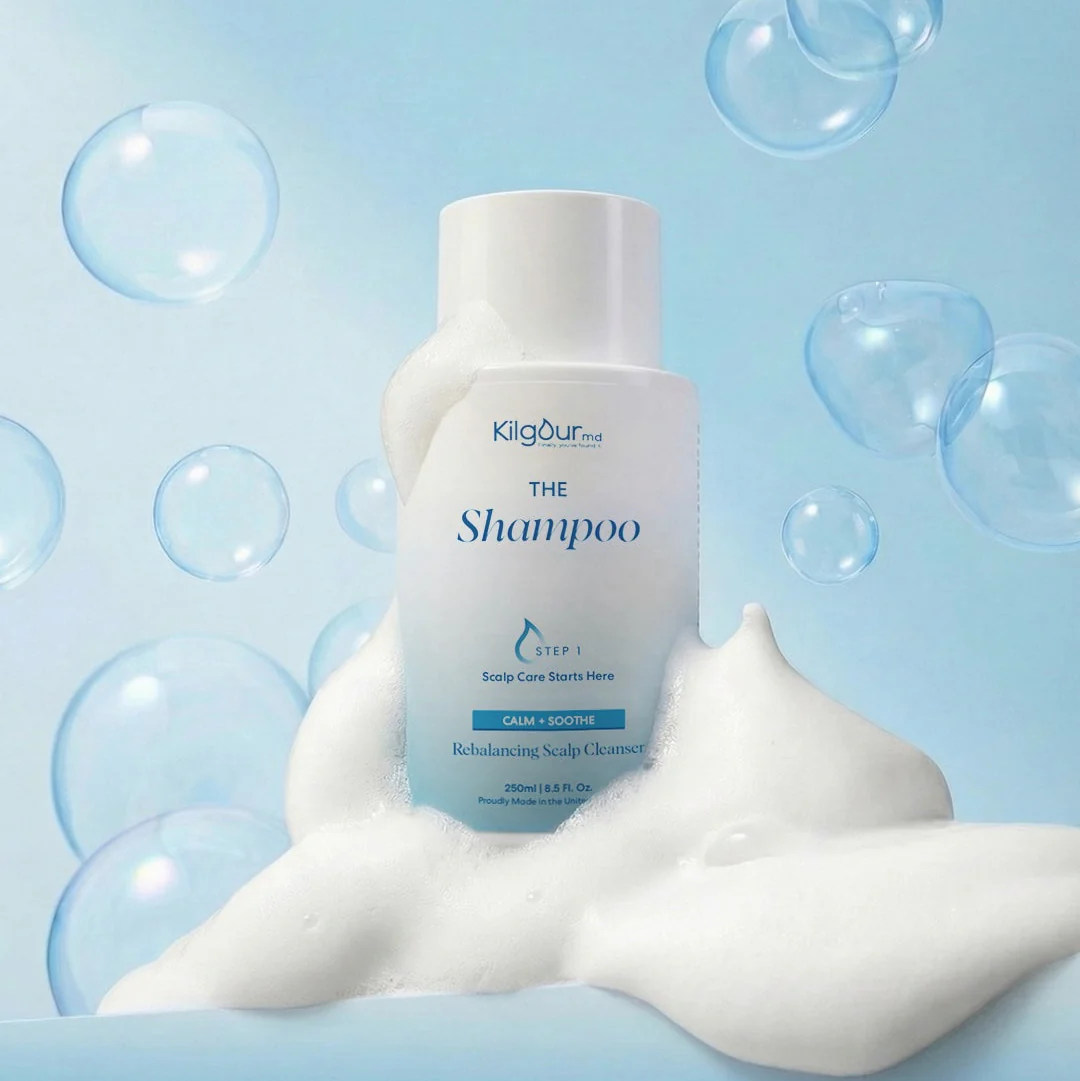
Calms your scalp while it washes. No sulfates. No stripping.
CutiBiome CLR · Calms inflammation
Piroctone Olamine · Extends growth
Patchoul’Up · Repairs lipid barrier
 Resveratrol · Shields follicles
 Panthenol · Penetrates strand core
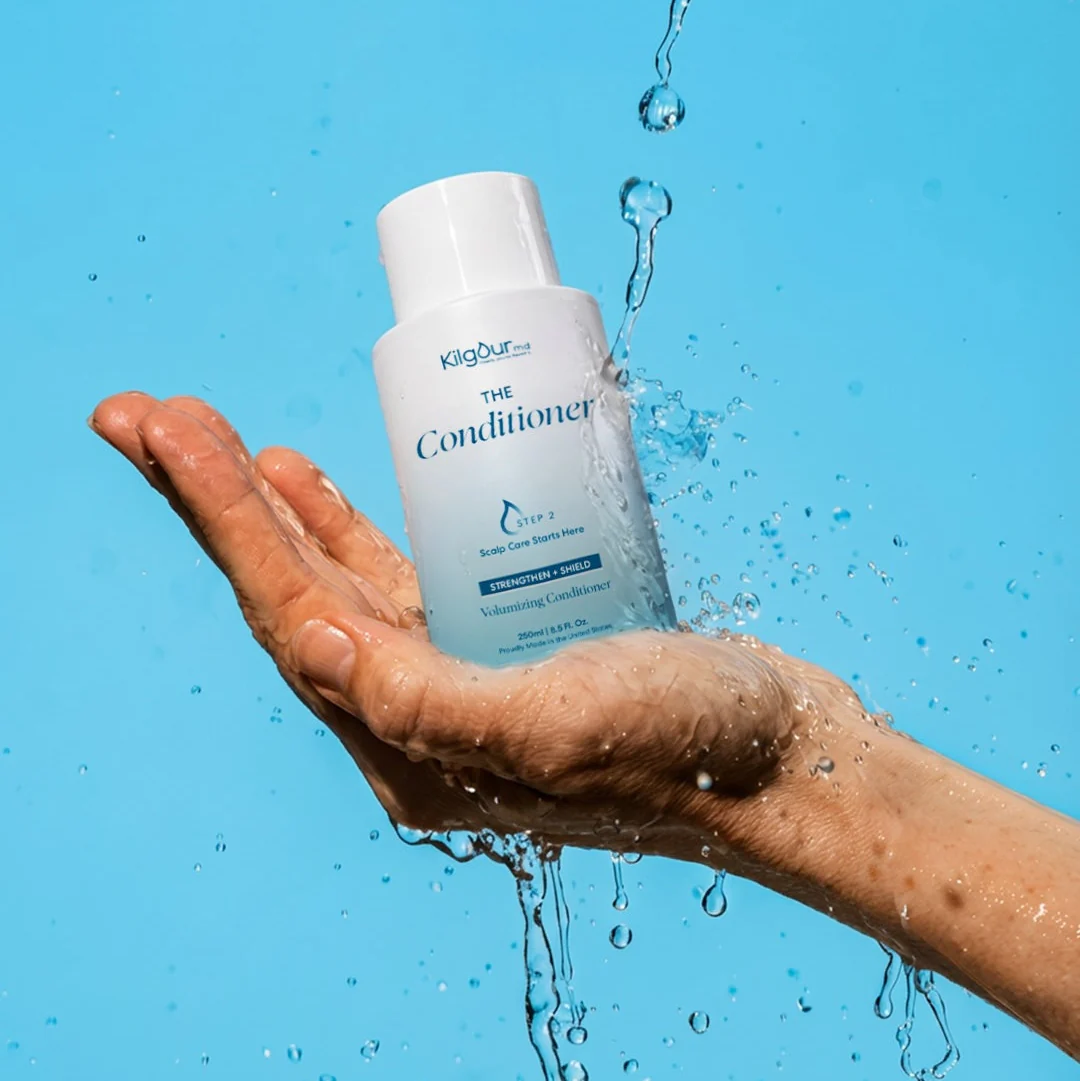
Volume that’s still there at dinner. Hydrates from inside the strand.
ResistHyal · Deep hydration
Kerashaft V · Thickens strands
Silkgel Neo · Thermal repair
Bio-Chelate 5 PF · Mineral delivery
Same shower. Same routine. Same time. You’re not adding steps. You’re replacing what’s already sitting in your shower with something that was actually built for the scalp and hair you have right now.
It costs about a dollar per wash. Less than most women spend on the shampoo that’s making things worse.
What Happens When You Make the Switch
Here’s what happens when you order today and make your next wash the first one that’s actually working FOR your hair instead of against it.
You step out of the shower, blow-dry the way you always do, and something is different. More lift at the roots. More fullness through the mid-lengths. You didn’t change your routine. You didn’t add mousse or root clips. Your hair just has more body — because for the first time, it’s being hydrated from the inside instead of weighed down from the outside.
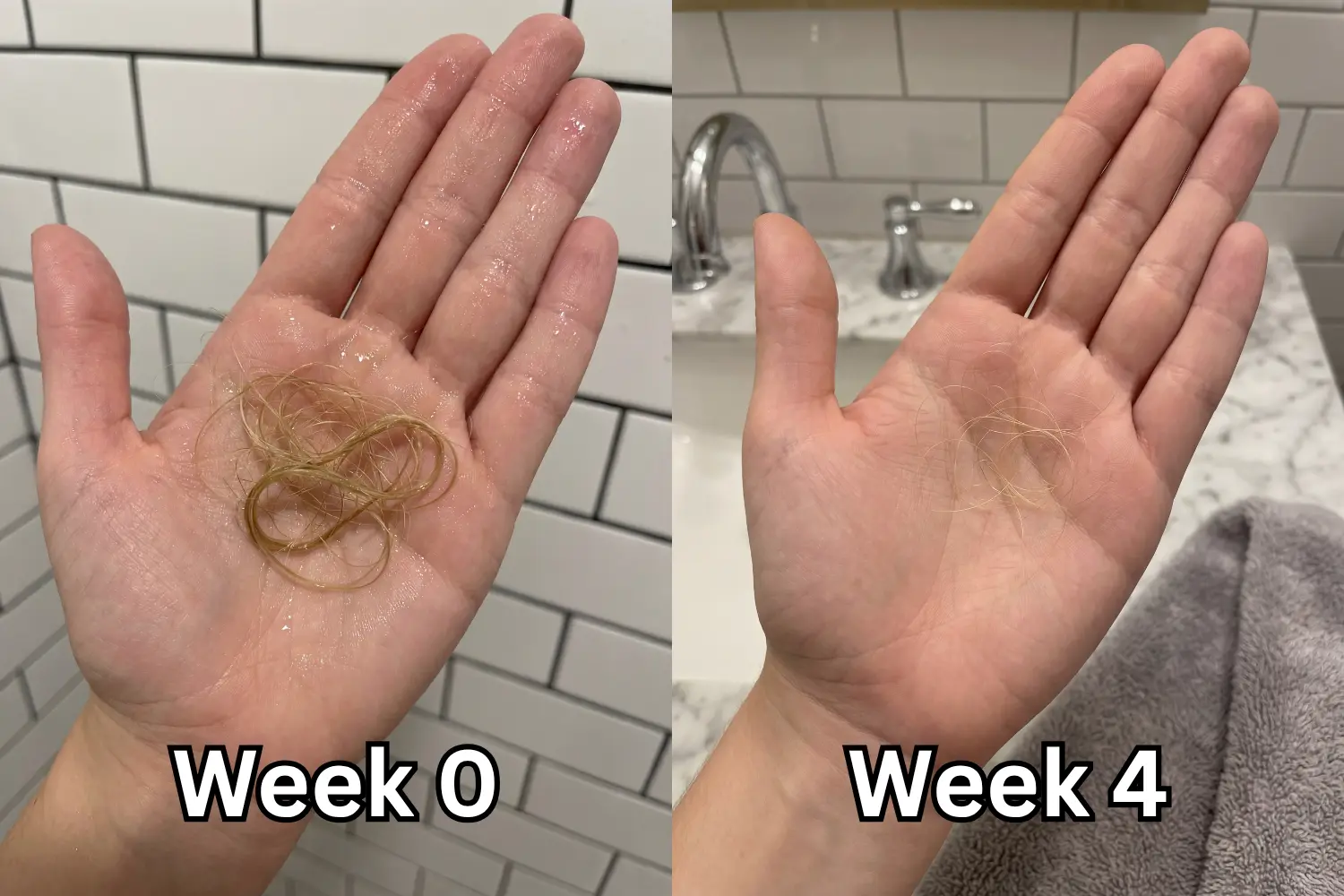
You look down at the drain and there’s less hair. Noticeably less. Your hands come back with less during the lather. Your brush has less in it after the blow-dry. The shedding that used to make you dread wash day is slowing down — visibly, measurably, every wash.
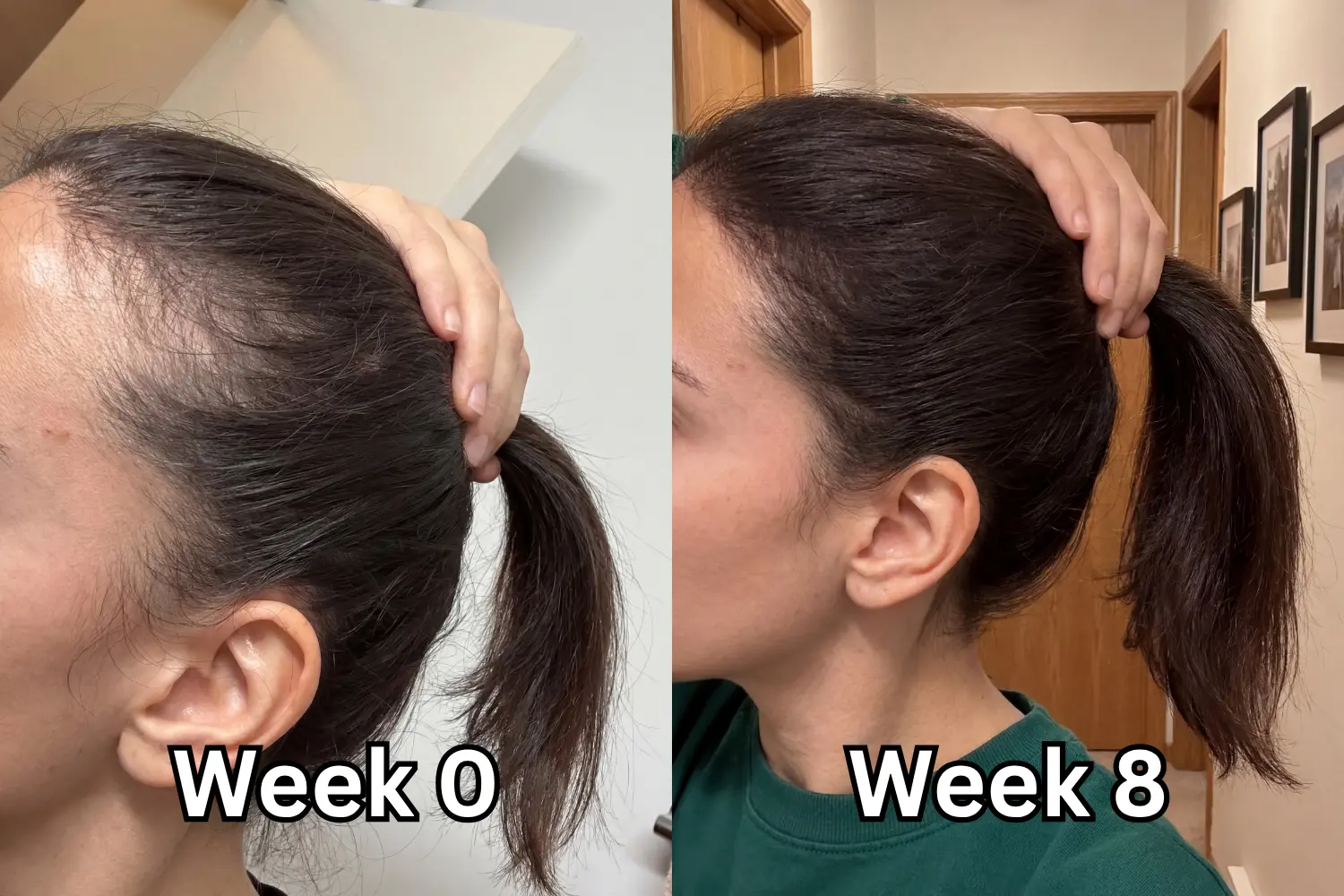
You pull your hair back and there’s more of it between your fingers. Noticeably more. The baby hairs that used to snap off at a quarter inch are surviving — reaching an inch, two inches, becoming real hair. The dry shampoo stays in the drawer. The root clips go back in the cabinet. There’s less to hide because there’s more hair on your head.
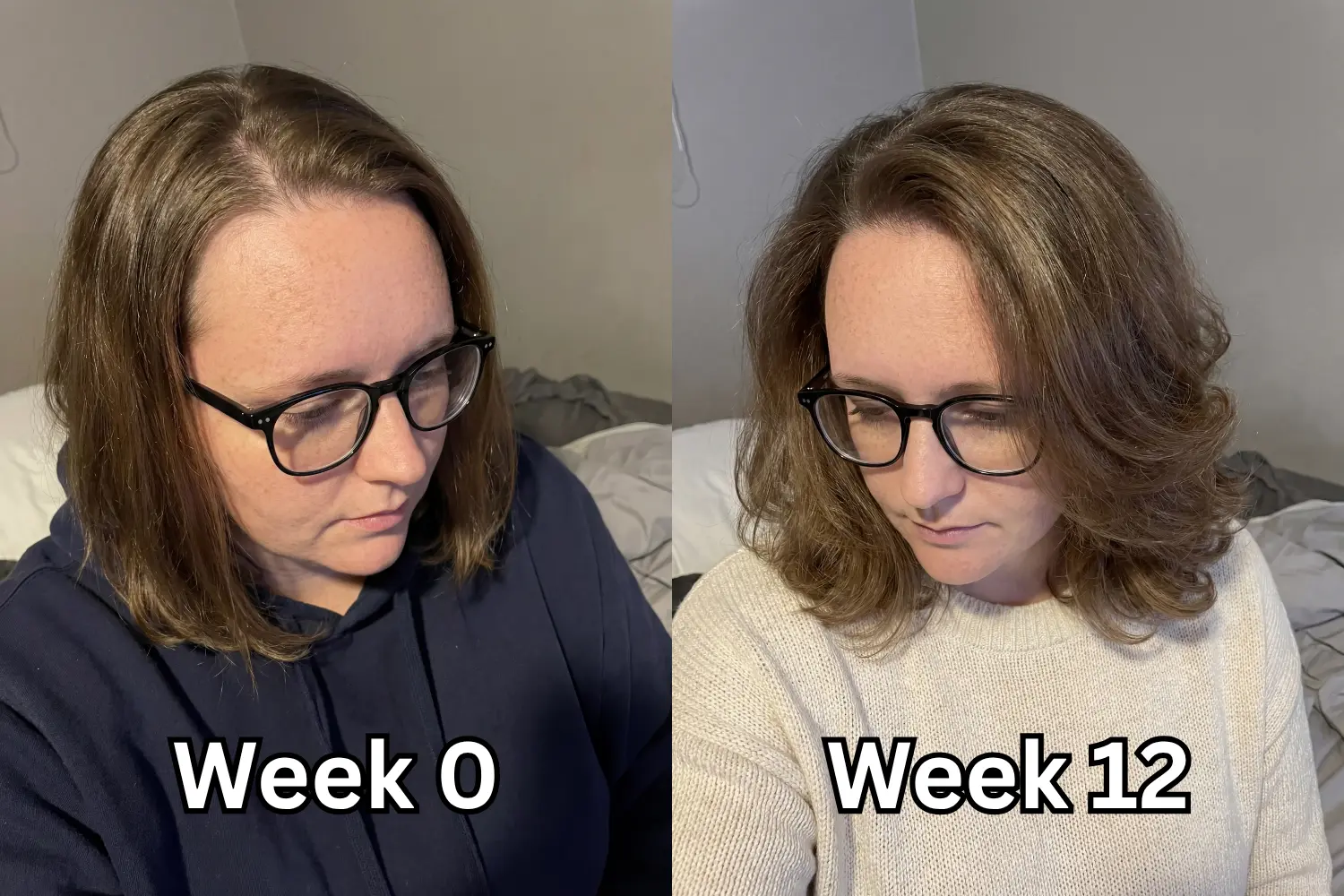
Your hairdresser stops mid-cut and asks what you changed. Your sister says something. A friend you haven’t seen in two months says “what did you DO to your hair?” Not the polite compliment people give when they’re being nice. The real one — where they actually want to know. Because they can see it from across the room.
That’s nine compounds doing nine specific jobs. Every wash. In the same two bottles, in the same shower, in the same amount of time.
150,000 Women. 1,000 Physicians. And the Doctors Who Changed Their Minds.
When I released the serums, I hoped dermatologists would pay attention. Some did. Most didn’t. Dermatology is conservative. We’re trained to be skeptical.
Then the results started showing up. Not in my inbox — in theirs. Their patients were coming back with different hair. Patients they’d told to “try minoxidil” or “it’s just aging” were showing up with visible regrowth. And the doctors wanted to know what changed.
Over 1,000 physicians now recommend KilgourMD to their patients. Dermatologists. Hair restoration surgeons. Hormone specialists. Internal medicine doctors. OB-GYNs.

“For years I watched women come in with thinning hair and leave with a minoxidil script — a drug that targets one pathway and ignores the scalp entirely. Their shampoo was stripping the barrier every wash and nobody told them. KilgourMD is the first wash protocol I’ve seen that actually addresses what’s happening to these women’s scalps.”

“In 19 years advising for L’Oreal, Johnson & Johnson, and working with everyone from Olympic athletes to the British Royal Family — the wash step is where women lose the most ground after estrogen drops. Their shampoo strips. Their conditioner coats. Neither replaces what estrogen did. KilgourMD does.”

“Women eat perfectly and still shed because the wash step strips the building blocks out before follicles can use them. KilgourMD delivers directly during the wash. That’s the difference.”
These are not people who endorse products. These are people who endorse evidence.
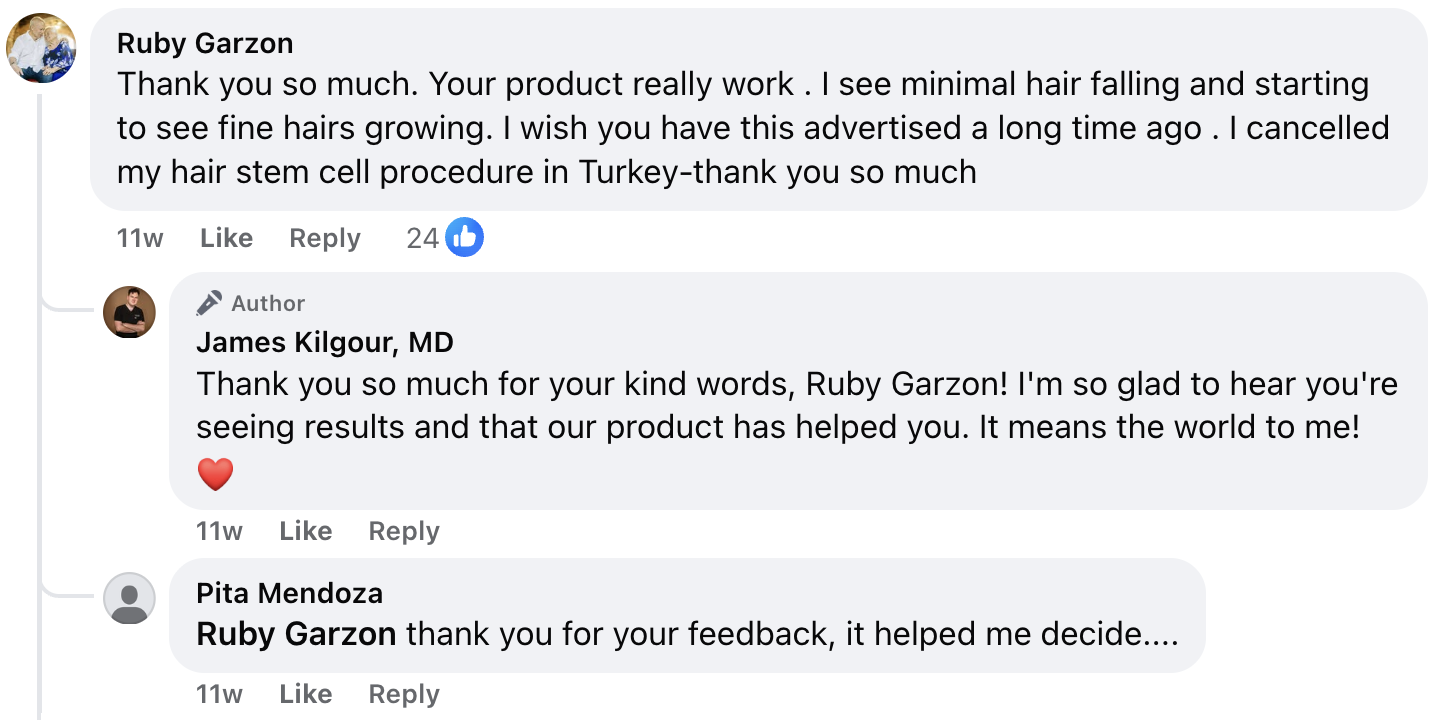
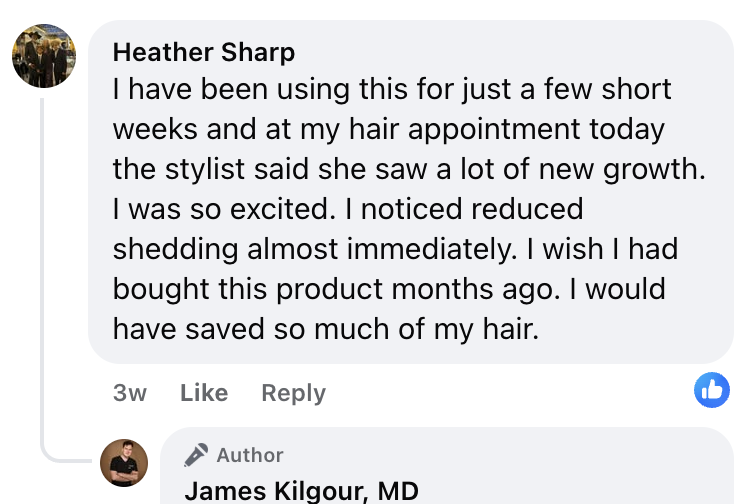
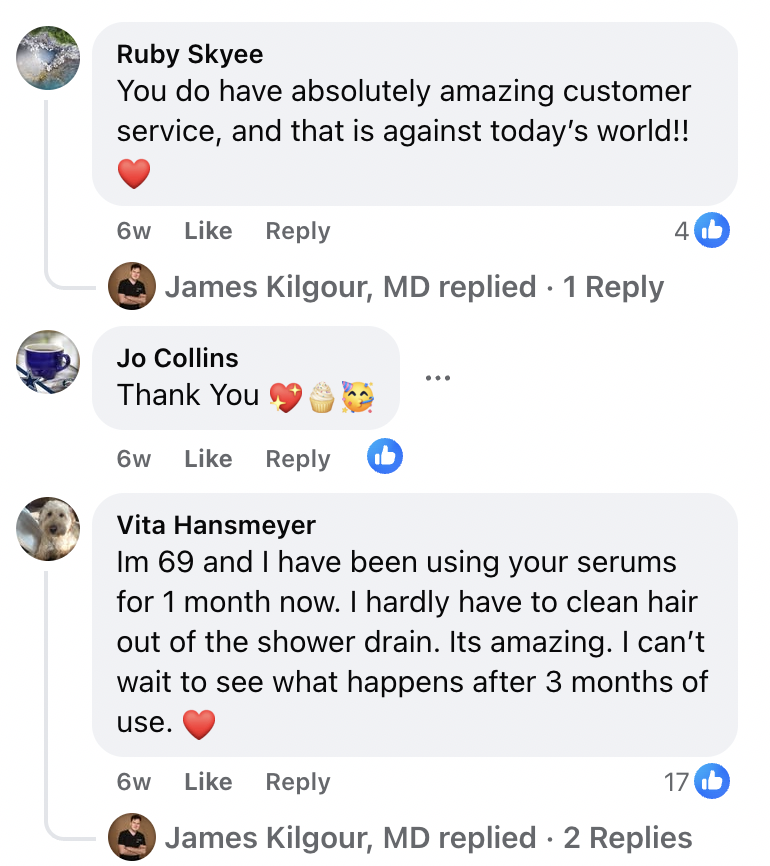
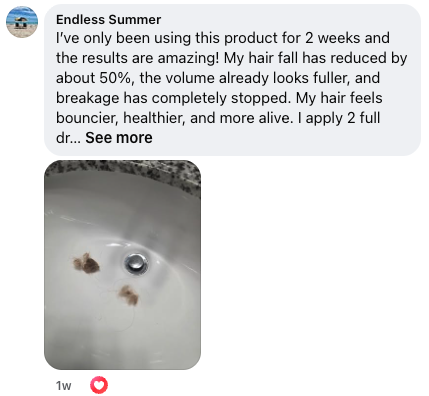
Real Women. Real Switches. No Filters.
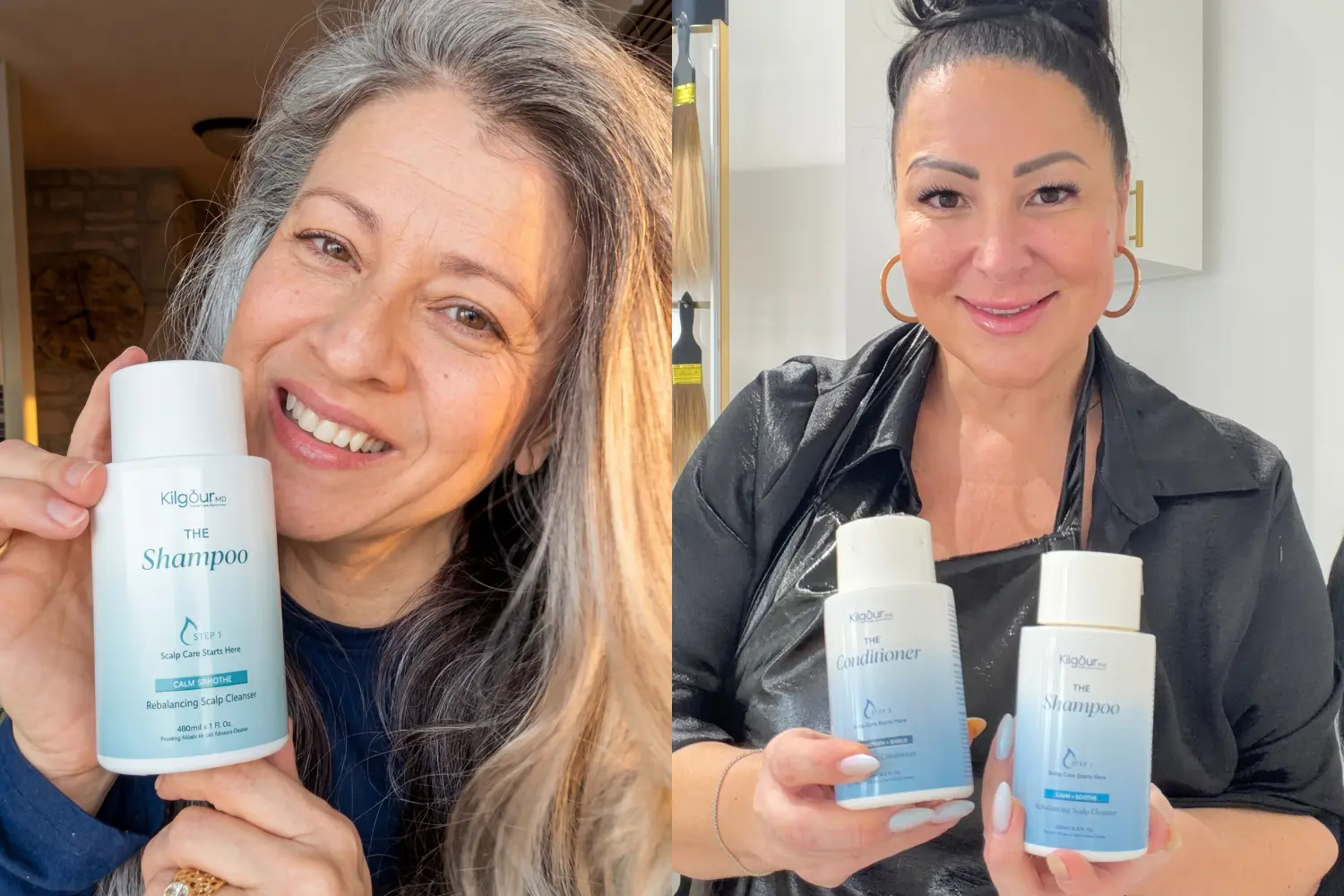
These are real comments from women using KilgourMD shampoo and conditioner right now.
Your Next Wash Is a Decision
Here’s what I know after working with thousands of women.
Every wash between now and the day you switch is doing the same thing. Sulfates strip the barrier. Inflammation floods in. The enzyme activates. DHT attaches to the follicle. The strand loosens. Falls out in your hands.
Then you condition what’s left with synthetic weight that crushes whatever volume the strand was trying to hold.
Three to four times a week. Week after week. While you wait for something to change.
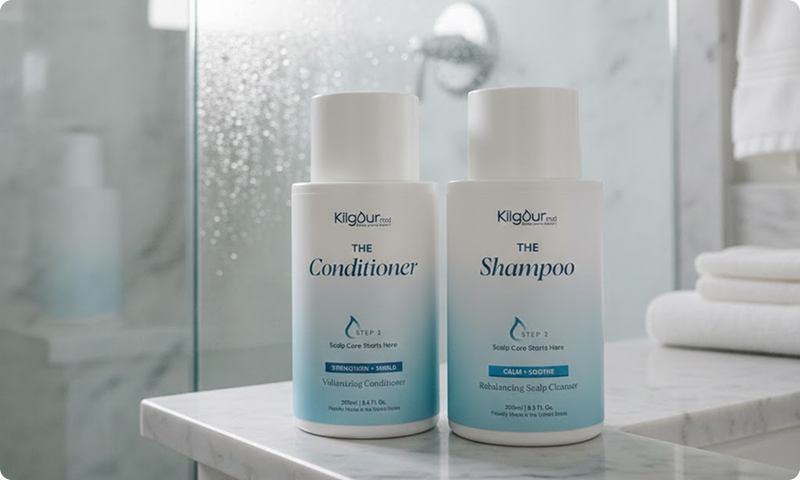
Over 150,000 women use it. Over 1,000 physicians stand behind it.
Your shampoo was made for the hair you had at 30.
This was made for the hair you have now.