


12 weeks. Same woman. Same camera angle.
Jessica M., 41 · Seattle, WA
Most women treat their hair. Smart women treat their scalp age. KilgourMD is the only protocol I recommend for it.

Your Hair Profile
Before we show you your result, let’s make sure we’ve got this right.
Your worst spot
—
And you’re noticing
—
You noticed hair loss
—
You’re in
—
You’ve already tried
—
What you want
—
Your result is built from these answers. Change anything that isn’t right.

growth phase is significantly shortened
A shorter growth phase means more shedding and less fullness. The good news is that for the first time there are actives shown to extend it.
 More SheddingVisible sign #1
Normally a hair grows for three to six years, then sheds. One shed, every few years, from each follicle.
Estrogen is what kept that phase long. When it drops, the phase gets cut short — and in women losing their hair, researchers have found hairs finishing the whole cycle in under six months.
So the same follicle that used to shed once every four years is now shedding eight times in the same four years.
Source: Rushton, Westgate & Van Neste — Experimental Dermatology
 Less CoverageVisible sign #2
Every hair that sheds leaves a gap. The follicle sits empty for a while before the next one starts.
Run that eight times as often and far more of your follicles are sitting empty at any given moment. In women losing their hair, researchers measured half as much hair actually growing as in women who weren’t.
Source: Van Neste — Plastic and Aesthetic Research, 304 women
 Less ThicknessVisible sign #3
The growing phase is also when the strand gets built. Less time building means less strand — so every hair comes back finer than the one it replaced, and it happens again each time round.
Researchers measured the hair of 1,099 women and found strand thickness peaks in your early forties and falls from there. It’s the thick ones you lose most of, which is why your ponytail feels thinner in your hand.
Source: Robbins et al. — British Journal of Dermatology, 1,099 women
This is an estimate based on your answers, not a medical diagnosis.
 Built by a Stanford dermatologist
You match the trial’s
top responders

Your answers match the women who participated in the peer-reviewed trial behind KilgourMD — published in the Journal of Drugs in Dermatology. It followed menopausal women with similar hair loss you just described.
Matching these criteria does not predict your result. Individual results vary and are not guaranteed.
 Independently Tested
Tested on women losing hair. Every strand counted by hand
Up to 68% less shedding in the first six weeks.
 Before
 After
Run by Dermaclaim, an independent lab. Published in the Journal of Drugs in Dermatology.
Women applied KilgourMD daily. At week six, the lab washed their hair and counted every strand that came out — by hand. Shedding was down by an average of 68%.
The lab counted long hairs and short hairs separately. Both were reduced.
That matters because short hairs are the ones that show when hair leaves the growth phase too soon. Fewer short hairs shedding means more hairs stayed in growth long enough to grow longer.

KilgourMD, clinically studied on menopausal women to reduce shedding and bring back density.
78% more hair in the growth phase.
 Before
 After
AnaGain is one of the few actives shown to both increase the number of hairs in the growth phase and extend the time they remain there.
That is the key difference from minoxidil. Minoxidil has been shown to move more hairs into the growth phase, but not to extend the phase itself.
Since you’re in menopause with a shortened growth phase, simply pushing more hairs into growth is only part of the solution. They also need to stay there longer.

AnaGain, clinically studied to increase hair in the growth phase and extend it.
79% increase in hair density.
 Before
 After
AnaGain keeps more hairs growing for longer. Capixyl handles the other side: the root those hairs grow from.
It blocks the local DHT signal linked to root shrinkage and reduces scalp inflammation by 48%. That helps the new growth come back thicker instead of finer.

Capixyl, clinically studied to increase hair density by 79% in four months.
Individual results vary. Not all users will experience these results.
Built by a Stanford dermatologist
The only serum formulated for menopausal women specifically
Every other serum is built for hair loss in general. This one was built for one thing — the growth phase getting cut short — which is what your answers point to.
Built For The
Root Cause
Supplements feed hair that isn’t underfed. Shampoos rinse off in ninety seconds. Neither touches how long a hair grows.
KilgourMD is built around actives chosen for one thing: holding hair in the growth phase and keeping it there longer.

Patented Liposomal
Delivery
The part of the follicle that controls how long a hair grows sits at the bottom, not the surface — and most topicals never get past the scalp’s outer barrier.
Ours are wrapped in patented liposomes to carry them through. In an independent permeation study, 6x more active delivered than a competing serum.
Tested The Way
It’s Used
Most serums borrow their proof from ingredients tested in a lab. We tested the finished formula.
Women used it nightly at home for four months. An independent lab counted every strand that came out, by hand, and two dermatologists graded the regrowth. Not a survey.

Formulated For
No Side Effects.
Thirty seconds before bed. Lightweight, dries in, never greasy.
Unlike minoxidil: no shedding phase, no itching, no unwanted hair growth, not toxic to pets. No side effects reported in the trial.
Individual results vary. Not all users will experience these results.


 250,000+ women using daily
Thousands of doctors have put
their patients on KilgourMD
88% would recommend this product


Thank you from a wash-day crier
I used to count strands. I’d untangle the wash-day clump and count to make myself stop imagining it was worse than it was. 400, 500 sometimes. You don’t forget numbers like that. I don’t count anymore because there’s nothing worth counting. If you’re where I was — counting — just start. The counting is the worst part and it can end.

I cried when I saw the baby hairs
Seven years of watching my temples creep backward. Seven years of supplements, red light caps, scalp massagers, all of it. Four months on this serum and there is a row of short dark hairs standing straight up at both temples. I know what broken hair looks like, these are not broken hairs, they are all the same length and they were not there in April. I sat on the edge of the tub and cried.

Consistency is key to success
I am in my fourth month of using the serum. It has become part of my usual routine before bed. I am not balding, but had hair thinning due to age (63). My hair is long — halfway down my back — so the little shorties you see on my forehead and sticking up are all new growth, and there is a lot of it. My hairline is filling in quite noticeably and when I wear a ponytail, I look like a baby duckling with all the shorties sticking up. Small price to pay for a thick head of hair again. It works.
Give it 90 nights. If nothing
grows back, you pay nothing
The first six weeks, the shedding drops — your scalp starts holding onto hair instead of letting it go early. The weeks after that are when it shows: the hairs that stayed in the growing phase have been growing the whole time, and they come through as density where it had thinned.

Ninety nights is long enough to see both. If your shedding isn’t down and nothing’s filled in, one email and every dollar comes back — and you keep the bottle.
All it asks for is thirty seconds before bed. One serum, straight onto the scalp. Nothing swallowed, no hormones, no side effects.
And your answers qualify you for
28% off the full protocol — for a limited time.
Individual results vary. Not all users will experience these results.
 547,993 GLP-1 users studied
Your GLP-1 hair profile is ready

What you achieved
Down 20–40 lbs. You earned every one of them.
What it’s costing you
Your part. Wider, and you know which way to flip it.

What it doesn’t have to cost
Any of it.
You don’t have to trade one for the other.
Clinical studies show you can achieve your goal of less shedding and real regrowth in as little as 6 weeks.
— Dr. James Kilgour, MD
Individual results vary. Not all users will experience these results.
 GW / JAAD International
Your GLP-1 has pushed about half your hair out of growing
Anagen-to-telogen ratio
less sheddingBalance
tippingMore shedding,
less growing

6–12 months ago — You started
Hair is only ever doing one of two things: anagen, growing without interruption, or telogen, where it stops growing and sheds out later.
Studies show a GLP-1 shifts the balance — hair that should have stayed in anagen moves into telogen instead. The calorie deficit pushes more across at the same time. A healthy scalp holds about 90% in anagen. On a GLP-1 it can fall to 40–50%.
3–6 months ago — You noticed it
The first hairs that shifted finished telogen and let go — that’s what showed up in your brush and your shower drain. But that was only the first batch. You were still on your GLP-1, so more kept shifting behind them.

3–6 months ago — You came off
Most women are told the shedding settles once the GLP-1 is out. That’s true of what hadn’t shifted yet — nothing new gets pushed into telogen after you stop.
It isn’t true of what already had.
Today — It’s visible
Every month on your GLP-1, another batch moves into telogen and sheds out. And the follicles they leave behind stay empty — nothing’s pushing them back into anagen while you’re still on it.
So it builds both ways. Which is why your part typically keeps widening — more falling out each month, and less coming back to fill what already went.

Ahead — What the research shows

A follicle can sit in telogen a while and still come back. Past a point, it stops re-entering anagen at all.
You said you’re staying on your GLP-1 as long as it takes. That’s the right call for your health — but it keeps shifting hair into telogen the whole time, and more of it crosses over while it does — and the longer it runs, the more of it there is.
This timeline is an estimate based on your answers, not a medical assessment. Individual experiences vary.
Built by a Stanford dermatologist
Your match: five actives that push your hair back into growing
Before
 After

AnaGain™
Hair Cycle ActiveThe one thing that moves hair back out of telogen and into anagen — reversing the shift instead of waiting on it. In its own clinical studies, it nearly doubled the number of hairs in the growing phase.
Capixyl™
Density PeptideYour body feeds hair last in a deficit. Capixyl goes straight to the root and skips that queue, so what grows back comes in thick instead of fine. In its studies, hair density increased up to 79% versus untreated.

Procapil®
Anti-Shedding PeptideStops the next batch letting go. It reinforces the grip at the base of the follicle — so fewer healthy strands shift over while you’re still on your GLP-1. In its studies, it cut hair fall by up to 46%.

GlycoRoot™
Proprietary ActiveDeveloped with our Stanford biotech lab to deliver plant glycogen cellular fuel directly into follicles left empty behind each shed, boosting microcirculation at the root so they can fill back in. In human testing, it reduced shedding by up to 31% in two months.

L-Ascorbic Acid
Collagen SupportThe most potent form of vitamin C. Supports the collagen the root sits in and shields the follicle from the oxidative stress of rapid weight loss — so the ones still in anagen stay there.
Individual results vary. Not all users will experience these results.
Tested by Dermaclaim
Tested on women losing hair. Every strand counted by hand
Up to 68% less shedding in the first six weeks.
Before
After
Run by Dermaclaim, an independent lab. Peer-reviewed and published in the Journal of Drugs in Dermatology.
Women applied the Prevention serum every night. At week six, the lab washed their hair twice and counted every strand that came out — by hand.
95% were shedding less within six weeks. At week 18, two independent dermatologists graded density on the Ludwig scale, and density improved up to a full grade — part narrowing, crown filling.

Jennifer Hanway
Board-Certified Nutritionist
“Most women treat their hair. The ones who get it back treat what the GLP-1 actually did to their scalp. KilgourMD is the only protocol I recommend for it.”
Up to 79% more density.
Before
After
Each active was studied on its own, before it ever went in the bottle.
Density: hair density up to 79% versus untreated — 81% better than the leading alternative.
And it works on the inflammation behind it — scalp inflammation down up to 48% in its studies. That inflammation is what cuts a growth phase short, so the strand never reaches full thickness.
Success rate: in a randomised controlled trial against minoxidil, two and a half times as many women saw results.
And none of what comes with minoxidil. No side effects were reported in the trial, no dread shed before it works, no dependency — stop and you keep what you grew.
Individual results vary. Not all users will experience these results.
250,000+ women using daily
Same hair loss. Same GLP-1. Here’s where they are now

Jennifer B.
My 90 day pictures

I am happy with my results. My thoughts:
- I washed my hair daily the first three weeks to give the product the best opportunity to work; I now wash it every 2-3 days
- I stopped blow drying my hair and let it air dry now and I think that has helped with less breakage
- I am wearing my hair shorter than I ever have which also helps with less breakage
- I just use the applicator provided and dab it on and massage it in; on nights I wash my hair I let my hair dry slightly and then apply the serum and that helps with spreading the product better
- With travel a few times I have missed a day or two applications but other than that I have been very religious about using the serums daily
- My serums each last right around 30 days
My next 90 days of product just shipped today!!

Beth S.
New baby hairs!!

Started in April. Look at all those baby hairs I can see when my hairdresser blew out my hair.
Individual results vary. Not all users will experience these results.
Give it 90 nights. If nothing grows back, you pay nothing
In the trial, shedding dropped in the first six weeks — fewer hairs in the drain, less in the brush. The weeks after that are when it starts showing: hair pushed back into anagen has been growing the whole time, and it comes through as length and density where it had thinned.
Ninety nights is long enough to see both. If your shedding isn’t down and nothing’s filled in, one email and every dollar comes back — and you keep the bottles.
All it asks for is thirty seconds on the scalp before bed. Nothing swallowed, nothing prescribed, nothing that touches your GLP-1 or slows the weight loss down.
And your answers qualify you for
28% off the full protocol — for a limited time.


6 Things I Wish Every Patient Knew About Hair Loss After 45
A patient flew 5,000 miles to ask what I did for my mother’s hair. I told her six things — every one the opposite of what she’d been doing. It shouldn’t take a flight across the world to hear them.
In Stock · Free Shipping · 90-Day Money-Back Guarantee
A few months ago, a woman flew from England to my clinic in California — because of my mother.
She knew my mom, Gaynor. She’d watched Gaynor’s hair come back over the better part of a year, in person, while her own was thinning. So she didn’t email. She got on a plane, flew 5,000 miles, and asked me one question: “What did you do for her?”
I told her. Six things — every one the opposite of what she’d been doing. It shouldn’t take a flight across the world to hear them. So here they are.
Your hair isn’t the problem — your scalp is.
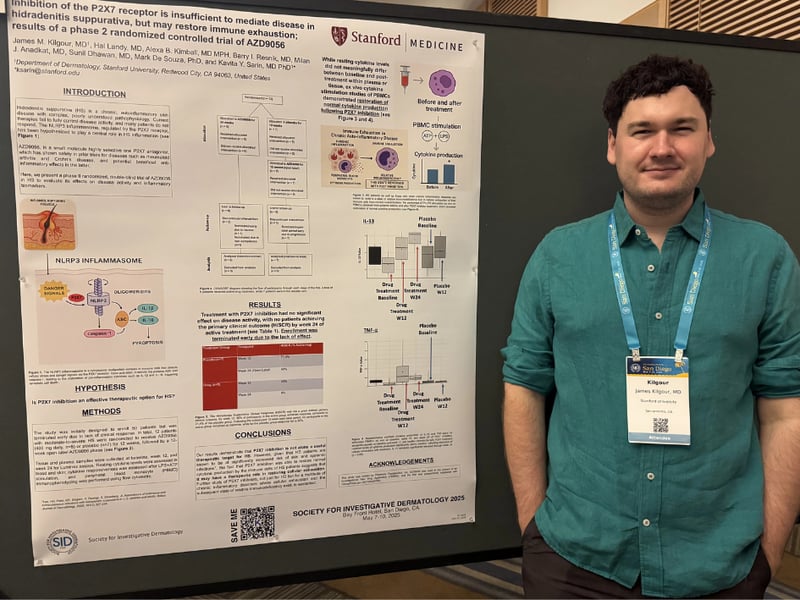
Pull a strand from your brush. Full, pigmented, intact — that’s not a dying hair. Something pushed it out, and that something is the scalp underneath.
Harvard proved it in 2020: a dying follicle moved into young scalp grew back; a healthy one moved into aged scalp died. The follicle never decided. The scalp did.
Biotin and collagen were never going to fix this.
They feed the hair. Your hair was never starving — your scalp was aging. It’s more building material poured into a factory that’s already shutting down.
Minoxidil isn’t wrong — it’s incomplete.
It forces blood to the surface, and if it’s helped you at all, you’re not imagining it. But the real problem — the aging scalp underneath — is one floor down, and minoxidil never goes there. It props up the top floor while the foundation keeps sinking.
Washing less doesn’t save your hair — it hides the shedding.
Stretching your wash days doesn’t mean less loss. It means the same loss, saved up into one bigger clump. What’s happening between washes is the problem — not the washing.
Thinning after 45 usually isn’t permanent.
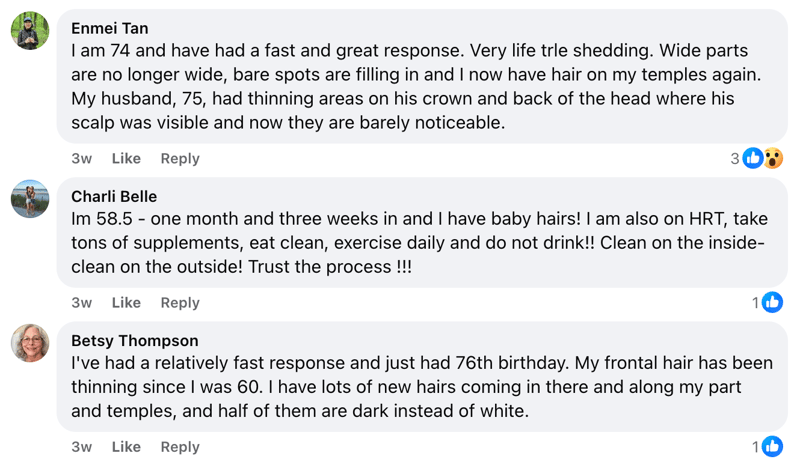
Read this one slowly. The hair you’ve lost isn’t gone — the follicles aren’t dead. They’ve gone quiet, waiting on a scalp that stopped feeding them.
Here’s how you tell: if the strands in your brush still have their structure, the follicle that made them is alive. It didn’t die. It’s starving. Feed the scalp, and it wakes back up — the shedding stops, then the part fills in.
Your doctor couldn’t have told you — until this June.
Normal bloodwork, “it’s just age” — both true, neither explained your hair, because the answer sits in a layer of skin no blood test checks and most dermatology training (built on studies of men) skips.
That changed this June, when the first women-only trial published in the Journal of Drugs in Dermatology. An independent lab counted every strand shed, by hand, before and after:
Minoxidil’s response rate in women is about 30%. A 98% response is a number you almost never see in dermatology. That’s why you’re only hearing this now.
Everything Above Was Pointing At One Thing
Every point above lands in one place: the scalp. So that’s what I spent years building for — the first serum designed to reverse the aging underneath your hair, not chase the strand like everything else. It’s the exact serum every woman in the trial used.
The KilgourMD Prevention Serum. Thirty seconds a night.
How it works
No hormones. No prescription. Nothing in your bloodstream — because the problem was never there. Zero side effects across the entire trial. 150,000 women on it. 1,000+ clinicians recommend it through FrontRowMD.
My 90-Day Guarantee

Use it every night for 90 days. If your hair isn’t visibly better, email me “it didn’t work.” Every penny back, keep the bottle. No forms, no return, no retention call.
My mother’s 68 now — two years on it, more density than she had at 55. This is the answer I couldn’t give her when she started losing it.
When 95 of 100 women stop shedding, the guarantee isn’t generous. It’s just honest.

Picture the version most women never get to: the part closed back in, the ponytail that holds weight again, the morning you realize you haven't thought about your hair in a week.
That's not a promise — it's what 98 of 100 women in the trial walked toward, thirty seconds a night.
Here's the part nobody says out loud: the scalp doesn't pause while you decide. Every month you wait, the collagen thins a little more and a few more follicles go quiet. Doing nothing isn't holding steady — it's losing ground you'll have to win back later.
For most women over 45, the hair isn't gone. It's waiting on a scalp nobody ever treated. Thirty seconds a night, for 90 days, covered either way — that's how you find out which side of the line you're on.

— Dr. James Kilgour, MD · Board-Certified Dermatologist · Stanford-Trained
In Stock · Free Shipping · 90-Day Money-Back Guarantee